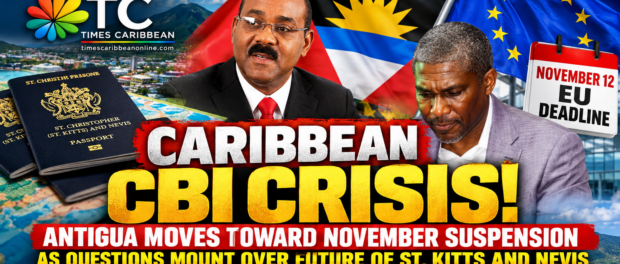
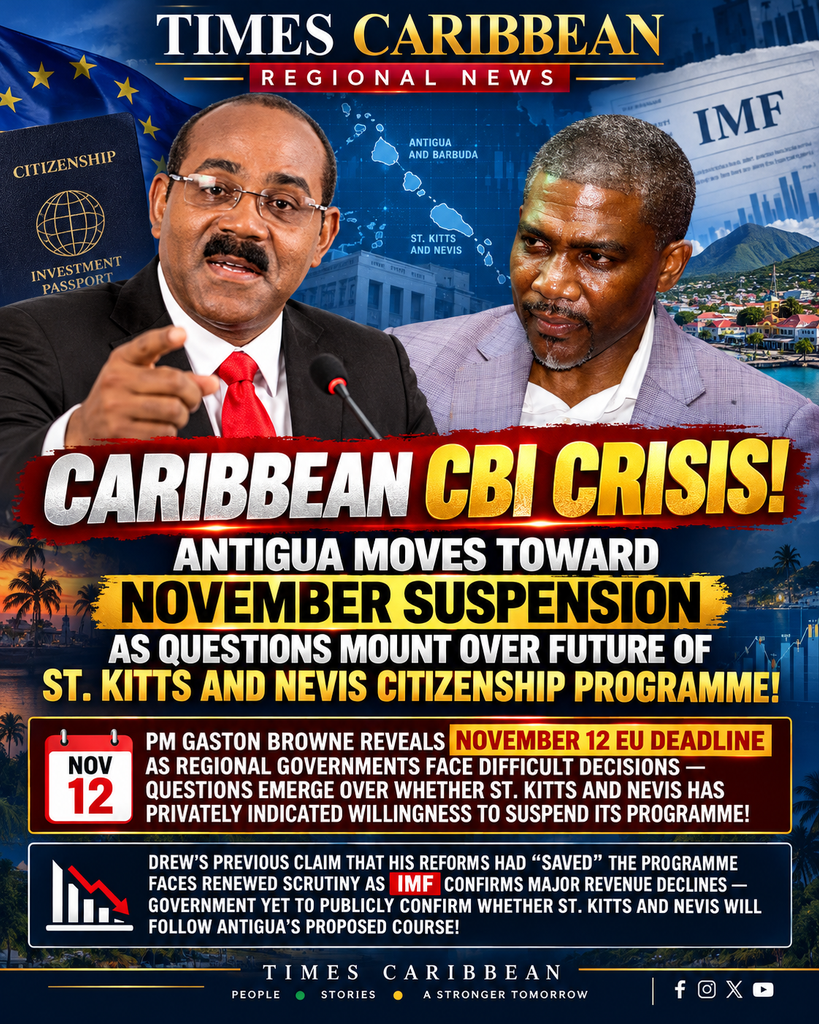
CARIBBEAN CBI CRISIS! ANTIGUA MOVES TOWARD NOVEMBER SUSPENSION AS QUESTIONS MOUNT OVER FUTURE OF ST. KITTS AND NEVIS CITIZENSHIP PROGRAMME!
TIMES CARIBBEAN | SPECIAL REPORT | OCTOBER 26, 2026
PM GASTON BROWNE REVEALS NOVEMBER 12 EU DEADLINE AS REGIONAL GOVERNMENTS FACE DIFFICULT DECISIONS — QUESTIONS EMERGE OVER WHETHER ST. KITTS AND NEVIS HAS PRIVATELY INDICATED WILLINGNESS TO SUSPEND ITS PROGRAMME!
DREW’S PREVIOUS CLAIM THAT HIS REFORMS HAD “SAVED” THE PROGRAMME FACES RENEWED SCRUTINY AS IMF CONFIRMS MAJOR REVENUE DECLINES — GOVERNMENT YET TO PUBLICLY CONFIRM WHETHER ST. KITTS AND NEVIS WILL FOLLOW ANTIGUA’S PROPOSED COURSE!
BASSETERRE, ST. KITTS / ST. JOHN’S, ANTIGUA — The future of the Caribbean’s multibillion-dollar Citizenship by Investment (CBI) industry has entered a period of extraordinary uncertainty following confirmation from Antigua and Barbuda Prime Minister Gaston Browne that his government is leaning toward suspending its programme by November 12, 2026, to preserve visa-free access to Europe’s Schengen Area.
The announcement has intensified questions across the Eastern Caribbean, particularly in St. Kitts and Nevis, where the government of Prime Minister Dr. Terrance Drew previously implemented far-reaching reforms that it maintained were necessary to protect and preserve the Federation’s longstanding citizenship programme.
But the situation has changed dramatically.
According to reports published on October 25, Browne disclosed that preliminary Cabinet discussions in Antigua and Barbuda favour suspension following talks with European Union representatives. He stressed, however, that no final Cabinet decision had been made.
That distinction is important. Antigua and Barbuda has not yet formally disbanded its programme, and the November 12 date is being reported as a deadline for a commitment to suspension, not confirmation of completed closure.
Nevertheless, the implications for St. Kitts and Nevis are substantial.
Reports of discussions behind closed doors have also raised the possibility that St. Kitts and Nevis could make a similar commitment. However, Times Caribbean has not independently verified that the Drew administration has agreed to suspend or close its programme, and no publicly documented decision establishing such a commitment has been identified.
EU PRESSURE INTENSIFIES: FIVE CARIBBEAN COUNTRIES DIRECTLY AFFECTED
The latest developments follow formal communications issued by the European Commission in June 2026 to five Eastern Caribbean countries operating Citizenship by Investment programmes: St. Kitts and Nevis, Antigua and Barbuda, Dominica, Grenada and Saint Lucia.
The European Commission requested that the programmes be phased out by June 1, 2028, warning that their continued operation could jeopardise visa-free access to Schengen countries.
Under the European Union’s revised Visa Suspension Mechanism, the operation of an investor citizenship scheme can itself constitute grounds for suspension of visa-free travel arrangements, even where programme administrators maintain that screening and regulatory systems have been strengthened.
The European position presents Caribbean governments with an exceptionally difficult policy choice.
They must weigh the economic value of CBI revenues against the importance of protecting international travel privileges enjoyed by their citizens.
And the consequences of losing those privileges would extend beyond individuals who obtained citizenship through investment.
Ordinary citizens of St. Kitts and Nevis, including those born in the Federation, could also face additional visa requirements for travel to participating European countries if the country’s visa-free arrangements were suspended.
BROWNE MAKES HIS POSITION PUBLIC — WHAT WILL ST. KITTS AND NEVIS DO?
Prime Minister Browne’s public discussion of the latest EU negotiations has brought an important regional issue into sharper focus.
According to the Antiguan leader, officials were presented with the possibility of continuing their citizenship programmes while risking Schengen visa-free access, or committing by November 12 to suspending the schemes.
Browne has indicated that his government is leaning toward the second option, although he is seeking further regional consultation before a final decision.
His statements have naturally raised questions about the position of neighbouring St. Kitts and Nevis.
Has the Drew administration already indicated a willingness to suspend the country’s CBI programme?
Has the government considered a timetable for suspension or eventual closure?
What would happen to investors whose applications are presently being processed?
And what alternative revenue measures are being developed should the programme cease accepting new applications?
These are questions that require clear answers, particularly given the significant contribution that citizenship revenues have historically made to the national economy.
At the time of publication, Times Caribbean had not identified a public announcement by the Drew administration confirming any final decision to suspend the programme in response to the reported November 12 deadline.
That does not establish that no discussions have occurred. It does, however, leave the government’s precise position on this latest development unclear.
DREW ONCE DECLARED: “THE CBI PROGRAMME HAS BEEN SAVED”
The unfolding situation also places renewed attention on statements made by Prime Minister Drew following his administration’s introduction of sweeping CBI reforms.
After assuming office in August 2022, Drew repeatedly raised concerns about the previous administration’s management of the programme, arguing that changes were necessary to protect its international credibility and preserve access to important overseas markets.
In an October 17, 2024 address on the state of the CBI programme, Drew defended his administration’s reforms, including increased minimum investments, enhanced screening and stronger regulatory controls.
He declared:
“The Saint Kitts and Nevis CBI programme has been saved.”
The Prime Minister acknowledged that the reforms had contributed to lower revenues, but presented those reductions as a necessary consequence of protecting the programme’s long-term sustainability.
Two years later, however, the industry faces a challenge that goes beyond individual national regulatory reforms.
The EU’s latest position raises the possibility that even programmes with enhanced safeguards could face consequences simply because they continue granting citizenship through investment.
That leaves an important question: Can a programme be preserved through stronger regulation if a major international partner is demanding its eventual phase-out?
IMF CONFIRMS DRAMATIC DECLINE IN CBI REVENUE
While political debate continues over whether the government’s reforms were necessary, too restrictive or economically damaging, independent International Monetary Fund assessments confirm that St. Kitts and Nevis has experienced a severe contraction in citizenship revenue.
CBI revenue as a share of GDP
0%7%14%21%28%202220242025
Source: IMF 2026 Article IV Consultation. Figures rounded as reported.
2022 figure represents the approximate peak; the IMF reported a decline to 5.3% of GDP in 2025.

IMF eLibrary
In its 2025 assessment, the IMF reported that St. Kitts and Nevis experienced a year-on-year CBI revenue decline exceeding 50 percent in 2024, following tighter due diligence requirements and higher investment thresholds introduced in 2023. The Fund also documented a substantial decline in applications.
International Monetary Fund
Its May 2026 assessment subsequently confirmed that CBI revenues had declined further, contributing to a fiscal deficit equivalent to 11.7 percent of GDP in 2025.
International Monetary Fund
These figures demonstrate the seriousness of the revenue contraction, although they do not, by themselves, establish that the programme has completely collapsed or that every decline resulted solely from government decisions.
The IMF has identified regulatory reforms, pricing changes and the impact of international scrutiny among the factors affecting demand.
Still, the central economic concern remains.
An industry that once contributed substantial resources to government finances is generating significantly less revenue at the same time that its long-term existence is being questioned internationally.
A POTENTIAL ECONOMIC CHALLENGE FOR ST. KITTS AND NEVIS
A suspension or closure of the CBI programme could have implications extending well beyond the Citizenship by Investment Unit.
Government revenue projections, development financing, public expenditure, construction activity and private-sector investment could all be affected, depending on the terms of any suspension and the availability of alternative financing.
The scale of those effects would require a detailed assessment.
A temporary suspension of new applications, for example, would not necessarily have the same consequences as permanent abolition of the programme.
Existing applications, approved projects, outstanding government obligations and transitional arrangements would all require consideration.
The government would also need to explain how any loss of CBI revenue would be addressed without placing unsustainable pressure on taxpayers or essential public services.
Antigua and Barbuda’s earlier position was that CBI revenues could not simply be abandoned without credible alternatives. That same concern is relevant throughout the Eastern Caribbean.
Antigua and Barbuda Government
IS A REGIONAL SUSPENSION NOW INEVITABLE?
Not necessarily.
The latest discussions indicate growing pressure and increasingly limited policy options, but the final decisions remain matters for the individual governments.
Prime Minister Browne has called for further consultations among OECS leaders in the hope of establishing a coordinated response.
There is also a distinction between the EU’s previously communicated June 2028 phase-out request and the newly reported November 12, 2026 deadline for governments to indicate a commitment to suspension.
Both developments are significant, but neither should be interpreted as evidence that St. Kitts and Nevis has already formally terminated its programme.
The possibility of private assurances or commitments must remain unconfirmed until supported by documentary evidence or an official statement.
THE PUBLIC DESERVES CLARITY ON WHAT COMES NEXT
For the people of St. Kitts and Nevis, this is no longer simply a debate about citizenship applications or investment thresholds.
It is a discussion about national revenue, economic stability, international travel privileges and the future of a programme that has been closely connected to the Federation’s development financing for decades.
Prime Minister Drew has previously defended his administration’s reforms as necessary to safeguard the programme.
The IMF has documented the subsequent sharp decline in revenues.
And the European Union has now increased pressure on the five Eastern Caribbean countries still operating these schemes.
The next few weeks could therefore prove consequential for the entire region.
Will St. Kitts and Nevis commit to suspending its citizenship programme by November 12? Will it seek further negotiations with Europe? Or will the government choose to preserve the programme despite the potential consequences for Schengen visa-free travel?
The answers have not yet been publicly established.
But with Antigua and Barbuda’s Prime Minister openly discussing the likelihood of suspension, attention is increasingly turning to Basseterre.
For a programme that Prime Minister Drew once declared had been saved, the next major test may be whether it can continue operating at all.
TIMES CARIBBEAN | REGIONAL NEWS & SPECIAL REPORT
Editorial note: This report distinguishes public statements and IMF findings from unverified accounts concerning possible private commitments by the St. Kitts and Nevis government. As of October 26, 2026, a formal decision by St. Kitts and Nevis to suspend or terminate its CBI programme has not been independently verified.
#TimesCaribbean #StKittsNevis #AntiguaBarbuda #CBI #CitizenshipByInvestment #TerranceDrew #GastonBrowne #EuropeanUnion #CaribbeanEconomy #SchengenVisa #OECS #CaribbeanNews
Sources: Government of Antigua and Barbuda, October 25 reporting from Antigua Observer and Antigua News, IMF 2025 and 2026 Article IV consultations, and the Prime Minister of St. Kitts and Nevis’s October 2024 CBI address.
















Leave a comment
You must be logged in to post a comment.