DENZIL DOUGLAS HAILS HISTORIC CITIZENSHIP AMENDMENT BILL AS NEW DOOR OPENS FOR GENERATIONS OF KITTITIAN AND NEVISIAN DESCENDANTS OVERSEAS!
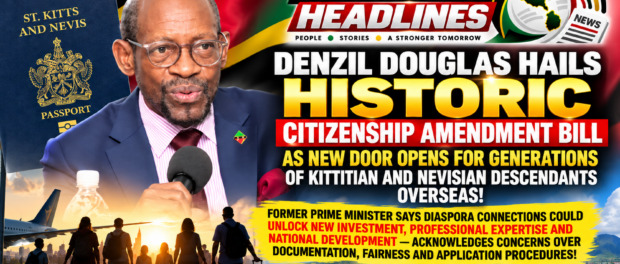
FORMER PRIME MINISTER SAYS DIASPORA CONNECTIONS COULD UNLOCK NEW INVESTMENT, PROFESSIONAL EXPERTISE AND NATIONAL DEVELOPMENT — ACKNOWLEDGES CONCERNS OVER DOCUMENTATION, FAIRNESS AND APPLICATION PROCEDURES!

BASSETERRE, ST. KITTS — October 26, 2026
For generations, thousands of Kittitians and Nevisians have left the shores of the Federation in search of opportunities abroad. They built families, established careers, created businesses and contributed to communities across the United Kingdom, United States, Canada, Bermuda and beyond.
But for some of their children and grandchildren, one important connection has remained difficult to secure: the legal right to be recognised as citizens of their ancestral homeland.
Now, former Prime Minister and current Senior Minister of Foreign Affairs, the Right Honourable Dr. Denzil L. Douglas, is welcoming legislation that could change that reality for eligible descendants.
Speaking during the October 23 sitting of the National Assembly, Dr. Douglas strongly supported the St. Christopher and Nevis Citizenship (Amendment) Bill, 2026, describing the reform as an opportunity to reconnect generations, strengthen national identity and open new avenues for economic development.
The legislation was passed by the National Assembly on Friday, October 23, establishing a new registration pathway for qualifying descendants born abroad.
FROM 1995 TO 2026: DOUGLAS RECALLS HIS GOVERNMENT’S EFFORTS TO BRING NATIONALS HOME
Dr. Douglas linked the new citizenship initiative to policies introduced during his administration after taking office in 1995.
He recalled the establishment of the Returning National Secretariat, which was designed to encourage nationals living overseas to return to St. Kitts and Nevis and contribute their professional knowledge and experience.
At that time, the Federation was navigating a major economic transition, moving away from its historic dependence on sugar production towards a more diversified economy.
The government, Douglas explained, recognised that overseas nationals possessed valuable skills that could support national development.
“We need your expertise,” Douglas recalled telling members of the diaspora during outreach activities in Europe and North America.
His message then was straightforward: St. Kitts and Nevis could benefit immediately from the talents, qualifications and experience of nationals who had already established themselves internationally.
More than three decades later, Douglas believes the country has an opportunity to extend that relationship to additional generations of descendants.
MORE THAN A PASSPORT: LAND, HOMES AND THE RIGHT TO BELONG
One of the most significant issues highlighted by the senior minister concerns descendants who maintain strong family connections to St. Kitts and Nevis but have encountered difficulties establishing their citizenship status.
Drawing on his interactions with Kittitian and Nevisian families in Bermuda, Douglas pointed to challenges some individuals have faced when attempting to acquire property, purchase homes or establish permanent roots in the Federation.
For such families, the issue extends beyond travel documents.
It concerns identity, heritage and the practical ability to build a future in the country from which their parents or grandparents originated.
The new citizenship pathway is intended to address a longstanding legal gap affecting certain descendants born abroad after Independence in 1983.
According to the government’s explanation, the reform allows qualifying adults with the prescribed parental or grandparental connections to apply for citizenship by registration. It does not automatically confer citizenship on every overseas descendant.
DOUGLAS SEES MAJOR ECONOMIC OPPORTUNITIES IN RECONNECTING THE DIASPORA
Beyond citizenship rights, Douglas outlined what he considers the broader national benefits of reconnecting overseas descendants with the Federation.
He pointed to the professional expertise, international business relationships, investment potential and financial resources accumulated by Kittitian and Nevisian families living abroad.
The senior minister believes these connections could help generate new economic opportunities while strengthening the country’s human-resource base.
His argument reflects a wider development question facing small Caribbean states: how can countries with limited populations make better use of the knowledge, networks and financial resources of their global communities?
For St. Kitts and Nevis, Douglas sees citizenship reform as one possible answer.
He expressed particular interest in descendants who are proud of their ancestry and willing to contribute to the country through investment, professional service and other forms of participation.
FAIRNESS, DOCUMENTATION AND APPEALS REMAIN IMPORTANT ISSUES
Despite welcoming the legislation, Douglas acknowledged concerns raised during the parliamentary debate regarding its implementation.
Among the matters identified were the documentary evidence required to establish ancestry, fair treatment of applicants and the availability of appropriate review procedures.
These concerns have practical implications.
For families whose parents or grandparents migrated decades ago, obtaining birth certificates, historical records and other supporting documents may prove challenging.
And while Parliament has approved the legislative framework, the way applications are processed will help determine whether the promised benefits are accessible to eligible descendants.
Douglas expressed confidence that the relevant concerns would receive attention as the new framework is implemented.
The senior minister also commended Attorney General Garth Wilkin and the legal drafting team for their work on the legislation.

SKNIS
APPLICATIONS EXPECTED TO BEGIN NOVEMBER 2
The government has announced its intention to begin accepting applications under the new Section 3A citizenship pathway on Monday, November 2, 2026, subject to the necessary regulations being enacted.
According to the official announcement, application forms are expected to be available through the relevant ministry in Basseterre, its website and diplomatic missions overseas.
Authorities are also developing arrangements to facilitate payments and support applicants residing outside the Federation.
SKN Consulate in Toronto
This means eligible descendants should pay close attention to the final application rules, documentation requirements and official commencement arrangements before submitting applications.
A NEW CHAPTER FOR KITTITIANS AND NEVISIANS ACROSS THE WORLD
Dr. Douglas’s contribution places the citizenship amendment within a broader historical perspective.
From the migration of earlier generations to the creation of families and communities overseas, the story of St. Kitts and Nevis has never been confined to the Federation’s geographic boundaries.
And while overseas descendants have often maintained their cultural and emotional connections to the islands, the legislation seeks to provide a clearer legal pathway for those who qualify.
For Douglas, the opportunity is not simply to reconnect families.
It is also to strengthen the country’s relationship with people who may have much to contribute to its development.
The next important test will be implementation: whether the procedures are clear, the requirements reasonable, and eligible applicants treated fairly and consistently.
For generations of Kittitian and Nevisian descendants overseas, the citizenship amendment could offer something deeply meaningful — a formal route to belong to the country they have long regarded as part of their family story.
ST. KITTS-NEVIS HEADLINES
Reporting based on Dr. Douglas’s October 23 parliamentary contribution and official government releases published by the St. Kitts and Nevis Information Service.
















Leave a comment
You must be logged in to post a comment.