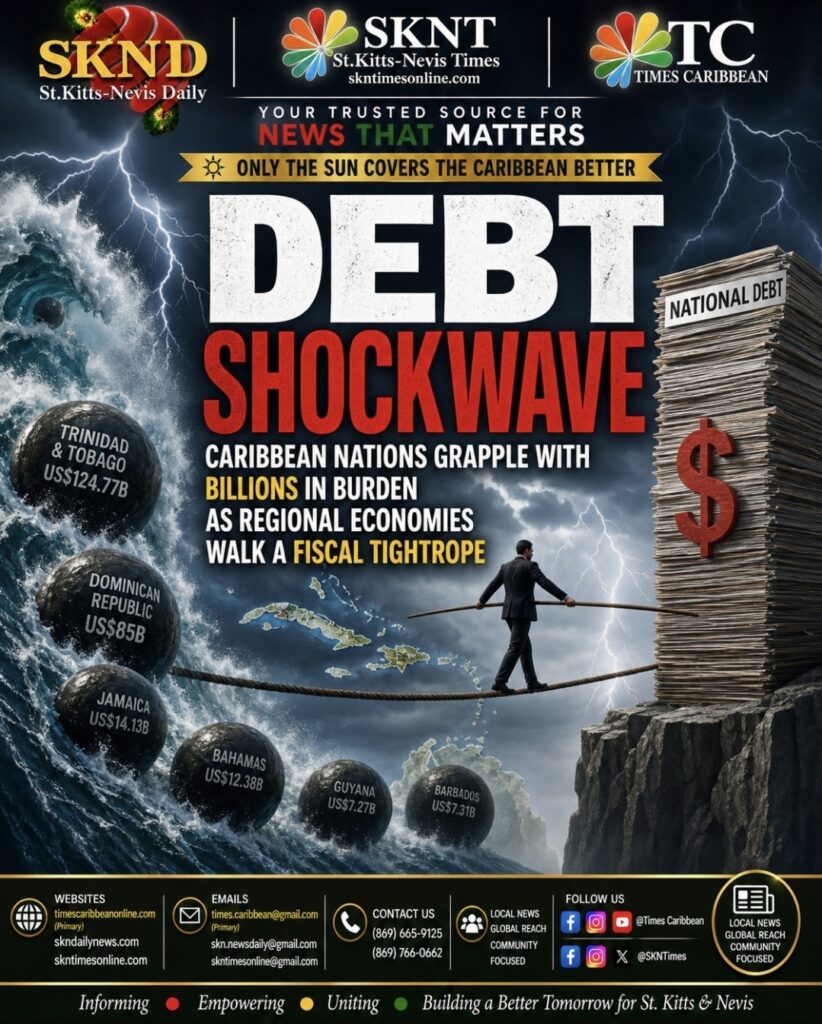
DEBT SHOCKWAVE: Caribbean Nations Grapple with Billions in Burden as Regional Economies Walk a Fiscal Tightrope

TIMES CARIBBEAN | SKN TIMES | ST. KITTS–NEVIS DAILY
BRIDGETOWN / BASSETERRE / PORT OF SPAIN — A stark snapshot of national debt across the Caribbean is raising urgent questions about fiscal sustainability, economic resilience, and the widening divide between small island states and larger regional economies.
The latest comparative breakdown reveals a region caught between survival and strategy — where some nations manage debt in the millions, while others are navigating staggering liabilities exceeding US$100 billion.
A REGION OF CONTRASTS: FROM MILLIONS TO MEGA-DEBT
At the lower end of the spectrum, small territories like Turks & Caicos (US$1.75 million), Anguilla (US$108 million), and the British Virgin Islands (US$146 million) maintain relatively modest debt levels — figures that, on paper, suggest prudent fiscal management.
But analysts warn: low absolute debt does not always equal economic strength. These micro-economies often rely heavily on tourism and offshore finance, making them extremely vulnerable to global shocks.
Meanwhile, countries like St. Kitts & Nevis (US$600 million), Dominica (US$700 million), and Sint Maarten (US$800 million) sit in a precarious middle ground — balancing post-COVID recovery, climate resilience costs, and infrastructure expansion.
THE BILLION-DOLLAR CLUB: PRESSURE MOUNTING
The real pressure emerges among Caribbean nations carrying multi-billion-dollar debt loads:
- St. Vincent & the Grenadines – US$1.29B
- Antigua & Barbuda – US$1.7B
- St. Lucia – US$2.1B
- Belize – US$2.1B
- Suriname – US$3.5B
- Haiti – US$3.92B
For these economies, the challenge is not just repayment — it is growth under constraint. High debt servicing costs continue to crowd out spending on healthcare, education, and climate adaptation, leaving governments with limited fiscal breathing room.
HEAVYWEIGHTS UNDER PRESSURE
At the top of the list, the scale becomes staggering:
- Guyana – US$7.27B
- Barbados – US$7.31B
- The Bahamas – US$12.38B
- Jamaica – US$14.13B
- Dominican Republic – US$85B
- Trinidad & Tobago – US$124.77B
These figures tell a deeper story.
Trinidad & Tobago: Energy Wealth, Debt Reality
Despite being one of the Caribbean’s most resource-rich nations, Trinidad & Tobago’s US$124.77 billion debt signals structural imbalances — including energy sector volatility, fiscal deficits, and public sector spending pressures.
Dominican Republic: Growth vs. Exposure
With US$85 billion in debt, the Dominican Republic remains one of the region’s fastest-growing economies. However, rapid expansion fueled by borrowing raises concerns about long-term exposure to global interest rate shifts.
Jamaica & Barbados: Lessons in Reform
Countries like Jamaica and Barbados have undertaken aggressive debt restructuring programs, earning international praise — yet their high debt levels still underscore the long road to true fiscal stability.
THE SMALL ISLAND PARADOX
Perhaps the most critical takeaway is what economists call the “Small Island Debt Paradox.”
Small states:
- Borrow heavily to build resilience
- Face repeated climate disasters
- Depend on volatile industries (tourism, remittances)
- Have limited revenue streams
This creates a cycle where borrowing becomes not a choice, but a necessity.
ST. KITTS & NEVIS IN FOCUS
With a reported US$600 million debt, St. Kitts & Nevis sits in a relatively moderate position regionally — but that does not eliminate concern.
Economic watchers note:
- Rising global interest rates could increase debt servicing costs
- Infrastructure expansion and social programs require sustained financing
- Economic diversification remains critical to long-term stability
The key question: Is the federation borrowing for growth — or borrowing to survive?
THE CLIMATE FACTOR: A SILENT DEBT DRIVER
Across the Caribbean, one factor looms large — climate change.
Hurricanes, flooding, and rising sea levels are forcing governments to:
- Rebuild infrastructure repeatedly
- Invest in climate resilience
- Take on emergency financing
This has led to growing calls for:
- Debt forgiveness mechanisms
- Climate-linked financing models
- International support for Small Island Developing States (SIDS)
A REGION AT A CROSSROADS
The Caribbean now stands at a defining economic moment.
On one side:
- Growth opportunities in energy, tourism, and digital economies
On the other:
- Rising debt burdens
- Global economic uncertainty
- Climate vulnerability
THE BOTTOM LINE
This debt landscape is more than numbers — it is a warning signal.
A signal that:
- Fiscal discipline must tighten
- Economic diversification must accelerate
- Regional cooperation must deepen
Because without decisive action, the Caribbean risks moving from manageable debt… to a full-blown fiscal crisis.
TIMES CARIBBEAN ANALYSIS
The question is no longer whether the region can manage its debt.
The real question is: how long before the weight of that debt begins to reshape the Caribbean’s economic future?
















Leave a comment
You must be logged in to post a comment.