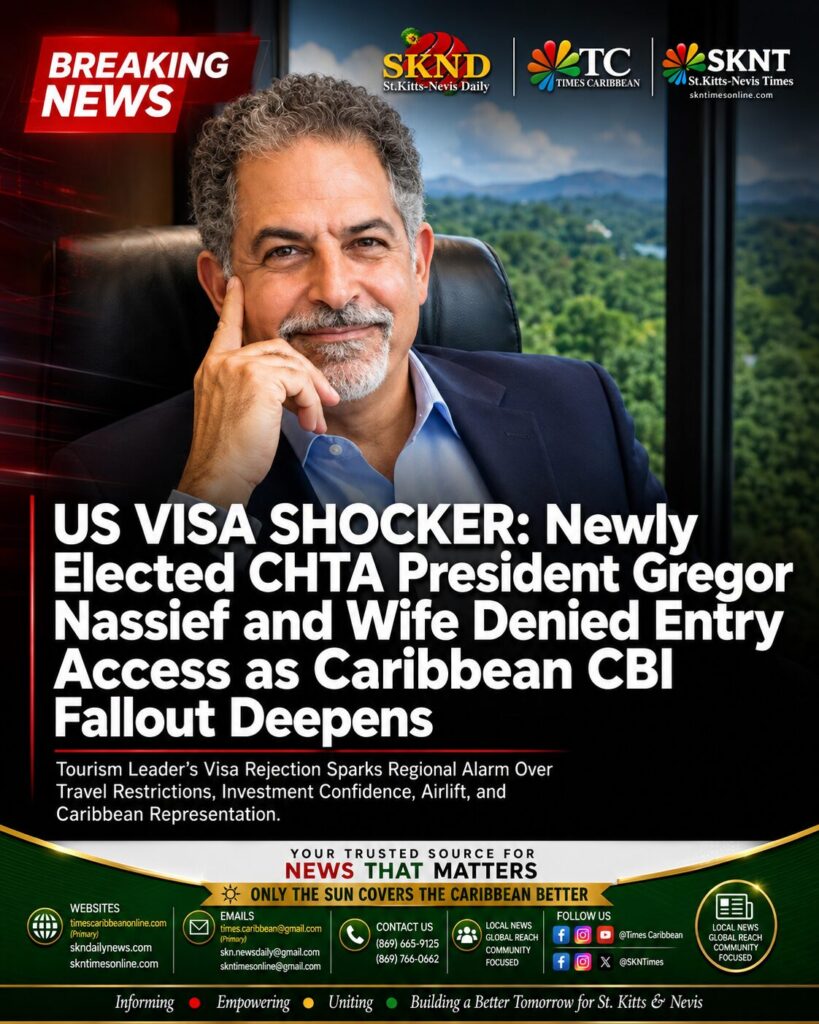
US VISA SHOCKER: Newly Elected CHTA President Gregor Nassief and Wife Denied Entry Access as Caribbean CBI Fallout Deepens

US VISA SHOCKER: Newly Elected CHTA President Gregor Nassief and Wife Denied Entry Access as Caribbean CBI Fallout Deepens
Tourism Leader’s Visa Rejection Sparks Regional Alarm Over Travel Restrictions, Investment Confidence, Airlift, and Caribbean Representation
BASSETERRE, ST. KITTS, June 2026 — In a stunning development sending tremors across the region’s tourism and investment circles, Gregor Nassief, the Dominican-born hotelier who recently made history by becoming the first Dominican national elected to lead the Caribbean Hotel and Tourism Association, has been denied a renewal of his United States visa.
His wife was reportedly denied as well.
The development is more than a private travel setback. It has immediately become a powerful symbol of the growing pressure now facing parts of the Caribbean as Washington tightens travel and visa restrictions linked to concerns over citizenship-by-investment programmes, passport security, vetting systems and immigration safeguards.
Nassief, one of Dominica’s best-known tourism investors and hospitality executives, reportedly travelled to Barbados for what was expected to be a routine visa renewal process. Instead, both he and his wife were refused.
For a region that depends heavily on movement, access, airlift, investment promotion and international representation, the denial has landed like a warning shot.
This is not an ordinary applicant. Nassief is not merely a private businessman seeking convenience. He is the newly elected head of the Caribbean’s most influential private-sector tourism body, an organization representing the interests of hotels, resorts, tourism businesses, investors and hospitality stakeholders across the region.
That is why the situation is so explosive.
If the person elected to champion Caribbean tourism at the highest regional level cannot access the United States, then Caribbean leaders, tourism officials and investment agencies may now be forced to confront a much larger question: how deeply could these new restrictions affect the region’s ability to do business, attend meetings, promote destinations, negotiate partnerships and protect the tourism lifeline?
The United States remains one of the Caribbean’s most important source markets, business corridors and diplomatic gateways. Many regional tourism meetings, airline negotiations, investment discussions, trade events and family connections are tied directly or indirectly to U.S. access.
Nassief himself has reportedly warned that the implications could extend far beyond his personal circumstances. The concern is not simply whether one hotelier can travel. The concern is whether Caribbean nationals from countries under scrutiny could increasingly find themselves restricted from essential travel connected to business, education, healthcare, tourism, family life and regional development.
At the center of the issue is Washington’s growing concern over Caribbean citizenship-by-investment programmes. Antigua and Barbuda and Dominica have been placed directly in the crosshairs of the Trump administration’s expanded travel restrictions, with U.S. officials citing concerns related to screening, vetting and the potential misuse of passports issued through investment-based citizenship schemes.
Caribbean governments have pushed back against the broad characterizations, insisting that reforms, due diligence improvements and international cooperation have been strengthened. However, the visa denial involving Nassief has intensified public anxiety because it appears to show that the policy environment is no longer theoretical. It is now affecting high-profile Caribbean professionals with major regional roles.
For Dominica, the optics are especially painful.
Nassief’s election to the CHTA leadership was widely celebrated as a historic moment for the Nature Isle and a major recognition of Dominican excellence in hospitality, sustainable tourism and regional leadership. Weeks later, the same figure now finds himself at the center of a visa controversy that could overshadow that achievement and raise uncomfortable questions about how Dominican nationals may be viewed under the new U.S. policy climate.
For the wider Caribbean, the message is even more sobering.
Tourism is not just beaches, hotels and visitor arrivals. It is air access. It is investor confidence. It is banking relationships. It is conferences. It is marketing. It is diplomacy. It is the ability of Caribbean representatives to sit at the table where major decisions are made.
When the elected head of the Caribbean Hotel and Tourism Association cannot renew a U.S. visa, the region has a problem that goes well beyond paperwork.
It raises questions about whether Caribbean tourism leaders from affected countries could be excluded from key industry events in the United States. It raises concerns about whether airlines may reassess routes if outbound Caribbean passenger volumes are reduced. It raises fears that investors may become more cautious if travel uncertainty grows around certain jurisdictions. It also raises the possibility that small island states, already facing economic vulnerability, climate pressure and post-pandemic recovery challenges, could be further disadvantaged by external policy shifts.
The situation also places renewed pressure on Caribbean governments to speak with clarity, urgency and unity. While individual countries have defended their citizenship-by-investment systems, this latest development suggests that a broader regional diplomatic response may be required.
The Caribbean may now need more than quiet assurances. It may need coordinated engagement with Washington, clear technical reforms where necessary, stronger public communication, and a united strategy to protect legitimate travellers, business leaders, students, patients, families and tourism professionals from being caught in a widening policy net.
For now, Gregor Nassief’s visa denial stands as one of the clearest signs yet that the CBI controversy has entered a more serious phase.
What once seemed like a policy dispute between governments is now touching people, institutions and industries at the heart of Caribbean economic life.
The man elected to represent Caribbean tourism to the world has reportedly been blocked from entering one of the region’s most important partner countries.
That is not just a visa issue.
That is a regional alarm bell. :::
















Leave a comment
You must be logged in to post a comment.