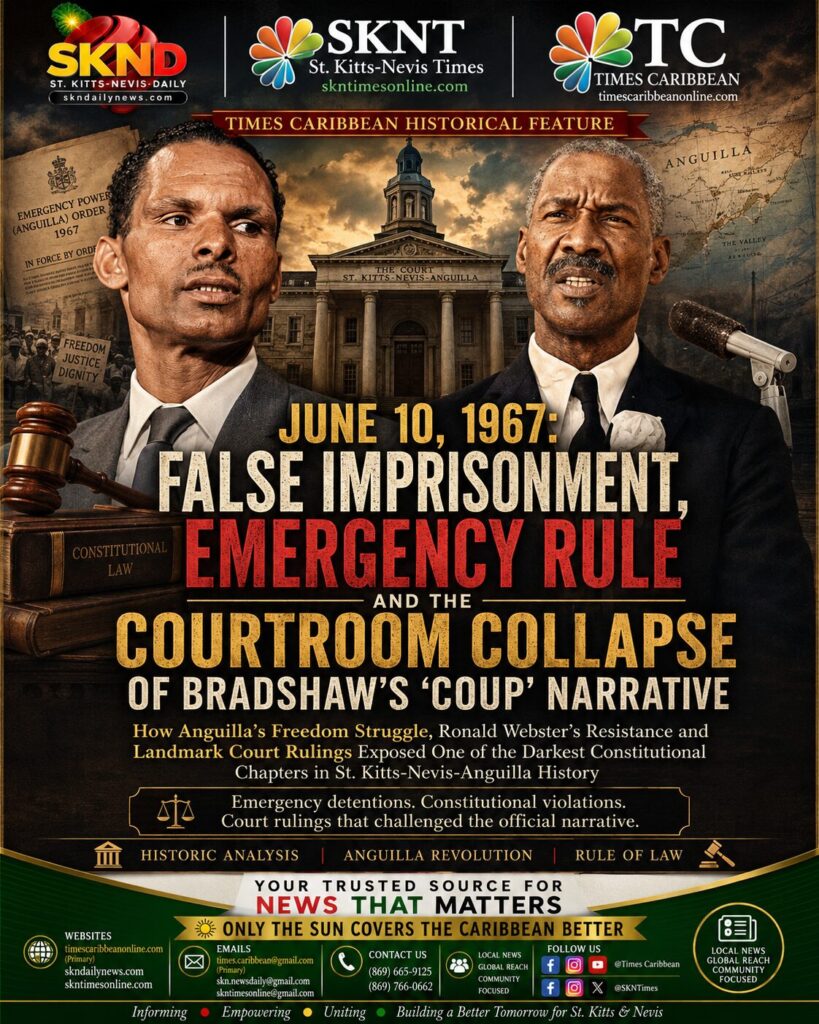
June 10, 1967: False Imprisonment, Emergency Rule and the Courtroom Collapse of Bradshaw’s “Coup” Narrative

How Anguilla’s Freedom Struggle, Ronald Webster’s Resistance and Landmark Court Rulings Exposed One of the Darkest Constitutional Chapters in St. Kitts-Nevis-Anguilla History
By Times Caribbean
BASSETERRE, ST. KITTS — June 10, 1967 remains one of the most controversial and revealing dates in the political and constitutional history of St. Kitts, Nevis and Anguilla. What Premier Robert Llewellyn Bradshaw’s Labour administration framed as an attempted coup would, over time, become something far more damaging to the government’s legacy: a story of emergency rule, false imprisonment, alleged political persecution, human rights violations and judicial rebuke.
On that day, an armed group made up largely of Anguillans and mercenary elements launched raids on police and defence-related infrastructure in Basseterre. The Bradshaw government quickly accused the opposition People’s Action Movement of being connected to a coordinated plot to overthrow the administration.
It was a grave allegation. It was also one that the courts and historical record would later heavily undermine.
What emerged from the aftermath was not a clean legal victory for Bradshaw’s government, but a series of rulings and revelations that exposed the dangers of unchecked executive power. The state had detained political opponents and others under emergency regulations that were later challenged as unconstitutional. The courts found that citizens had been unlawfully imprisoned. Efforts by the government to shield itself from legal consequences through indemnity legislation were struck down. Damages were awarded for false imprisonment.
The June 10 crisis, therefore, cannot be remembered only as a security incident. It must also be remembered as a constitutional reckoning.
Bradshaw’s Emergency Crackdown
Following the raids, Premier Bradshaw’s administration moved swiftly and aggressively. Under emergency powers, the government rounded up and detained political opponents and other individuals, many of whom were accused, directly or indirectly, of being part of a conspiracy against the state.
Critics of the Bradshaw administration have long argued that the emergency was used not only to respond to an armed incursion, but also to suppress political opposition. The detentions became one of the most troubling episodes in the federation’s political history, raising urgent questions about personal liberty, due process and the abuse of state power.
The central issue was not whether the state had a right to protect public order. Any government faced with armed raids would be expected to act. The deeper question was whether Bradshaw’s government used that crisis as a justification to imprison people without adequate legal basis, proper evidence or constitutional safeguards.
The courts would later provide a powerful answer.
False Imprisonment and the Violation of Fundamental Rights
The legal fallout from the detentions became a landmark moment in Caribbean constitutional law. Detainees challenged the state’s actions, arguing that their arrests and imprisonment under the Emergency Powers Regulations violated their constitutional rights.
In the reported litigation involving John Joseph Reynolds, the courts addressed whether the detention orders and emergency regulations were valid, and whether the government could rely on later legislation to protect itself from liability.
The outcome was devastating for the government’s position.
The litigation established that the state could be held liable for false imprisonment. It confirmed that emergency powers did not place the executive above the Constitution. It also demonstrated that a government could not simply detain citizens, later claim necessity, and expect the courts to accept that explanation without scrutiny.
For those detained, the rulings were more than technical legal victories. They were an acknowledgment that their liberty had been unlawfully taken. The government’s actions were not merely controversial; they were found to have violated fundamental legal protections.
That is why June 10 and its aftermath remain so significant. The issue was not just politics. It was human rights.
The Failed Attempt to Shield the State
The Bradshaw administration’s response to legal challenge was also revealing. When the government attempted to use an Indemnity Act to retroactively protect state actors from legal consequences, the courts rejected that move where it conflicted with entrenched constitutional rights.
This was a crucial constitutional moment.
The government, in effect, tried to protect itself from the consequences of its own emergency actions. But the courts made clear that constitutional rights could not be erased by ordinary legislation. A citizen’s right to liberty and compensation for unlawful detention could not be swept aside because it became politically inconvenient for the state.
The ruling sent a message that still echoes today: governments cannot create legal cover for constitutional overreach after the fact.
The “Coup” Claim That Evidence Could Not Sustain
The Bradshaw government’s political narrative was simple and explosive: the opposition PAM was allegedly part of a coordinated coup attempt. But in the courtroom, political accusation had to face evidential discipline.
That is where the government’s case weakened.
Throughout the legal and tribunal processes, government lawyers struggled to produce hard evidence proving that PAM leaders had directed, financed or orchestrated a coordinated armed overthrow with the Anguillan attackers. The broader allegation that the opposition was behind a coup was not supported by the kind of evidence required to sustain such a serious claim.
There were armed raids. There was a serious security crisis. There was a state of emergency. But those facts did not automatically prove that PAM had organized a coup.
The courts forced a separation between what was politically alleged and what was legally established.
Ronald Webster and the Anguillan Freedom Struggle
To understand the true engine behind the 1967 crisis, one must look beyond Basseterre’s partisan battlefield and toward Anguilla’s struggle for self-determination.
At the centre of that struggle was Ronald Webster, widely remembered in Anguilla as the “Father of the Nation” and one of the leading figures of the Anguilla Revolution. Webster emerged as a central voice for Anguillans who rejected continued rule from Basseterre and demanded the right to determine their own political future.
For Anguillans, the issue was not simply party politics in St. Kitts. It was freedom from a system they believed had neglected, marginalized and dominated them. Many Anguillans viewed Bradshaw’s rule as harsh, remote and unacceptable. Historical Anguillan accounts frame the revolution as a movement against political domination by the St. Kitts-based government, rather than as a local St. Kitts opposition plot to install PAM in power.
Webster’s role was therefore critical. He represented the Anguillan demand for liberation from the Associated State arrangement and became the leading symbol of resistance to Basseterre’s authority. His leadership helped transform Anguilla’s grievances into an organized political movement that ultimately reshaped the map of the Eastern Caribbean.
The June 10 raids must be understood in that context. The Anguillans were not primarily fighting to make PAM the government of St. Kitts, Nevis and Anguilla. They were fighting to break Anguilla away from Bradshaw’s administration.
Anguilla’s Real Objective: Separation, Not a PAM Government
Historical analysis strongly suggests that the raids were linked to Anguilla’s secession campaign. Anguillans wanted to force the Bradshaw government to accept their separation. Reports from the period indicate that the plan included pressure tactics against the government, including the alleged intention to seize Premier Bradshaw as a bargaining tool.
However dramatic and unlawful such a plan would have been, its political purpose was rooted in Anguilla’s freedom struggle — not in a conventional St. Kitts party-political coup.
That distinction matters.
The Bradshaw government’s narrative made PAM the villain. The historical record points instead to Anguilla’s revolutionary movement as the central force behind the crisis. Ronald Webster and the Anguillan leadership were pursuing separation from Basseterre, not the installation of a St. Kitts opposition administration.
British Parliamentary Concern
The controversy also reached the floor of the British Parliament. UK Hansard records from July 1967 show that British parliamentarians raised concerns about the detention of persons without trial under the emergency regulations in St. Kitts, Nevis and Anguilla.
That international scrutiny was significant. It showed that the Bradshaw administration’s actions were not merely a local political matter. They raised broader constitutional and human rights concerns within the British imperial and associated-state framework.
The question was not simply whether Bradshaw believed an emergency existed. The question was whether people could be imprisoned without trial, held under broad emergency powers and denied meaningful constitutional protection.
The legal and parliamentary record suggests that the answer was deeply troubling.
A Dark Chapter in Constitutional Governance
The June 10 episode and its aftermath represent one of the darkest constitutional chapters in the history of St. Kitts, Nevis and Anguilla. It showed how quickly emergency powers could become instruments of political control. It showed how political opponents could be branded as threats before evidence had been properly tested. It showed how governments could attempt to use Parliament to protect themselves from accountability.
Most importantly, it showed why independent courts matter.
The rulings that followed did not deny that a security crisis had occurred. They did not erase the fact that armed raids took place. What they did was insist that even during a crisis, the government remained bound by the Constitution.
False imprisonment could not be excused by political rhetoric. Human rights could not be suspended by executive convenience. Indemnity could not be used as a shield for unlawful detention.
History’s Final Verdict
More than half a century later, the events of June 10, 1967 deserve to be remembered with honesty.
Yes, armed raids took place in Basseterre. Yes, the state faced a serious security challenge. But the sweeping claim that PAM orchestrated a coordinated coup was heavily weakened by the courts, by the absence of hard evidence and by the broader historical context of Anguilla’s fight for self-determination.
Ronald Webster and the Anguillan freedom movement were central to the crisis. Their struggle was aimed at breaking free from rule by Basseterre and from what many Anguillans regarded as the oppressive authority of Premier Bradshaw’s administration.
The Bradshaw government, meanwhile, responded with emergency detentions that the courts would later expose as constitutionally defective and legally indefensible. The false-imprisonment litigation became a landmark reminder that no government, however powerful, is above the law.
June 10, 1967 was therefore not merely the day of an alleged coup. It was the beginning of a legal and historical reckoning.
It was the day a government’s accusation began colliding with evidence.
It was the day emergency power began moving toward judicial defeat.
And it became the chapter in which the courts, the Constitution and the Anguillan freedom struggle forced history to reconsider the official narrative.
















Leave a comment
You must be logged in to post a comment.