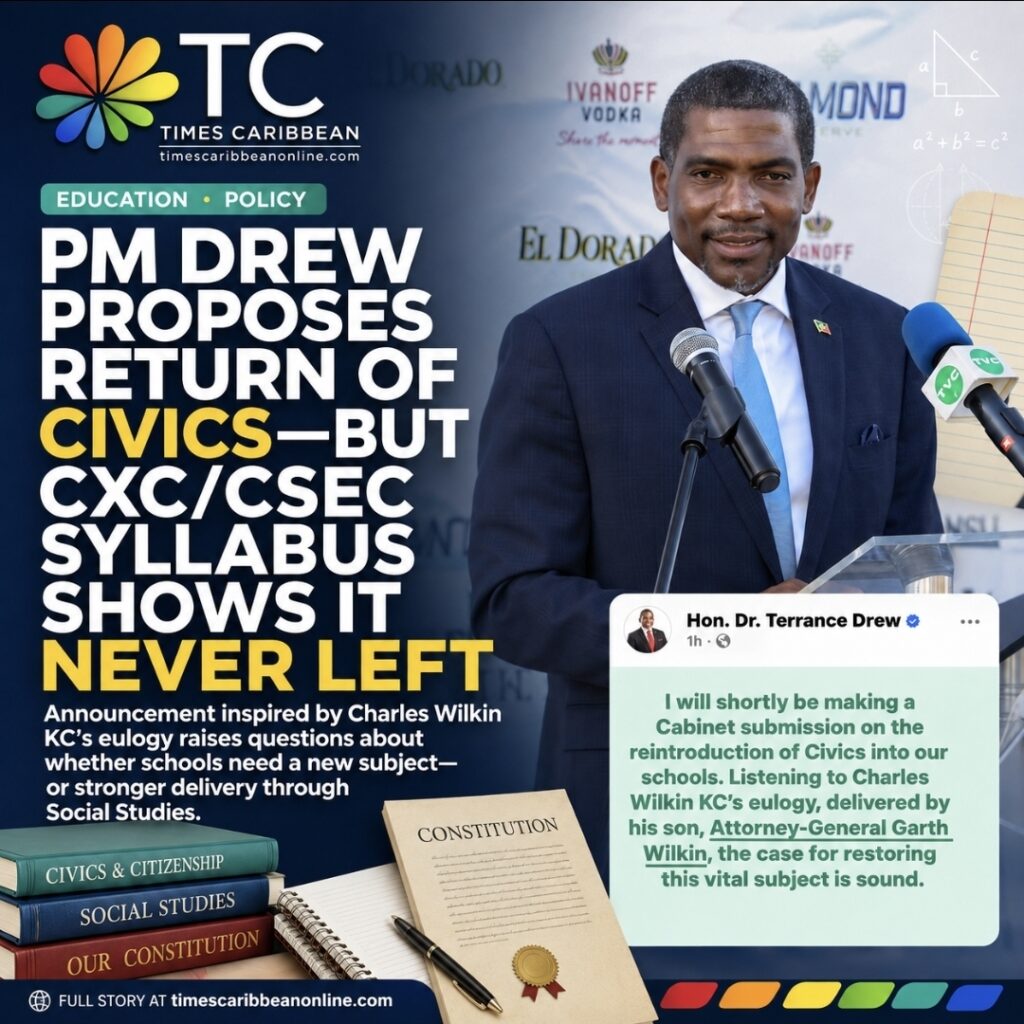
PM DREW PROPOSES RETURN OF CIVICS—BUT CXC SYLLABUS SHOWS IT NEVER FULLY LEFT
Announcement inspired by Charles Wilkin KC’s eulogy raises questions about whether schools need a new subject or stronger delivery of material already taught through Social Studies
BASSETERRE, St. Kitts — Prime Minister Dr. Terrance Drew has announced his intention to make a Cabinet submission for the reintroduction of Civics into the nation’s schools after being inspired by the eulogy delivered for distinguished legal scholar and national advocate Charles Wilkin KC.
The announcement has received attention as citizens reflect on the importance of constitutional awareness, responsible citizenship, national identity and respect for public institutions.
But there is an important point to clarify.
Civics is not offered as a standalone CSEC examination subject by the Caribbean Examinations Council. Instead, major civic-education topics are already incorporated into the existing CSEC Social Studies programme.
The official syllabus covers areas such as citizenship, government, elections, political participation, public institutions, individual rights and responsibilities, regional integration and social participation.
According to the official CSEC Social Studies syllabus, the programme is designed to prepare students for “effective social participation” and to help them understand their roles and responsibilities within families, communities, government and the wider Caribbean.
That raises a fair question: What exactly is being reintroduced?
If the Prime Minister is proposing a separate Civics programme for primary and lower-secondary students, that would represent a specific policy initiative worthy of public discussion. Countries can teach Civics as an individual classroom subject even though it is not available as a separate CSEC examination.
But if the proposal is aimed at senior secondary students, the Government should explain how the new programme would differ from the civic material already contained within CSEC Social Studies.
The issue may therefore be less about “bringing back” Civics and more about strengthening how civic education is taught.
Are students receiving enough practical instruction about the Constitution? Do they understand how Parliament, Cabinet, the courts and other public institutions function? Are they being taught how to evaluate public policy, participate responsibly in democracy and hold leaders accountable?
Those are the real questions.
Charles Wilkin KC was widely respected for his commitment to constitutional governance, national development and the rule of law. A renewed focus on those principles would be a fitting response to his contribution.
Still, curriculum reform should begin with a clear review of what is already being taught, where the gaps exist and whether teachers have the necessary time, resources and training.
Civic education matters. No dispute there.
But before announcing its “return,” the Government should clarify whether it intends to create a separate subject, strengthen Social Studies or introduce a dedicated programme in the lower grades.
The distinction matters. Otherwise, the country could be promised the return of something that, at least within the regional Social Studies curriculum, never completely left.
















Leave a comment
You must be logged in to post a comment.