JAMAICA AT 64: ITS GREATEST RESOURCE HAS NO BORDERS
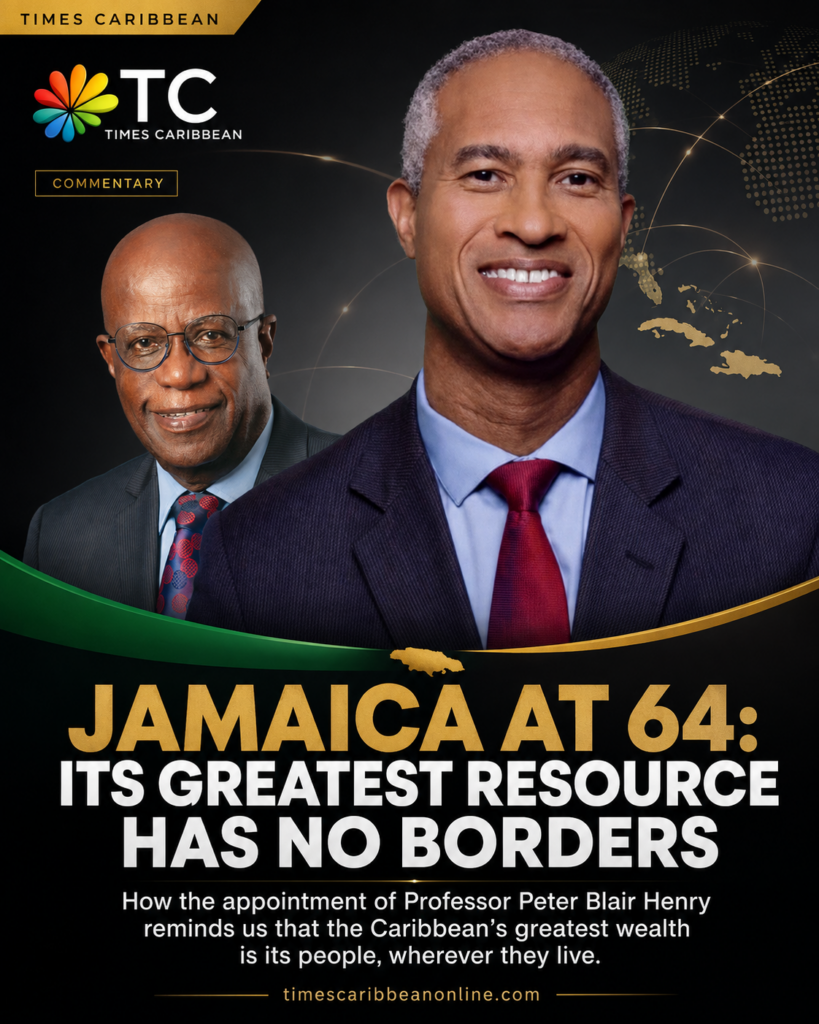
How the appointment of Professor Peter Blair Henry reminds us that the Caribbean’s greatest wealth is its people, wherever they live.
As Jamaica celebrates its 64th anniversary of Independence, it is worth pausing to reflect on a decision that says as much about the country’s future as it does about its past.
The Government’s appointment of Professor Peter Blair Henry as Chair of the Jamaica Reconstruction and Resilience Oversight Committee (JAMRROC) is more than the selection of one of the world’s most accomplished economists.
It is an affirmation of a simple but profound truth.
Jamaica’s borders are geographical.
Its talent is global.
Significantly, this is not the first time Jamaica has called on Professor Henry’s counsel. Successive governments have recognised the value of his thinking on economic growth, development and public policy. His latest appointment reflects confidence built over time. It demonstrates a willingness to draw upon one of Jamaica’s finest minds, wherever in the world he may be.
As the country marks another Independence anniversary, there is an important lesson here, not only for Jamaica but for the entire Caribbean.
A conversation I have never forgotten
The announcement took me back to 2015.
The year before, at the invitation of the Central Bank of Barbados, I had created the Caribbean Economic Forum, a public platform designed to bring world-class economic thinking into a Caribbean conversation.
Our inaugural Distinguished Visiting Fellow was Dr. C. Fred Bergsten, one of America’s most influential economists whose public service stretched back to the Reagan Administration.
For the Second Caribbean Economic Forum in 2015, however, I wanted someone different.
Someone who understood the Caribbean instinctively.
Someone whose scholarship had earned global respect, yet whose thinking had been shaped by the realities of a Jamaican childhood and the complexities of small developing economies.
Professor Peter Blair Henry was the obvious choice.
I remember looking forward to that conversation with genuine anticipation.
Not because he had advised President Barack Obama.
Not because he had become Dean of New York University’s Stern School of Business.
Not because he had become one of the world’s leading economists.
But because he was one of us.

Looking at the Caribbean through Caribbean eyes
For much of the late twentieth century, Caribbean economic policy was shaped by circumstances over which we often had little control.
Debt crises.
Structural adjustment.
International Monetary Fund programmes.
Fiscal retrenchment.
There were difficult decisions that had to be made, and many governments, Jamaica included, endured years of painful adjustment.
Too often, however, the policy prescriptions reflected assumptions developed for economies far larger and fundamentally different from our own.
Listening to Peter Blair Henry in Barbados was refreshing.
He did not reject sound economics.
Far from it.
His message was that sound economics is universal, but successful policy must always be adapted to local realities.
Small island developing states cannot simply copy the policy manuals of larger industrial economies.
They must build strategies rooted in their own history, institutions, vulnerabilities and opportunities.
It was an economist speaking with global authority, yet firmly grounded in Caribbean experience.
A room that reflected the Caribbean
That evening in the Grande Salle of the Central Bank of Barbados, named after the institution’s first Governor, Sir Courtney Blackman, there was a remarkable mix of people.
Central bankers.
Business leaders.
Students.
Public servants.
Academics.
Ordinary Barbadians who had accepted the Bank’s invitation.
There was something almost tangible in the atmosphere.
This was not simply a lecture.
It was a Caribbean conversation.
People recognised that Professor Henry’s insights were not abstract theories imported from distant capitals.
They were ideas informed by an understanding of societies that looked and felt like our own.
That, I believe, explains why the discussion was received with such enthusiasm.
Watching Jamaica once again call upon Professor Henry reminded me of that evening.
It also reminded me that our region continues to underestimate one of its greatest comparative advantages.
Our greatest strategic asset
When Caribbean people speak about the diaspora, the conversation often begins with remittances.
Those financial contributions matter enormously.
But there is another form of investment that may prove even more valuable.
Knowledge.
Experience.
Innovation.
Leadership.
Networks.
Across North America, Europe, Africa, Asia and beyond are Caribbean men and women leading universities, conducting cutting-edge research, managing multinational corporations, developing new technologies, advancing medicine and shaping international public policy.
Some were born in the Caribbean.
Others inherited the Caribbean through their parents and grandparents.
Still others have built enduring professional and emotional ties to our region.
Collectively, they represent one of the greatest strategic assets available to Caribbean development.
Yet too often we admire their achievements from afar instead of inviting them into the centre of our national conversations.
Jamaica’s decision should encourage every CARICOM government to ask a simple question.
Who are our Peter Blair Henrys?
Where are our scientists?
Our engineers?
Our physicians?
Our educators?
Our entrepreneurs?
Our innovators?
Do we even know where they are?
More importantly, do we have a deliberate strategy to engage them?
Independence in a new century
When Jamaica lowered the Union Jack and raised the Black, Green and Gold on August 6, 1962, Independence was understood principally in geographical terms.
A sovereign people governing a sovereign land.
Sixty-four years later, the meaning of Independence has expanded.
Jamaica’s borders remain the same.
Its national community does not.
Today it stretches from Kingston to New York, Toronto to London, Silicon Valley to Singapore.
Its people influence universities, financial markets, international organisations, research laboratories, boardrooms and governments across the world.
The appointment of Professor Peter Blair Henry reminds us that nationhood is no longer confined to territory.
It also embraces talent.
The wisest countries understand that some of their greatest natural resources carry passports, board aircraft and build careers abroad, while never ceasing to belong.
Jamaica has understood that before.
It understands it again today.
As the nation celebrates 64 years of Independence, perhaps the greatest lesson is this.
A country’s wealth is measured not only by the resources beneath its soil, but by the brilliance of its people, wherever in the world they may live.
That is a lesson worthy not only of Jamaica’s Independence.
It is a lesson worthy of the Caribbean’s future.
Julian Rogers is Publisher of Caribbean Bridges and Founder of the Caribbean Economic Forum, established in 2014 at the invitation of the Central Bank of Barbados. He moderated the Second Caribbean Economic Forum in 2015, featuring Distinguished Visiting Fellow Professor Peter Blair Henry.
















Leave a comment
You must be logged in to post a comment.