FAO Takes Climate-Smart Farming Training Directly to Saint Lucia’s Farmers
Regional Sessions in Soufrière and Union Strengthen Practical Skills in Irrigation, Fertigation and Sustainable Vegetable Production
CASTRIES, Saint Lucia — Farmers and agricultural professionals across Saint Lucia are gaining stronger hands-on skills to improve crop performance, conserve water, and build more resilient farming systems, following two practical regional training sessions delivered by the Food and Agriculture Organization of the United Nations, in collaboration with the Ministry of Agriculture, Fisheries, Food Security and Rural Development.
The training sessions, held on June 9, 2026, at the Extension Office in Soufrière and June 10, 2026, at the Forestry Conference Room in Union, brought practical irrigation and fertigation knowledge closer to farmers in both the south and north of the island.
Under the theme “Practical Integrated Crop Management: Improving Crop Performance through Irrigation, Fertigation and Nutrient Management,” the sessions attracted 38 participants, including farmers, nursery operators, agricultural officers, extension personnel, technical specialists, Ministry support staff, and public and private sector representatives.
By holding the sessions in two regions, FAO and the Ministry ensured that the training was more accessible while allowing participants to examine how irrigation and fertigation systems can be adapted to Saint Lucia’s diverse farming conditions.
The sessions were led by Mr. Marcko Theodoracopoulos, FAO Horticulture Specialist, and Ms. Anne Desrochers, FAO Plant Production and Protection Specialist. Participants explored the connection between irrigation, fertigation, crop nutrition, plant growth stages and field conditions, with special emphasis on how these elements must work together in everyday farm management.
A major focus was placed on the design, operation and maintenance of drip irrigation systems, including filtration, flushing, leak prevention, pressure management and water flow. The training also addressed the unique challenges faced by farmers working on Saint Lucia’s hilly and uneven terrain, where elevation changes can affect pressure and the even distribution of water and nutrients.
Participants received practical guidance on field layout, water source location, available pressure, and how these factors should influence irrigation system design to improve efficiency and reduce waste.
The hands-on component also covered the installation and calibration of Venturi fertilizer injectors, fertilizer preparation, injection rates, prevention of system blockages, separate stock solutions, and the use of electrical conductivity and pH measurements to guide fertigation and reduce crop stress.
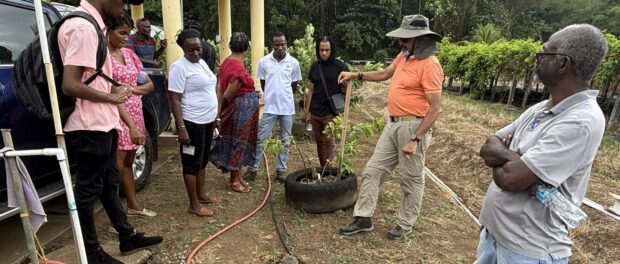
Through field demonstrations, participants were able to observe irrigation and fertigation systems under real farming conditions, troubleshoot common problems, and consider how the technologies could be adapted to their own farms and demonstration sites.
Ms. Desrochers said the regional approach was important because it allowed farmers and extension officers to connect technical knowledge with real production challenges.
“Delivering the training in the North and South allowed participants to relate the technical information directly to the conditions they manage on their farms. Irrigation and fertigation systems must be adapted to each site, particularly where terrain, water access and pressure vary. Strengthening farmers’ and extension officers’ capacity to make these adjustments is essential for ensuring that the technologies provided through the project are used effectively and sustainably,” she stated.
Local farmer Mr. Erbert Lionel, who attended the Soufrière session, described the training as both interesting and valuable. He said the workshop helped farmers better understand how fertilization and irrigation can work together to improve crop performance.
“On behalf of the farmers, I would like to sincerely thank FAO for helping us better understand these practices and how to combine them to achieve better results,” he said.
In the north, Mr. Anderson Emillaire, who participated in the Union session, said the workshop was practical, informative and useful.
“We really appreciate the knowledge provided during the session. Even where some of the topics were familiar, it was helpful to revisit them, and we would welcome more training as the project progresses,” he said.
The sessions formed part of a wider FAO technical mission in Saint Lucia from June 8 to 12, 2026. During the mission, FAO specialists and Ministry counterparts visited beneficiary farms to assess progress with land and greenhouse preparation, water access, irrigation requirements, and the installation of technological packages under the project.
Beneficiary farmers received one-on-one technical support on bed layout, contour alignment, drainage, water flow and pressure, and the placement of irrigation mainlines and driplines. These farm visits helped identify site-specific adjustments, materials and preparatory actions required before installation works move forward.
The mission also included a visit to Saint Lucia’s recently refurbished biological control laboratory, commissioned under the same project. The facility is expected to strengthen national capacity to produce and use biological control agents as part of broader efforts to improve integrated pest management and reduce reliance on chemical pesticides.
Through continued training, practical technology support and field-level engagement, FAO says it remains committed to working with the Government of Saint Lucia to advance climate-smart, sustainable and more productive agriculture.
For Saint Lucia’s farmers, the initiative represents more than another training exercise. It is a practical step toward improving yields, managing resources more efficiently, and preparing the agricultural sector for the growing pressures of climate change.
















Leave a comment
You must be logged in to post a comment.