GUYANA REVIEWS PORT KAITUMA WHARF CONTRACTS AFTER MV BARIMA TRAGEDY — LEGAL ACTION COULD FOLLOW
Attorney General Anil Nandlall says contractual arrangements are under examination as authorities probe whether negligence occurred in the design, supervision or execution of the troubled wharf project
GEORGETOWN, Guyana — The Government of Guyana has widened its response to the MV Barima tragedy, launching an official review of contracts connected to the troubled Port Kaituma wharf project, with possible legal action now on the table if evidence of negligence or other wrongdoing emerges.
Attorney General and Minister of Legal Affairs Mohabir Anil Nandlall, SC, confirmed that his chambers are examining the contractual arrangements surrounding the wharf, which was intended to accommodate the newer MV Ma Lisha at Port Kaituma.
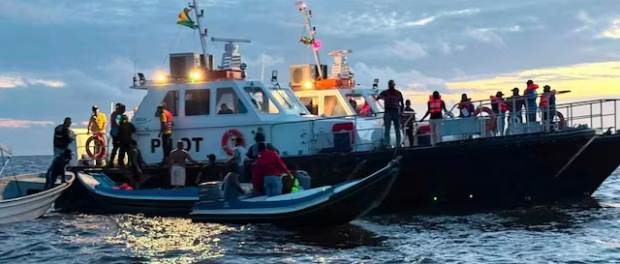
The disclosure adds another major layer to the government’s response following the July 18 MV Barima incident, which has already triggered a police investigation and an independent international Commission of Inquiry (CoI).
And the contract review could have significant consequences.
According to the government, legal action may be considered against any party where evidence establishes negligence connected to the project. The review is expected to examine responsibilities surrounding the wharf’s design, supervision and execution.
Importantly, the review itself does not establish wrongdoing by any contractor, engineer, consultant or public official. Any finding of negligence or liability would have to emerge through the appropriate investigative and legal processes.
STRUCTURAL PROBLEMS AT NEW WHARF
Questions surrounding the Port Kaituma facility have intensified after Minister of Public Works Bishop Juan Edghill disclosed that the newly constructed wharf developed structural problems following significant movement of the surrounding soil.
Sections of the facility consequently required rebuilding and corrective work.
Months earlier, in May, Edghill had described Port Kaituma as the remaining wharf under the government’s Region One programme, saying corrective works were still being completed. The upgraded facilities were designed to accommodate roll-on/roll-off vessels including the MV Ma Lisha.
The MV Ma Lisha had not yet commenced service to Port Kaituma when the Barima tragedy occurred, according to the government.
That timeline is now receiving increased public attention as investigators examine the broader circumstances surrounding the maritime disaster.
COI AND POLICE INVESTIGATIONS CONTINUE
The contract review is separate from, but running alongside, the ongoing criminal investigation and the independent Commission of Inquiry.
President Dr. Mohamed Irfaan Ali announced that the international CoI would examine the circumstances surrounding the MV Barima tragedy, including the vessel’s loading, passenger boarding procedures, seaworthiness, maintenance, compliance with maritime safety requirements, crew actions and the effectiveness of the emergency response.
The commission has also been empowered to determine whether negligence, misconduct, dereliction of duty or institutional failures contributed to the disaster and to recommend reforms aimed at strengthening Guyana’s maritime safety system.
Nandlall has stressed that the CoI does not replace the responsibilities of police, prosecutors or other state agencies.
Instead, its findings and recommendations could potentially identify additional matters or individuals requiring investigation, while any questions of criminal or civil liability would ultimately be handled through the relevant authorities and courts.
ACCOUNTABILITY NOW IN SHARP FOCUS
The Port Kaituma contract review therefore opens a second important line of scrutiny: what happened with the infrastructure that was supposed to support the newer transportation system, and whether every party responsible for that project properly discharged its obligations.
For families affected by the MV Barima tragedy and for Guyanese demanding answers, the coming investigations could prove critical.
There are now several parallel questions before authorities — what caused the disaster, whether established maritime procedures were followed, whether institutional failures played a role, and whether problems surrounding the Port Kaituma infrastructure involved negligence for which individuals or companies could legally be held responsible.
Those conclusions have not yet been reached.
But one thing is now official: the contracts are being examined, accountability is being considered, and Guyana’s government says legal action remains an option wherever the evidence ultimately leads.
TIMES CARIBBEAN
















Leave a comment
You must be logged in to post a comment.