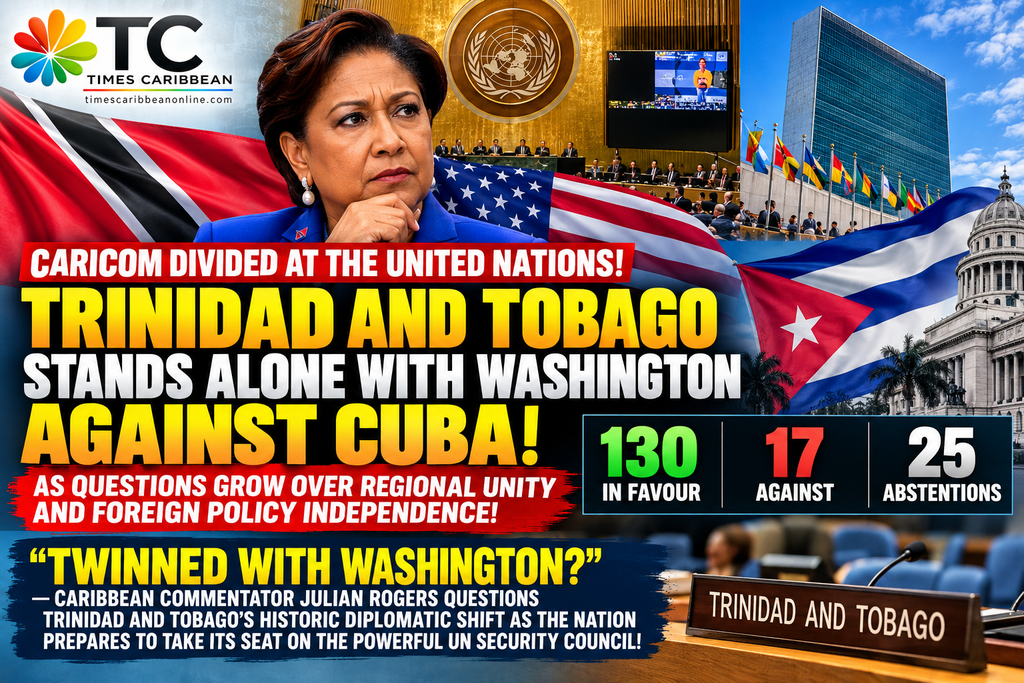
CARICOM DIVIDED AT THE UNITED NATIONS! TRINIDAD AND TOBAGO STANDS ALONE WITH WASHINGTON AGAINST CUBA AS QUESTIONS GROW OVER REGIONAL UNITY AND FOREIGN POLICY INDEPENDENCE!
TIMES CARIBBEAN | REGIONAL NEWS & DIPLOMATIC ANALYSIS | OCTOBER 28, 2026
“TWINNED WITH WASHINGTON?” — CARIBBEAN COMMENTATOR JULIAN ROGERS QUESTIONS TRINIDAD AND TOBAGO’S HISTORIC DIPLOMATIC SHIFT AS THE NATION PREPARES TO TAKE ITS SEAT ON THE POWERFUL UN SECURITY COUNCIL!
By Times Caribbean News Desk | Caribbean Affairs & International Relations
PORT OF SPAIN / NEW YORK, October 28, 2026 — A dramatic diplomatic shift has placed Trinidad and Tobago at the centre of a growing Caribbean debate after the twin-island republic broke with decades of established foreign policy and voted alongside the United States against a United Nations resolution calling for an end to Washington’s economic embargo on Cuba.
The decision, which saw Trinidad and Tobago become the only CARICOM member to vote against the resolution, has raised questions about regional solidarity, foreign policy independence and the country’s increasingly close relationship with Washington.
The UN General Assembly adopted the resolution on Wednesday by 130 votes in favour, 17 against and 25 abstentions.
While several Caribbean nations maintained their traditional support for ending the embargo, Jamaica, Guyana and Haiti abstained. Antigua and Barbuda, Dominica and Saint Lucia had no vote recorded.
The result highlighted significant differences within CARICOM over one of the region’s longest-standing diplomatic issues.
JULIAN ROGERS QUESTIONS TRINIDAD AND TOBAGO’S GROWING ALIGNMENT WITH WASHINGTON
In a sharply worded commentary published under Caribbean Bridges, regional political analyst Julian Rogers argues that Trinidad and Tobago’s vote represents more than an isolated diplomatic decision.
He describes what he sees as a developing pattern of closer political, economic and security cooperation between Prime Minister Kamla Persad-Bissessar’s administration and the United States.
Rogers points to expanded American security arrangements, military cooperation, surveillance technology and recent diplomatic engagements as developments that warrant greater public scrutiny.
In his assessment, Wednesday’s vote adds another dimension to a relationship he characterises as a diplomatic twinning with Washington.
His central concern is whether the country’s increasingly close strategic partnership with the United States could affect its ability to maintain an independent voice on major international questions.
A DEPARTURE FROM DECADES OF CARIBBEAN DIPLOMATIC TRADITION
For decades, CARICOM governments have generally supported annual United Nations resolutions calling for an end to the American embargo on Cuba.
The policy has reflected a longstanding regional position that economic restrictions should not prevent constructive engagement between nations, regardless of differences in political systems.
Trinidad and Tobago itself supported the resolution in previous years, including 2025.
Wednesday’s reversal therefore represents a notable change in the country’s diplomatic position.
Rogers argues that the significance lies not simply in how Trinidad and Tobago voted, but in the broader direction of its international relationships.
NATIONAL SECURITY OR FOREIGN POLICY REALIGNMENT?
There are competing perspectives.
The Trinidad and Tobago government has defended stronger cooperation with Washington as an important part of its national security strategy, particularly in addressing organised crime, illegal trafficking and regional instability.
The country’s proximity to Venezuela and its economic and energy interests also influence its foreign policy calculations.
Prime Minister Persad-Bissessar has expressed strong opposition to authoritarian political systems, including Cuba’s government.
The United States has similarly argued that Cuba’s economic difficulties stem partly from domestic governance and economic policies rather than external restrictions alone.
Critics, however, argue that opposing the American embargo does not necessarily constitute an endorsement of Cuba’s political system.
The annual UN resolution calls for the removal of economic, commercial and financial restrictions. It does not require supporting Havana’s domestic political arrangements.
This distinction forms an important part of the debate over Trinidad and Tobago’s decision.
THE SECURITY COUNCIL FACTOR: A GLOBAL TEST OF INDEPENDENCE
The timing has added another layer of significance.
In June 2026, Trinidad and Tobago was elected to serve as a non-permanent member of the United Nations Security Council for the 2027–2028 term, securing 181 votes from 190 participating states.
Its tenure begins on January 1, 2027.
The position will place the Caribbean nation at the centre of international discussions concerning global security, diplomatic disputes and relations among major world powers.
Rogers argues that the appointment creates an important test of the country’s ability to balance strategic partnerships with independent decision-making.
For small states, maintaining relationships with powerful international partners while protecting national sovereignty remains a delicate diplomatic challenge.
And the consequences extend beyond Trinidad and Tobago.
As a CARICOM member serving on the Security Council, the country will inevitably face expectations concerning the representation of Caribbean perspectives on issues affecting regional and international stability.
IS CARICOM’S TRADITIONAL UNITED FRONT BEGINNING TO FRACTURE?
The Cuba vote has brought renewed attention to the challenges of maintaining common foreign policy positions among Caribbean governments with different economic priorities, security concerns and international relationships.
CARICOM has historically sought to strengthen the collective diplomatic influence of small states through coordinated positions on major international issues.
Yet Wednesday’s results demonstrate that regional governments are increasingly willing to adopt different approaches when national priorities and international partnerships intersect.
Such differences do not necessarily represent the collapse of regional cooperation.
They do, however, create legitimate questions about CARICOM’s ability to preserve a coordinated diplomatic voice in an increasingly complex geopolitical environment.
A CARIBBEAN QUESTION THAT DESERVES AN ANSWER
Rogers’ commentary ultimately raises an issue extending well beyond Cuba.
Can a small Caribbean nation deepen its strategic relationship with a major global power while maintaining an independent foreign policy and meaningful regional solidarity?
Trinidad and Tobago has every right to determine its national diplomatic priorities. Its government also has a responsibility to explain significant changes in established international positions.
The Cuba resolution does not, by itself, establish that Washington influenced Trinidad and Tobago’s decision.
But the combination of expanding bilateral security cooperation, increasingly visible political alignment and a reversal of longstanding UN voting practice has understandably attracted regional attention.
As Trinidad and Tobago prepares to assume its Security Council seat, its diplomacy will be examined with renewed interest.
The central question is no longer simply why Trinidad and Tobago voted against the Cuba resolution. It is whether the country can demonstrate that closer cooperation with Washington will strengthen, rather than compromise, its independent voice in world affairs.
For CARICOM, the wider challenge is equally significant: preserving meaningful regional cooperation while respecting the sovereign choices of individual member states.
And for Trinidad and Tobago, the next two years could provide the clearest answer yet.
Commentary reference: Caribbean Bridges — Julian Rogers | julian@caribbeanbridges.com. This Times Caribbean article examines Rogers’ arguments alongside the reported UN voting results and regional diplomatic developments. His characterisation of Trinidad and Tobago’s foreign policy represents commentary rather than an established finding of external influence.
#TimesCaribbean #CaribbeanNews #CARICOM #TrinidadAndTobago #Cuba #UnitedNations #CaribbeanDiplomacy #JulianRogers #UNSecurityCouncil #ForeignPolicy #RegionalUnity
















Leave a comment
You must be logged in to post a comment.