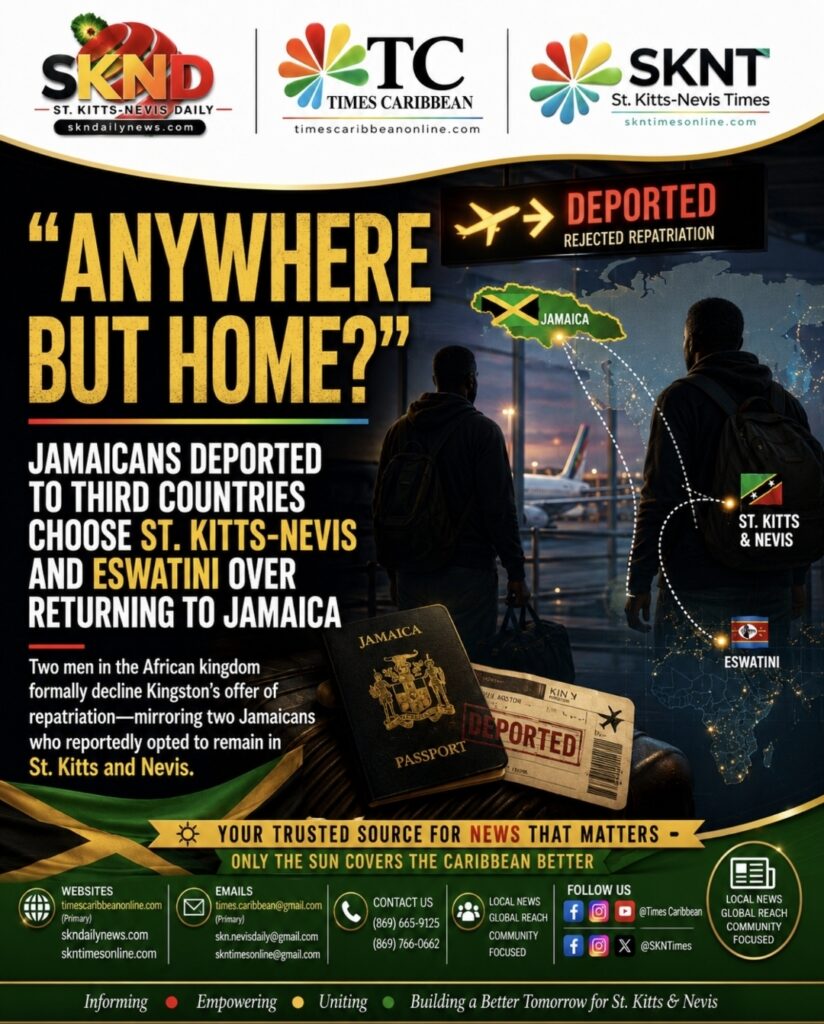
ANYWHERE BUT HOME?” JAMAICANS DEPORTED TO THIRD COUNTRIES CHOOSE ST. KITTS-NEVIS AND ESWATINI OVER RETURNING TO JAMAICA

Two men in the African kingdom formally decline Kingston’s offer of repatriation—mirroring two Jamaicans who reportedly opted to remain in St. Kitts and Nevis
KINGSTON, Jamaica — A striking and deeply uncomfortable pattern is emerging from the United States’ controversial third-country deportation programme: several Jamaican nationals sent to unfamiliar countries are reportedly choosing to remain there rather than return home to Jamaica.
Jamaica’s Ministry of Foreign Affairs has confirmed that two of three Jamaican citizens recently deported by the United States to the southern African kingdom of Eswatini formally declined government offers to facilitate their return.
Officials are still attempting to contact the third Jamaican.
According to the ministry, the men were advised of the consular assistance available to them and told that the Jamaican Government was prepared to arrange their repatriation. However, both maintained that they did not wish to return to Jamaica.
The men were also informed that Jamaican authorities could neither confirm their present immigration status in the United States nor secure their return there. Contact was reportedly established through Jamaica’s Consulate in Miami and a legal adviser representing the unidentified men.
The stunning development mirrors the situation involving two Jamaicans transferred from the United States to St. Kitts and Nevis under a similar third-country arrangement in May.
Those men reportedly entered the Federation as ordinary passengers, were not being held in custody and indicated that they had no immediate plans to return to Jamaica.
The cases now raise an unavoidable regional question: Why would Jamaican nationals sent to countries with which they may have had little or no previous connection decline an officially supported journey home?
No confirmed explanation has been publicly provided by the men. Their decisions could involve family connections, ongoing legal strategies, personal circumstances or hopes of eventually returning to the United States. Any broader conclusion about their motives would therefore be premature.
Nevertheless, four Jamaicans across two dramatically different destinations—St. Kitts and Nevis in the Caribbean and Eswatini in southern Africa—have now reportedly chosen not to accept an immediate return to Jamaica.
The situation is particularly remarkable because Jamaica’s official deportation policy states that the Government is obligated to accept verified Jamaican citizens who have been ordered deported. Consular officials may issue travel documents, communicate with relatives and facilitate repatriation after release.
Eswatini has become one of the principal destinations in Washington’s expanding third-country deportation programme. Reuters reported that 29 deportees had been sent there under a US$5.1 million agreement by July 8, with only two having been released and repatriated at that point—one to Jamaica and another to Cambodia.
The latest refusals are likely to intensify debate across the Caribbean about the legal status, freedom of movement, public cost and long-term future of people transferred under third-country agreements.
They may also force Jamaica into an uncomfortable national conversation—not merely about deportation, but about why some of its citizens appear prepared to remain thousands of miles away in uncertain circumstances rather than accept the Government’s offer to bring them home.
















Leave a comment
You must be logged in to post a comment.