U.S.–ISRAEL STRIKES ROCK TEHRAN AS PRESIDENT URGES IRANIANS TO “SEIZE CONTROL” — WAR DRUMS ECHO ACROSS THE GLOBE
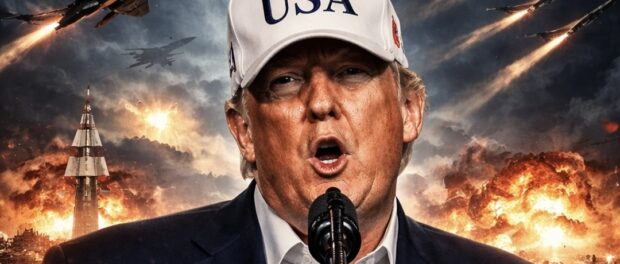
BASSETERRE / WASHINGTON / TEHRAN — In a move that has jolted the international system and sent shockwaves through global markets, U.S. President Donald Trump declared Saturday that American and Israeli forces had launched coordinated strikes on targets inside Iran — even as Iranian state media reported explosions in Tehran, Qom, Isfahan, Kermanshah, and Karaj.
Within hours of the reported blasts, President Trump took to Truth Social in a stark, unscripted video message that may define his presidency’s most consequential foreign policy gamble.
“This will be probably your only chance for generations,” Trump said, urging the Iranian people to seize control of their government when U.S. military operations conclude.
In the same breath, the president acknowledged the grave cost that could follow:
“The lives of courageous American heroes may be lost and we may have casualties.”
The juxtaposition was jarring — revolutionary rhetoric abroad, sobering warning at home.
Explosions Across Iran
Iranian state media outlets reported multiple explosions across major urban centers:
- Tehran – The political and military nerve center
- Qom – A religious epicenter of the Islamic Republic
- Isfahan – Home to strategic nuclear and military infrastructure
- Kermanshah – Near key western military zones
- Karaj – An industrial hub just outside the capital
While U.S. and Israeli officials have not released detailed targeting information, analysts suggest strikes likely focused on air defense systems, missile depots, or nuclear-linked facilities.
The scale and geographic spread signal something far beyond a symbolic warning shot.
“Regime Change” Language Returns
Trump’s call for Iranians to “seize control” marks a dramatic rhetorical escalation. U.S. administrations have historically avoided overt regime-change language in public addresses, particularly in live conflict scenarios.
This is not Iraq in 2003.
This is not Libya in 2011.
This is a direct military confrontation with a regional power capable of asymmetric retaliation — including cyber warfare, missile attacks, and proxy mobilization through allied militias across the Middle East.
By explicitly encouraging internal revolt, Trump has reframed the operation not merely as deterrence — but as transformational.
The risk?
If the Iranian government survives intact, Washington could face a hardened adversary, emboldened domestically and diplomatically.
A Sobering Warning to American Families
ABC News correspondent Martha Raddatz reacted with visible gravity to Trump’s statement that casualties may occur.
“I have to think of the parents of the military tonight, the spouses, who had not really heard a warning like that from President Trump.”
Her remark underscores a striking element: presidents rarely pre-announce potential American casualties in such blunt terms.
For military families across the United States — and for regional allies hosting U.S. bases — the words landed like a thunderclap.
Global Implications: Oil, Alliances, and Escalation
The Middle East now stands at the edge of a widening conflict:
- Iranian retaliation could target U.S. assets in the Gulf.
- Hezbollah in Lebanon may open a northern front against Israel.
- Oil markets could spike, affecting small island economies like those in CARICOM already battling inflation.
- Shipping lanes in the Strait of Hormuz may face disruption, threatening global trade.
For the Caribbean — including St. Kitts and Nevis — this is not distant geopolitics. Fuel costs, tourism confidence, and diaspora security could all feel secondary impacts.
Regional leaders gathering under multilateral umbrellas like CARICOM may soon be forced to navigate delicate diplomatic positioning between Washington, Tehran, and other global powers.
The Strategic Calculation
Supporters of the operation argue that coordinated U.S.–Israeli action was necessary to neutralize imminent threats.
Critics warn it risks igniting a regional war without congressional authorization, without clear exit strategy, and without defined post-strike objectives.
Trump’s framing suggests he sees this moment as historic — a generational pivot point.
But history offers sobering lessons:
- Regime change is unpredictable.
- Nationalism often strengthens under foreign attack.
- Escalation can spiral faster than anticipated.
A Defining Moment
The images emerging from Tehran’s skyline and Washington’s late-night presidential address may come to define this era.
A president urging revolution.
A warning of American casualties.
Explosions in multiple Iranian cities.
The world now watches to see whether this is a limited strike designed for leverage — or the opening salvo of something far larger.
For now, one truth is undeniable:
The Middle East has entered a new and uncertain chapter — and the consequences will not remain confined to its borders.
















Leave a comment
You must be logged in to post a comment.