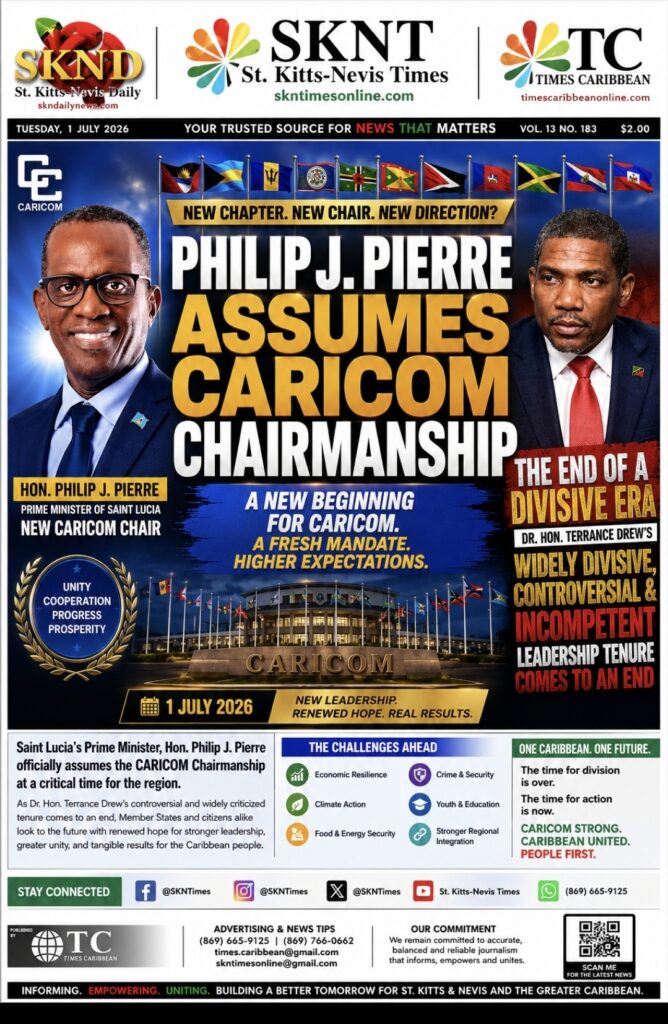
Philip J. Pierre Assumes CARICOM Chairmanship as Dr. Hon. Terrance Drew’s Widely Divisive, Controversial and Incompetent Leadership Tenure Comes to an End

As of 1 July 2026, the Honourable Phillip J Pierre has officially assumed the rotating six-month Chairmanship of CARICOM , succeeding at a pivotal moment for the 15-member regional bloc.
Pierre’s assumption of office comes as CARICOM continues to grapple with significant regional and international challenges, including economic uncertainty, climate resilience, food and energy security, migration, regional crime, geopolitical tensions, and questions surrounding the effectiveness and cohesion of the Community’s leadership.
His appointment also marks the close of a chairmanship that generated considerable public debate and political commentary across parts of the Caribbean.
A Chairmanship That Divided Opinion
Throughout Dr. Drew’s six-month tenure, commentators, opposition figures and sections of the regional public questioned aspects of CARICOM’s visibility, responsiveness and strategic direction. While supporters have pointed to achievements such as hosting a successful Heads of Government Conference in St. Kitts and Nevis and continued engagement with regional and international partners, critics argue that the period was overshadowed by a succession of controversies that distracted from the Community’s core priorities.
Among the issues that attracted discussion was the reappointment of as Secretary-General. While the decision ultimately received the support required under CARICOM’s procedures, some observers questioned both the consultation process and whether the organisation needed a broader conversation about institutional reform and leadership renewal.
Although no consensus emerged against the reappointment, the debate highlighted underlying concerns among some stakeholders about governance, accountability and the future direction of the regional institution.
Questions Over Leadership Style
Perhaps one of the most discussed aspects of Dr. Drew’s chairmanship was his diplomatic tour of CARICOM capitals immediately before St. Kitts and Nevis hosted the Conference of Heads of Government.
The visits saw the CARICOM Chairman meeting leaders across multiple Member States over several days before welcoming many of those same leaders to Basseterre.
Government officials characterised the initiative as proactive diplomacy intended to strengthen regional relationships, build consensus ahead of the summit and engage directly with fellow Heads of Government.
However, critics questioned whether the extensive travel delivered measurable policy outcomes commensurate with the public resources involved. Some political observers described the exercise as largely symbolic, arguing that many of the meetings were brief and produced few publicly identifiable deliverables beyond reaffirmations of regional cooperation.
Those contrasting perspectives became one of the defining political narratives surrounding the chairmanship.
Calls for a Stronger Regional Voice
Beyond questions surrounding diplomacy, some analysts also argued that CARICOM appeared less visible on several major regional and international developments during the period.
Commentators periodically called for quicker, more coordinated public responses from the regional body on issues affecting Caribbean citizens, suggesting that the Community’s collective voice could have been more prominent during moments of regional concern.
Supporters of the outgoing Chairman counter that CARICOM’s consensus-based decision-making process often requires careful consultation among Member States and that many important initiatives occur behind closed doors rather than through public statements.
A Difficult Period for Regional Unity
Few would dispute that the past six months presented considerable challenges for regional leadership.
CARICOM navigated a rapidly changing international environment marked by geopolitical uncertainty, economic pressures, climate-related concerns and evolving relationships with major global partners.
Whether these challenges exposed weaknesses in regional governance or simply reflected the complexity of leading a diverse Community remains a matter of legitimate political debate.
Pierre Faces High Expectations
Prime Minister Pierre now inherits an organisation facing heightened expectations from Caribbean citizens who increasingly want CARICOM to be more visible, more decisive and more results-oriented.
Observers will be watching closely to see whether his leadership places greater emphasis on measurable regional outcomes, institutional reform, stronger public communication and deeper cooperation among Member States.
His tenure will also be judged by CARICOM’s ability to advance long-standing priorities, including regional integration, food security, climate financing, digital transformation, freedom of movement and economic resilience.
The Road Ahead
As one chapter closes and another begins, Pierre assumes office with an opportunity to reset the regional conversation.
The transition offers CARICOM a chance not only to reflect on the strengths and shortcomings of the outgoing chairmanship but also to reaffirm its founding mission of collective action and regional solidarity.
While opinions on Dr. Drew’s tenure remain sharply divided, there is broad agreement that the Caribbean faces increasingly complex challenges requiring effective, credible and collaborative regional leadership.
For many across the region, the hope is that the next six months will be defined less by political controversy and more by tangible progress for the people of the Caribbean.
















Leave a comment
You must be logged in to post a comment.