“HEADS ONLY” MESSAGE IGNITES REGIONAL FIRESTORM — QUESTIONS MOUNT OVER PROCEDURE, LEADERSHIP, AND LEGITIMACY
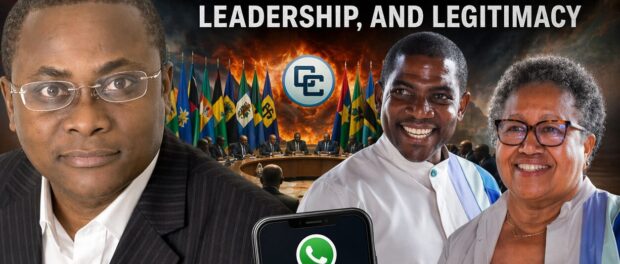
A deepening governance controversy within the Caribbean Community (CARICOM) has erupted into one of the most serious institutional challenges in recent years, following revelations contained in a sharply critical analysis by veteran journalist Orin Gordon in the Trinidad Guardian.
At the center of the storm is a seemingly routine communication — a “heads only” WhatsApp message — which has now evolved into a symbol of procedural breakdown, diplomatic miscalculation, and widening political discord among key regional actors.
THE MESSAGE THAT TRIGGERED A CRISIS
According to Orin Gordon’s Trinidad Guardian article, the WhatsApp message sent to Trinidad and Tobago’s Foreign and CARICOM Affairs Minister Sean Sobers effectively excluded him from a high-level discussion at the February CARICOM Heads of Government retreat in Nevis — a meeting at which leaders affirmed a second term for CARICOM Secretary-General Dr. Carla Barnett.
Gordon characterizes the message as an “electronic indictment” of the process, raising fundamental concerns about adherence to established procedures and the integrity of decision-making at the highest level of regional governance.
TRINIDAD AND TOBAGO’S RESPONSE — VALID CONCERNS, VOLATILE TONE
Prime Minister Kamla Persad-Bissessar has forcefully challenged the circumstances surrounding her country’s exclusion, arguing that Trinidad and Tobago — a key CARICOM member — was denied proper representation.
However, the tone of her response has drawn criticism. Her description of CARICOM’s actions as “odious” and akin to a “corrupt backroom operation” has been viewed by some regional observers as unnecessarily inflammatory, potentially compounding an already delicate situation.
Further complicating matters is the Prime Minister’s absence from an emergency virtual meeting convened on April 10 by CARICOM Chairman Dr. Terrance Drew, which was specifically called to address the dispute. Her non-participation — without a publicly stated reason — has raised questions about the consistency of Trinidad and Tobago’s engagement on the issue.
THE CHAIRMAN’S ROLE AND PROCEDURAL UNCERTAINTY
Dr. Drew has defended the process, reportedly documenting months of correspondence to demonstrate that Trinidad and Tobago had been kept informed of the CARICOM agenda, including discussions regarding the Secretary-General’s tenure.
Yet the controversy has exposed deeper institutional concerns. The “heads only” directive, reportedly linked to the Chairman’s preference, has no clear basis in codified CARICOM procedures, raising questions about whether established governance norms were overridden or misapplied.
The situation is further complicated by the simultaneous scheduling of a meeting of Foreign Ministers in St. Kitts, with Dr. Denzil Douglas affirming that ministers — including Sobers — were expected to attend. This overlap has intensified confusion about roles, responsibilities, and the proper channels of participation.
SYSTEMIC FAILURES ON MULTIPLE FRONTS
As Gordon’s analysis suggests, responsibility for the current impasse is not confined to a single actor. Instead, the crisis reflects a convergence of missteps:
- CARICOM planners may have erred in restricting attendance without clear procedural authority.
- Sean Sobers appeared uncertain about asserting his role as head of delegation in the Prime Minister’s absence.
- Trinidad and Tobago failed to ensure representation at a critical juncture.
- The Prime Minister’s public response escalated tensions and hardened positions.
Silence from key diplomatic figures, including Ambassador Ralph Maharaj, has only deepened uncertainty about how decisions were interpreted and communicated in real time.
A SECOND TERM UNDER A CLOUD
While CARICOM has formally affirmed a second term for Dr. Carla Barnett, the legitimacy of that decision is now being openly questioned in light of the procedural controversy.
Gordon’s analysis points toward what may be an unavoidable outcome: a reconsideration of the decision, or what some observers are calling a “do-over.” Central to that possibility is the notion that Dr. Barnett may need to withdraw from serving another term when her current tenure ends in August — effectively stepping aside to preserve institutional stability.
Such a move would not be a reflection of personal failure, but rather a recognition that the circumstances surrounding her reappointment have become too contentious for effective leadership moving forward.
REGIONAL UNITY AT RISK
The implications extend far beyond a single appointment. Trinidad and Tobago has signaled potential reconsideration of its financial contributions and participation in CARICOM activities, introducing the prospect of significant institutional disruption.
At stake is the cohesion of a regional body that relies on consensus, mutual respect, and clearly defined procedures. The current dispute underscores how quickly those foundations can be strained when governance processes are perceived to be compromised.
CONCLUSION: A DEFINING MOMENT FOR CARICOM
As highlighted in Orin Gordon’s Trinidad Guardian article, this controversy is not merely about a WhatsApp message or a disputed meeting. It is a test of CARICOM’s commitment to transparency, procedural integrity, and collective governance.
The organization now faces a critical decision: whether to stand by a process that has come under intense scrutiny, or to recalibrate in the interest of restoring trust among its member states.
The outcome will shape not only the future of its leadership, but the credibility of CARICOM itself as a cornerstone of Caribbean unity and cooperation.
















Leave a comment
You must be logged in to post a comment.