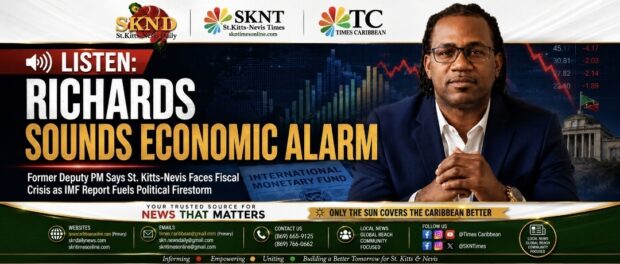
DR. RICHARDS SOUNDS ECONOMIC ALARM: Former Deputy PM Says St. Kitts-Nevis Faces Fiscal Crisis as IMF Report Fuels Political Firestorm
TIMES CARIBBEAN | SKN TIMES | ST. KITTS-NEVIS DAILY FEATURE
Former Deputy Prime Minister and former Minister of Finance, Dr. the Hon. Shawn K. Richards, has delivered one of his strongest national addresses yet, warning that St. Kitts and Nevis is facing what he described as a dangerous economic and financial slide under the current Labour administration.
In a sharply worded address to the nation, Richards accused the Government of “severely mismanaging” the country’s finances and weakening the economy at a time when citizens are already feeling the squeeze from rising costs, pressure on public services, and uncertainty over the country’s fiscal direction.
His address comes against the backdrop of the International Monetary Fund’s 2026 Article IV Consultation on St. Kitts and Nevis, which reported that declining Citizenship by Investment revenue helped widen the overall fiscal deficit to 11.7 percent of GDP in 2025, while public debt moved closer to the 60 percent of GDP regional benchmark and government deposits continued to decline.
“St. Kitts & Nevis Is in Serious Trouble,” Richards Declares
Richards told citizens that the country has reached a defining moment, arguing that the public must stop accepting what he called “unsubstantiated, repetitive promises” and begin critically assessing the nation’s financial condition.
According to Richards, the IMF’s findings represent more than technical economic language. He interpreted the report as a warning that the economy is under pressure, revenue is weakening, debt is rising, and the country is becoming dangerously dependent on a narrow revenue base, particularly the CBI programme.
The IMF itself stated that with CBI revenue declining further, the fiscal deficit widened in 2025, while persistent low CBI revenue is expected to keep deficits elevated in 2026 and over the medium term. The IMF also projected that public debt would continue rising.
Richards seized on those findings to argue that the Labour administration has failed to adjust to a changing fiscal reality.
The IMF Warning: Growth Risks Down, Inflation Risks Up
One of the most politically explosive parts of Richards’ address was his reference to the IMF’s warning that “near-term growth risks are tilted to the downside, while inflation risks are tilted to the upside.”
For Richards, that single line captured the danger facing households: slower economic expansion on one side, and higher prices on the other.
The Government, however, has presented a more optimistic interpretation of the IMF report, highlighting the Fund’s projection that economic growth is expected to rebound to 2 percent in 2026, supported by construction, agriculture, renewable energy projects, and continued expansion in tourism.
That contrast is now at the heart of the political battle: the Government is pointing to projected recovery, while Richards and the opposition are pointing to deficits, debt, declining deposits, and the cost-of-living impact on ordinary citizens.
Deficit, Debt and Deposits Become the New Political Battleground
Richards said the country’s fiscal numbers should worry every citizen. He highlighted the IMF-reported 2025 deficit of 11.7 percent of GDP, arguing that this means government spending has significantly exceeded revenue.
He further claimed that government deposits, which he said were much stronger during the Team Unity period, are projected to fall sharply under the current administration. The IMF has confirmed that government deposits declined further, while public debt moved closer to the regional benchmark and is projected to continue rising if low CBI revenues persist.
In political terms, Richards is attempting to frame the issue as a question of stewardship: who can be trusted to manage the public purse when the CBI cushion weakens, expenditure remains high, and citizens demand better services?
Cost of Living Takes Centre Stage
Richards also connected the fiscal debate to kitchen-table realities. He pointed to electricity fuel variation costs, business operating expenses, and the rising price of basic items such as bread.
His argument was simple but politically potent: when government finances weaken, the impact is eventually felt by ordinary people through higher prices, strained services, delayed projects, and fewer protections against inflation.
He also raised concerns about public institutions, including claims about medicine shortages, basic school supplies, and ministries requiring approval before purchasing essential items such as hygiene and office supplies. These claims were presented by Richards as examples of a wider squeeze within government operations.
A Direct Attack on Labour’s 2022 Promise of “Better”
The address was not merely economic. It was deeply political.
Richards repeatedly contrasted the current situation with Labour’s 2022 election promise of “better,” asking whether citizens are truly experiencing improvement in their daily lives.
He accused the administration of becoming a government of “many promises and too many failures,” and argued that major capital projects — including the Smart Hospital, the new Basseterre High School, and promised housing construction — have not moved with the urgency citizens expected.
The former Deputy Prime Minister also criticized what he described as heavy overseas travel by government officials at a time when ministries and departments are allegedly struggling with basic operational needs.
PAM Presents Itself as the Alternative
Richards used the address to position the People’s Action Movement as the party best suited to stabilize the country’s finances, diversify the economy, strengthen fiscal management, create jobs, and deliver long-promised capital projects.
He argued that the next general election will offer citizens a clear choice: continue with the current administration or return to what he described as more disciplined and experienced economic leadership.
The core message was unmistakable: Richards wants voters to view the IMF report not as an abstract document for economists, but as a national warning signal.
Analysis: A Fiscal Debate That Could Shape the Next Election
Richards’ address may mark a turning point in the political conversation ahead of the next election. For months, public debate has focused heavily on crime, healthcare, water, housing, electricity, and governance. His speech now places the economy — especially debt, deficits, CBI dependency, and public spending — at the centre of the opposition’s argument.
The IMF report gives both sides material to work with. The Government can point to projected growth recovery and investment in key sectors. The opposition can point to the deficit, rising debt pressure, declining deposits, and persistent risks tied to low CBI revenue.
But for voters, the issue may be less about technical IMF language and more about lived experience: the cost of bread, electricity bills, medicine availability, school resources, jobs, housing, and whether public services feel stronger or weaker than before.
Richards’ address was designed to convert economic data into political urgency. Whether that message resonates will depend on whether citizens believe the country is temporarily adjusting — or sliding into a deeper fiscal crisis.
For now, one thing is clear: the IMF report has become a political weapon, the economy has become a campaign battlefield, and Dr. Shawn Richards has placed Labour’s financial management squarely on trial before the people of St. Kitts and Nevis.
















Leave a comment
You must be logged in to post a comment.