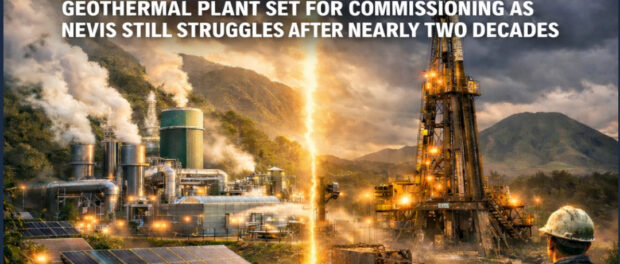
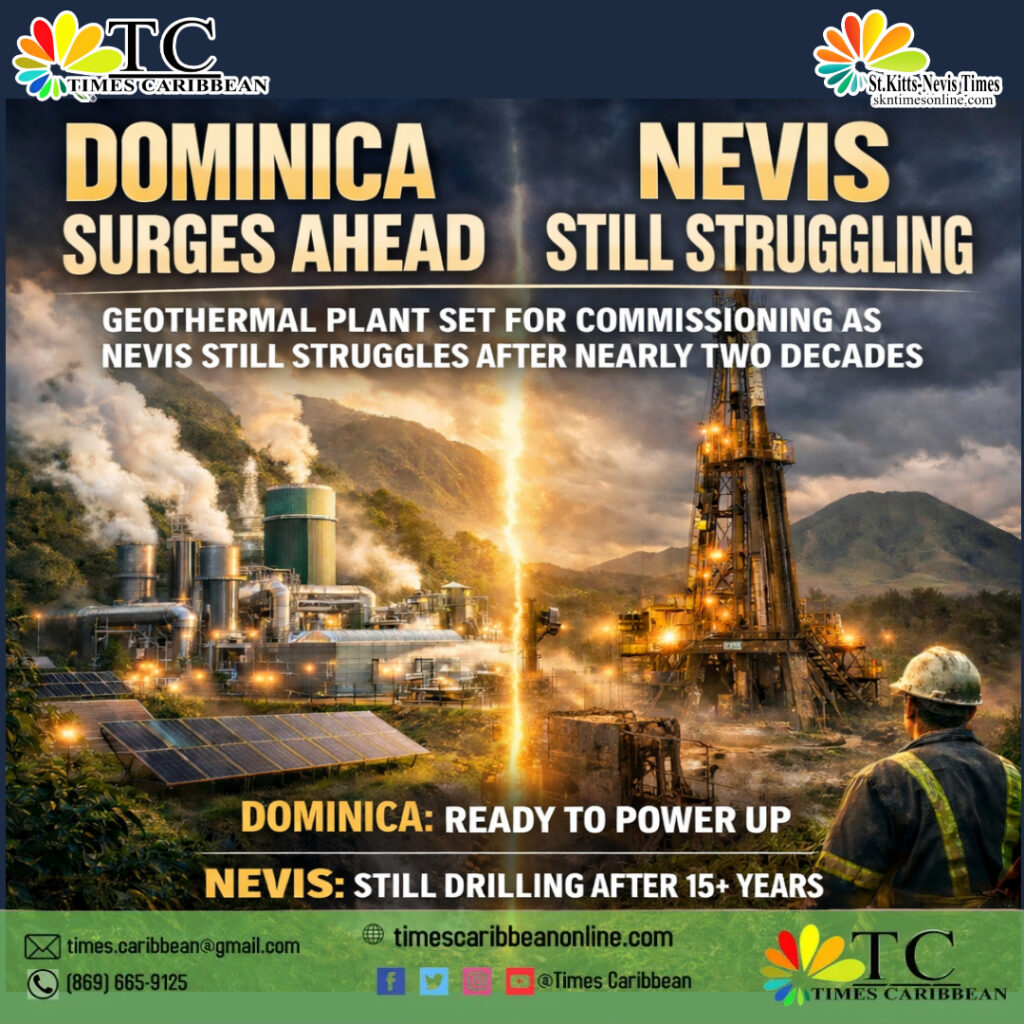
DOMINICA SURGES AHEAD: GEOTHERMAL PLANT SET FOR COMMISSIONING AS NEVIS STILL STRUGGLES AFTER NEARLY TWO DECADES
By Times Caribbean Investigative Desk
In a development that is sending shockwaves across the Eastern Caribbean energy sector, Dominica is poised to commission its long-awaited geothermal power plant within weeks—while Nevis, which began drilling three years earlier, remains stuck in the exploration phase nearly two decades later.
The contrast has ignited renewed debate across the region about leadership, project management, and missed economic opportunities as Dominica prepares to flip the switch on a 10-megawatt geothermal power facility valued at approximately US$34.8 million, while the Nevis geothermal project—once considered the region’s pioneer—continues to drill wells with no commercial plant in sight.
Dominica Ready to Deliver Renewable Power
Prime Minister Roosevelt Skerrit confirmed this week that the Laudat Geothermal Energy Plant has successfully completed critical testing phases and is now on track to be formally commissioned by the end of March 2026.
“The plant is operational, and we have been going through the testing phases for the last several weeks,” Skerrit told reporters.
“I believe we will be in a position to commission the plant by the end of March. From all reports, it has been successfully tested and we look forward to the Dominican people benefiting from this investment.”
The facility will produce 10 megawatts of baseload renewable electricity, positioning Dominica to significantly reduce its reliance on imported fossil fuels and stabilize electricity prices for consumers.
When operational, the project will become only the second geothermal plant in the OECS and the first major geothermal power facility in the CARICOM region, placing Dominica firmly at the forefront of Caribbean renewable energy innovation.
A Race That Began With Nevis in the Lead
The impending commissioning in Dominica is particularly striking when the timeline of the two projects is examined.
Nevis actually started drilling earlier.
- 2004 – Regional geothermal exploration initiative launched under an Organization of American States (OAS) framework.
- January 2008 – Nevis drills its first geothermal exploration wells, becoming one of the earliest islands in the region to pursue geothermal energy seriously.
- 2011 – Dominica drills its first exploration well, three years after Nevis.
At the time, Nevis was widely viewed as the regional leader in geothermal development, with strong optimism that the island could become a renewable energy powerhouse capable of exporting electricity to neighbouring islands.
Nearly 20 years later, however, that promise remains largely unrealized.
Nevis Still Drilling Wells
Despite early exploration success, the Nevis geothermal initiative has moved forward in fits and starts.
Additional drilling campaigns were carried out in 2017 and again in 2023, with further production wells reportedly continuing into 2026. Yet the project has still not reached the stage of constructing a commercial geothermal power plant.
Energy analysts note that while geothermal development is complex and capital-intensive, the length of time taken in Nevis is increasingly difficult to justify, especially when compared with Dominica’s progress.
“Dominica started three years later but will be producing electricity first,” one regional energy consultant told Times Caribbean.
“That comparison raises serious questions about policy continuity, financing strategy, and execution.”
Dominica’s Strategic Momentum
Dominica’s project has been driven by sustained international partnerships and financing arrangements involving multilateral institutions, development banks, and bilateral partners.
The government framed geothermal energy as a central pillar of its long-term energy independence strategy, enabling the country to transition from diesel-based electricity generation to renewable baseload power.
The Laudat plant is expected to:
- Reduce electricity costs over time
- Strengthen energy security
- Lower carbon emissions
- Create the possibility of exporting electricity to neighbouring islands in the future
For a small island state highly vulnerable to climate change, geothermal energy represents what officials describe as “a transformative economic and environmental opportunity.”
Missed Opportunity for Nevis?
For Nevis, the situation is more complicated.
For years, the island has been promoted as possessing one of the Caribbean’s most promising geothermal reservoirs, capable of generating significantly more electricity than the island itself consumes.
At various times, officials proposed exporting geothermal electricity to St. Kitts and potentially other neighbouring islands via submarine cables, creating a renewable energy hub.
Yet progress has repeatedly slowed due to financing challenges, changing partnerships, regulatory complexities, and technical hurdles.
Critics argue that the delays have cost Nevis valuable regional leadership in geothermal energy, allowing Dominica to leap ahead.
A Regional Energy Turning Point
Dominica’s imminent commissioning is expected to mark a historic milestone for renewable energy in the Eastern Caribbean, demonstrating that geothermal power—long discussed but rarely realized in the region—can move from theory to reality.
The development also underscores a stark reality:
The island that started later is about to generate electricity first.
As Dominica prepares to inaugurate its geothermal plant within weeks, attention is now turning toward Nevis with a pressing question increasingly being asked across the Caribbean energy community:
How did a three-year head start turn into a nearly two-decade delay?
For many observers, the answer may determine whether Nevis can still reclaim its once-promised role as the geothermal powerhouse of the Caribbean—or remain a project perpetually “still drilling.”
















Leave a comment
You must be logged in to post a comment.