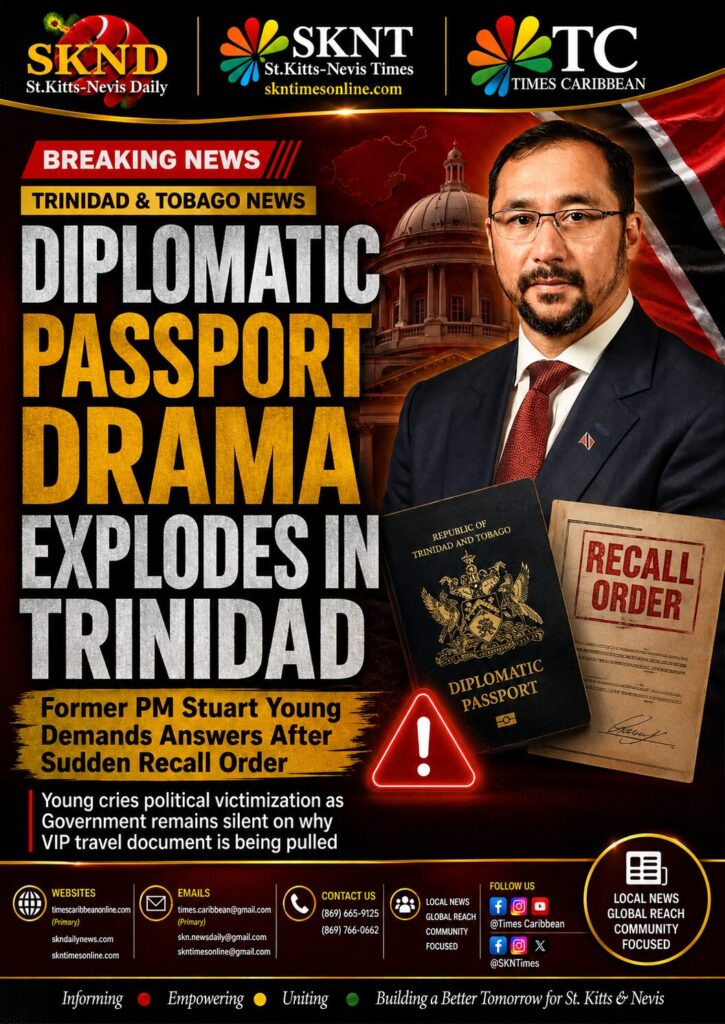
DIPLOMATIC PASSPORT DRAMA EXPLODES IN TRINIDAD: Former PM Stuart Young Demands Answers After Sudden Recall Order
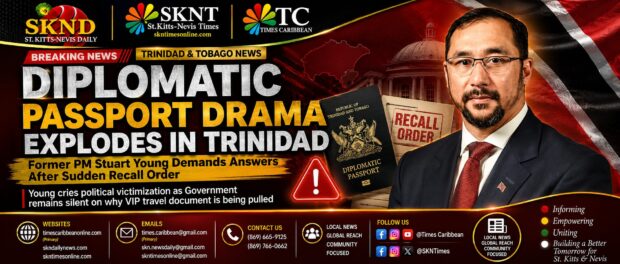
Young cries political victimization as Government remains silent on why VIP travel document is being pulled
PORT OF SPAIN, Trinidad and Tobago — Trinidad and Tobago’s already tense political climate has been jolted by another dramatic controversy, after former Prime Minister Stuart Young revealed that he received an unexpected call instructing him to return his diplomatic passport — a document he says he never requested, but was automatically issued to him after he left office.
According to Guardian Media, Young said in a social media video that the diplomatic passport was given to him on May 2, 2025, shortly after he demitted office following the April 2025 General Election. He reportedly said he received the call “out of the blue” and was told to return the document, but has asked that the request be made formally in writing before he takes any further action.
The former prime minister, who served just 42 days in office, framed the passport recall as the latest chapter in what he describes as a broader pattern of political victimization. Young did not identify who made the call, and there has been no public explanation from the Government stating why the diplomatic passport is being requested back.
For many observers, the silence is now louder than the request itself.
The controversy comes less than a year after Parliament amended the Prime Minister’s Pension legislation, introducing a minimum one-year service requirement and retroactively disqualifying Young from receiving a former prime minister’s pension. The Guardian reported that Young served from March 17 to April 28, 2025, and that the amended law applied retroactively from March 10, 2025.
That move had already triggered fierce debate over whether the Government was acting in the public interest or targeting a political opponent. Now, with the diplomatic passport issue erupting, critics are asking whether the country is witnessing legitimate administrative correction — or the continued stripping away of privileges associated with the office Young briefly held.
The stakes are not merely personal. Diplomatic passports are symbols of state status, access, and official recognition. While available reporting notes that there is no specific law guaranteeing former prime ministers the right to retain diplomatic passports after leaving office, the sudden nature of the request has raised questions about process, transparency, and political optics.
Young’s position is clear: put it in writing, state the authority, and explain the reason.
That demand has intensified public debate online, with many citizens arguing that if the Government has a lawful basis for recalling the passport, it should simply say so. Others contend that diplomatic passports should not be treated as lifetime entitlements and that public office should not automatically translate into permanent state privileges.
But the timing has sharpened suspicion. In July 2025, Guardian Media also reported that Young’s Special Branch security detail was pulled after the pension controversy, with a senior Cabinet official saying the detail would have ended three months after he left office and that threat assessments found no need for it to continue.
Taken together, the pension amendment, security withdrawal, and now the diplomatic passport recall have created a politically explosive narrative: a former prime minister claiming he is being targeted, and a Government yet to clearly explain the latest move in a way that satisfies public concern.
For the Kamla Persad-Bissessar administration, the issue is now bigger than Stuart Young. It is about whether state power is being exercised with transparency, consistency, and fairness — or whether political opponents can be left to learn of major decisions through sudden phone calls with no written explanation.
Until the Government provides a clear public statement, the controversy will continue to feed speculation, deepen partisan tensions, and raise uncomfortable questions about how Trinidad and Tobago treats former holders of its highest political office.
For now, Young still appears to be holding the passport — and the Government is holding back the explanation.
















Leave a comment
You must be logged in to post a comment.