COMMENTARY:“What Did Ellie Matt Do for St. Kitts?” Here Goes…
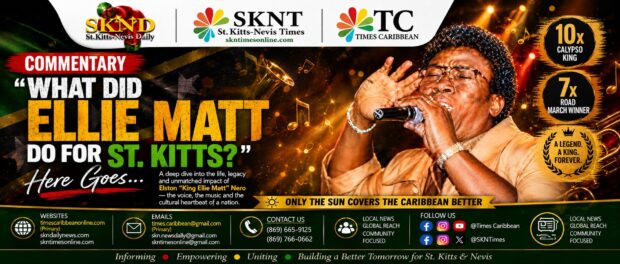
COMMENTARY
“What Did Ellie Matt Do for St. Kitts?” Here Goes…
Every now and again, a question is asked that reveals not only a gap in knowledge, but a gap in national memory. Someone recently asked: “What did Ellie Matt do for St. Kitts?”
It is a question that deserves an answer — not in anger, but in full. Not with shallow emotion, but with evidence, context, history and cultural truth.
So here goes.
Elston “King Ellie Matt” Nero did not merely sing songs. He helped give St. Kitts and Nevis a sound, a rhythm, a confidence, a Carnival identity and a cultural voice that travelled far beyond our 68 square miles. He was not just an entertainer on a stage. He was a national institution in motion — a self-taught musical force whose genius became part of the emotional architecture of a people.
To ask what Ellie Matt did for St. Kitts is like asking what a national anthem does for a country. It may not build a road, pave a sidewalk or sign a government cheque. But it builds something deeper. It builds memory. It builds identity. It tells a people who they are, where they came from, what they survived, what they laugh about, what they celebrate and what they refuse to forget.
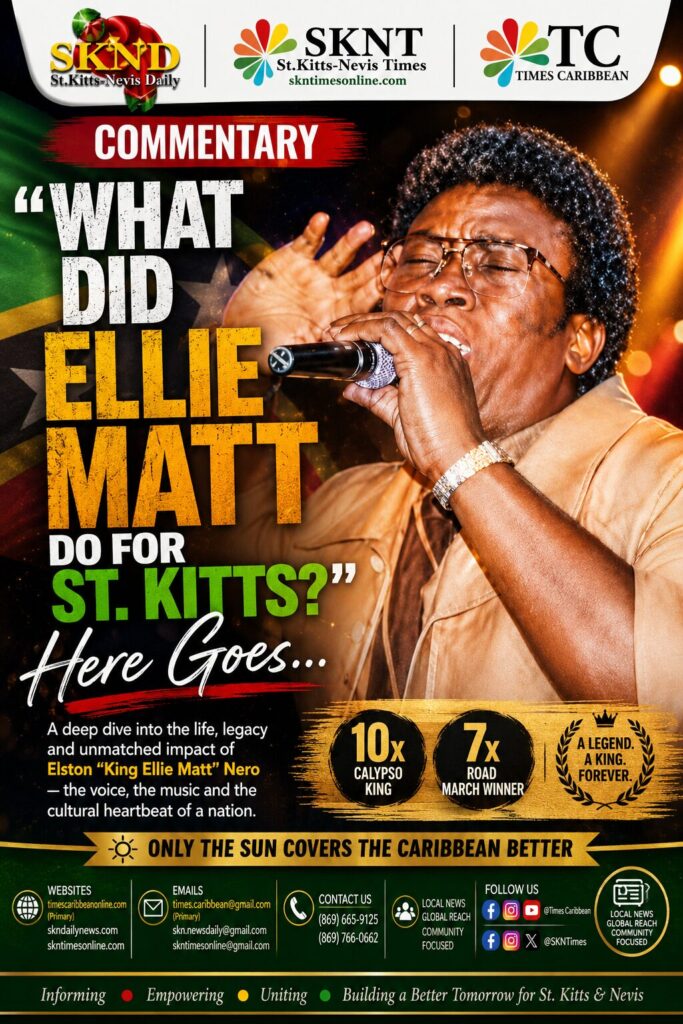
Ellie Matt’s contribution must first be measured in excellence. He was a ten-time National Calypso King and a seven-time Road March Champion. These were not casual titles handed out for popularity. These were hard-earned victories in one of the Caribbean’s toughest cultural arenas — a space where lyrical wit, melody, stagecraft, social commentary, crowd command and originality all collide under pressure.
To dominate that arena once is an achievement. To do it repeatedly across different years, different moods, different political climates and different generations is legacy.
Ellie Matt was not a one-season wonder. He was sustained brilliance.
His Calypso King crowns came across the 1970s, 1980s and into the early 1990s — a span that shows not a flash of talent, but an era of influence. His Road March victories prove something equally important: he did not only impress judges; he moved the people. His music left the tent and took over the streets. It became the soundtrack of Carnival, the engine of jump-up, the pulse of national celebration.
That is not ordinary.
That is cultural power.
Then there was Ellie Matt and the GI’s Brass — a band that helped define the sound of St. Kitts and Nevis for more than two decades. In an age before social media virality, before instant streaming, before online promotion and algorithm-driven fame, Ellie Matt built a brand through sheer musicianship, live performance, discipline, creativity and public love.
The GI’s Brass was more than a band. It was a cultural machine. It gave St. Kitts a big-band sound that could stand proudly alongside the best of the Caribbean. It carried local music to stages across the region and beyond. It helped prove that St. Kitts was not merely a consumer of Caribbean culture, but a producer of it.
And that point matters.
Small island nations often struggle against invisibility. Our population size means we are easily overlooked. Our artists must fight harder to be heard. Our stories are often swallowed by the louder cultural industries of bigger islands. Ellie Matt pushed back against that. He made St. Kitts louder. He made St. Kitts more visible. He made St. Kitts dance to its own sound.
That is what Ellie Matt did for St. Kitts.
He gave us songs that were not just seasonal entertainment, but cultural documents. Through calypso, he helped preserve the national mood. Calypso has always been more than music. It is newspaper, parliament, comedy club, street court, history book and village square rolled into one. The calypsonian is not merely a singer. He is observer, critic, storyteller, historian, comedian and philosopher.
Ellie Matt understood that role.
His songs captured patriotism, social life, politics, celebration, humour, everyday struggle and national pride. When he sang of St. Kitts, he did not sing like a tourist admiring scenery. He sang like a son of the soil carrying the weight, wit and warmth of the people in his voice.
That is why his music endured.
A hit song can fade after Carnival. A true cultural anthem stays in the blood. Ellie Matt produced music that people remembered not because they were forced to, but because the songs became part of weddings, fetes, radio mornings, village memories, family gatherings, overseas nostalgia and Carnival history.
For Kittitians and Nevisians abroad, his music carried home across oceans. In New York, London, Toronto, St. Thomas, Tortola, Anguilla, Antigua and beyond, Ellie Matt’s sound reminded nationals who they were. For the diaspora, his music was not just entertainment. It was emotional geography. It was Basseterre in a speaker. It was Newtown, Cayon Street, Fort Street, Carnival Village, Bay Road, the pasture, the playing field and the village shop all coming alive again.
That is what culture does when it is real.
Ellie Matt also gave St. Kitts something that cannot be easily quantified: pride. He showed that local talent did not have to imitate greatness from elsewhere. It could be greatness. It could be original, commanding, disciplined and exportable. He demonstrated that a musician from St. Kitts could be a maestro, a bandleader, a composer, an arranger, an instrumentalist and a regional icon.
He was reportedly self-taught, yet mastered multiple dimensions of music. That is important for young people to understand. Ellie Matt’s story is not only about fame. It is about discipline. It is about craft. It is about practice. It is about turning raw talent into national service. He did not simply stand in front of a microphone. He built arrangements, led musicians, shaped sound, wrote songs, commanded stages and created moments that outlived the night.
There is a lesson in that.
In a modern era where visibility is often confused with value, Ellie Matt’s career reminds us that legacy is not built by noise alone. Legacy is built by contribution. It is built by showing up again and again. It is built by excellence repeated until it becomes history.
And history is exactly what Ellie Matt became.
His influence went beyond Carnival. He helped shape the cultural economy before we even used that phrase seriously. Long before “creative industry” became a policy buzzword, artists like Ellie Matt were proving that music could generate movement, business, tourism, national attention, community pride and social energy. Every packed show, every Carnival crowd, every overseas performance, every radio replay, every band engagement and every cultural tribute formed part of a larger economy of identity.
The hotels, bars, promoters, taxi operators, vendors, costume makers, event organizers, broadcasters and communities all benefited from the cultural atmosphere that artists like Ellie Matt helped create.
So what did Ellie Matt do for St. Kitts?
He helped sell St. Kitts to itself.
He helped make Carnival feel like Carnival.
He helped transform local stages into national temples of expression.
He helped make music one of the strongest bridges between home and diaspora.
He helped prove that the Federation’s culture was not small, even if the islands were.
He helped raise the standard for live performance.
He helped inspire generations of musicians, calypsonians, bandleaders, performers and cultural workers.
He helped give St. Kitts and Nevis a musical identity that was confident, joyful, witty, fearless and unmistakably its own.
That is not a small contribution. That is nation-building.
Too often, we reduce national development to concrete, asphalt, buildings and budgets. Those things matter. But a nation is not only built by engineers, politicians, bankers and contractors. A nation is also built by artists. A people without culture may have infrastructure, but they do not have soul. A country without music may have borders, but it does not have heartbeat.
Ellie Matt gave St. Kitts heartbeat.
When the Government of St. Kitts and Nevis accorded him an Official Funeral, it was not merely honouring a singer. It was acknowledging a lifetime of national service through culture. It was recognizing that some citizens serve not by holding office, but by holding the spirit of the people in song.
That recognition was appropriate because Ellie Matt’s life was a public contribution. He belonged to his family, yes. He belonged to Newtown, yes. He belonged to the calypso fraternity, yes. But in a larger sense, he belonged to the national story.
His name became part of our shared vocabulary. His music became part of our public celebrations. His voice became part of our collective memory.
There is hardly a Kittitian or Nevisian alive who has never heard the name Ellie Matt. That alone says something profound. Very few people become so deeply woven into the consciousness of a nation that their name crosses class, party, parish, generation and geography. Ellie Matt did.
That is impact.
That is legacy.
That is what he did for St. Kitts.
He made us sing louder. He made us celebrate harder. He made us laugh at ourselves, believe in ourselves, dance with ourselves and remember ourselves. He carried our accent, our humour, our politics, our pride and our pulse into song. He turned ordinary Carnival seasons into historic memories. He gave the people music they could own.
And perhaps that is the greatest answer of all.
Ellie Matt did not just perform for St. Kitts.
He helped St. Kitts hear itself.
















Leave a comment
You must be logged in to post a comment.