Caribbean’s Most Corrupt Countries Revealed: Haiti, Belize, Dominican Republic, Suriname and Guyana Rank Lowest on 2025 Corruption Perceptions Index
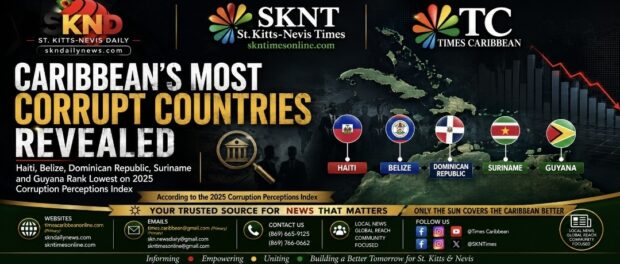
Haiti, Belize, Dominican Republic, Suriname and Guyana Rank Among Caribbean’s Lowest-Scoring Countries on 2025 Corruption Perceptions Index
Transparency International’s latest CPI places Haiti at the bottom of the Caribbean table, while Barbados, The Bahamas and St. Vincent and the Grenadines remain among the region’s strongest performers
TIMES CARIBBEAN ANALYSIS — The latest Corruption Perceptions Index (CPI) from Transparency International paints a sobering picture of governance, accountability and institutional trust across parts of the Caribbean, with Haiti again standing as the region’s lowest-scoring country and one of the lowest-ranked countries globally.
The 2025 CPI, published by Transparency International, ranks 182 countries and territories based on perceived levels of public-sector corruption. The index uses a scale from 0 to 100, where 0 represents very high perceived corruption and 100 represents very low perceived corruption.
Importantly, the CPI does not measure proven corruption cases, nor does it declare that every public official or institution in a country is corrupt. Rather, it reflects perceptions of public-sector corruption based on expert assessments and business surveys. Still, because the index is globally recognized and comparable across countries, it remains one of the most influential tools used by investors, civil society, policymakers and international institutions to assess governance risk.
Caribbean Countries With the Lowest CPI Scores
Based on the latest available CPI data, the lowest-scoring Caribbean and Caribbean-linked countries are:
| Caribbean Ranking by Lowest Score | Country | CPI Score 2025 | Global Rank |
|---|---|---|---|
| 1 | Haiti | 16 | 169 |
| 2 | Belize | 36 | 104 |
| 3 | Dominican Republic | 37 | 99 |
| 4 | Suriname | 38 | 96 |
| 5 | Guyana | 40 | 84 |
| 5 | Cuba | 40 | 84 |
| 7 | Trinidad and Tobago | 41 | 81 |
| 8 | Jamaica | 44 | 73 |
On the stronger end of the Caribbean table, Barbados remains the region’s best performer with a score of 68, followed by The Bahamas at 64, St. Vincent and the Grenadines at 63, Dominica at 60, Saint Lucia at 59 and Grenada at 56.
Haiti: The Caribbean’s Most Troubling CPI Case
Haiti’s score of 16 places it not only at the bottom of the Caribbean but also among the lowest-ranked countries in the world. The country’s CPI score reflects deep international concern about fragile institutions, weak accountability systems, political instability and the long-running governance crisis that has affected state capacity.
Transparency International’s Americas analysis also identifies Haiti among the lowest-scoring countries in the wider hemisphere, alongside Venezuela and Nicaragua. That regional context matters: Haiti’s governance crisis is not simply a domestic political problem. It is a regional security, humanitarian and institutional challenge with implications for migration, public safety, border management, development finance and the credibility of democratic governance in the wider Caribbean basin.
For Haiti, the corruption perception challenge is inseparable from the collapse of public trust. When public institutions are unable to deliver security, justice, basic services and transparent administration, citizens become more vulnerable to informal power networks, political patronage and non-state actors. In that environment, corruption is not only about missing money. It becomes a system of survival, access and control.
Belize, Dominican Republic and Suriname: The Middle-Low Governance Band
Belize, the Dominican Republic and Suriname occupy a difficult middle-low zone in the Caribbean corruption perception landscape.
Belize, with a score of 36, appears in the CPI table as a newly listed or newly scored country for this cycle, making long-term comparison more difficult. Its placement, however, immediately puts it among the lower-scoring Caribbean countries and raises questions about public procurement, institutional oversight, political financing, regulatory enforcement and administrative transparency.
The Dominican Republic, scoring 37, presents a more complex case. Its score remains low by global standards, but the country has also shown signs of measurable improvement over the longer term. This creates a paradox: the Dominican Republic remains among the Caribbean’s lower-scoring countries, yet it is also one of the few countries in the Americas that Transparency International has identified as having significantly improved over the longer period.
That distinction is important. A country can still face serious corruption perception challenges while moving in the right direction. In the Dominican Republic’s case, reforms linked to prosecutorial independence, anti-corruption investigations, public-sector modernization and greater scrutiny of political institutions appear to have contributed to improved perception, even though the country remains far from the higher-performing Caribbean group.
Suriname, with a score of 38, also remains below the 50-point threshold, which is widely seen as a warning line for countries still struggling to demonstrate robust control of public-sector corruption. Suriname’s position reflects concerns common to resource-rich small states: political patronage, public finance management, procurement transparency, and the governance of natural resources and state-linked economic activity.
Guyana: Improved, but Still Under the Global Average
Guyana’s CPI score of 40 is especially significant because it comes at a time when the country is experiencing one of the fastest economic transformations in the world due to its oil and gas boom.
Transparency International’s Americas analysis notes that Guyana is among the few countries in the region to have significantly improved over the longer period. That is important and should not be dismissed. However, the fact that Guyana still scores only 40 shows that improvement has not yet translated into strong global confidence in public-sector integrity.
For Guyana, the stakes are exceptionally high. Oil wealth can transform public services, infrastructure, education, healthcare and national savings. But without strong oversight, transparent procurement, open beneficial ownership records, independent audits, credible parliamentary scrutiny and protection for media and civil society, resource wealth can also intensify corruption risks.
The issue for Guyana is therefore not whether the country is improving. The issue is whether institutional reform can keep pace with the scale of national wealth now flowing through the state.
Trinidad and Tobago and Jamaica: Stable, but Still Below 50
Trinidad and Tobago scored 41, while Jamaica scored 44. Both countries remain below 50, placing them in a category where public-sector corruption perceptions continue to represent a serious governance concern.
Jamaica’s score of 44 is unchanged from the previous year, suggesting stability but not breakthrough progress. Jamaica has made strides in some areas of accountability and public-sector reform, but repeated public concerns around political integrity, procurement, policing, public boards and misuse of public resources continue to shape perception.
Trinidad and Tobago’s score of 41 also remains unchanged. For one of the Caribbean’s largest and most industrialized economies, this score signals persistent concerns about public trust, procurement systems, state enterprises, political financing, contract awards and the effectiveness of accountability institutions.
In both countries, the deeper issue is not the absence of laws. It is enforcement, consistency and consequence. Caribbean countries often have integrity commissions, audit offices, procurement rules, parliamentary committees and anti-corruption statutes. The problem is that citizens frequently perceive these systems as slow, politically constrained, under-resourced or selectively enforced.
The Stronger Caribbean Performers
At the top of the Caribbean table, Barbados remains the region’s best performer with a score of 68. The Bahamas follows at 64, St. Vincent and the Grenadines at 63, Dominica at 60, Saint Lucia at 59 and Grenada at 56.
These scores suggest comparatively stronger perceptions of institutional integrity, but they should not be read as a declaration of perfection. Transparency International itself warns that even higher-scoring countries can still have serious integrity vulnerabilities, including secrecy loopholes, weak political finance rules, offshore financial risks, and insufficient enforcement against sophisticated forms of corruption.
For small island states, the corruption challenge can look different from that of larger countries. It may not always appear as large-scale scandal. It may appear through conflicts of interest, political favoritism, opaque land deals, weak tendering practices, board appointments, public-sector hiring, discretionary concessions, or lack of timely disclosure.
Why the CPI Matters for the Caribbean
For the Caribbean, the CPI is more than a ranking. It is a development signal.
Low corruption perception scores can affect investor confidence, access to development finance, international reputation, public trust and the willingness of citizens to comply with institutions. They can also weaken the social contract, especially when citizens believe that opportunity depends more on political connection than merit, transparency or fairness.
The Caribbean’s development model depends heavily on trust. Tourism depends on trust. Citizenship by investment programmes depend on trust. Banking and offshore financial services depend on trust. Public-private partnerships depend on trust. Climate finance depends on trust. When corruption perceptions rise, the cost of doing business increases and the credibility of the state declines.
The CPI also matters because Caribbean governments are now managing more complex financial flows than ever before: climate resilience funding, infrastructure loans, health-sector investments, digital transformation projects, national security spending, public-private partnerships, and in Guyana’s case, major petroleum revenues. Without strong governance, these opportunities can become new corruption risks.
The Region’s Core Governance Challenge
The Caribbean’s corruption perception problem is not simply about individual misconduct. It is structural.
Across the region, recurring concerns include weak campaign finance transparency, slow justice systems, limited whistleblower protection, politicized public appointments, insufficient procurement transparency, inadequate asset disclosure enforcement, and limited access to timely public information.
In many Caribbean states, the small size of society also complicates accountability. Political, family, business and social relationships are often deeply interconnected. This can make conflicts of interest harder to avoid and harder to expose. It can also discourage whistleblowers, journalists and public officers from challenging questionable decisions.
That is why anti-corruption reform in the Caribbean must go beyond speeches and slogans. It requires enforceable systems.
What Reform Should Look Like
A serious Caribbean anti-corruption agenda should include stronger public procurement laws, real-time publication of major government contracts, enforceable campaign finance rules, independent audit institutions, stronger parliamentary oversight, effective whistleblower protection, beneficial ownership transparency, modern freedom of information systems, and better protection for journalists and civil society watchdogs.
It should also include cultural change within government. Public office must be treated as a public trust, not a political reward system. State boards, statutory bodies and government corporations must be governed by competence, transparency and accountability, not partisan loyalty.
The Bottom Line
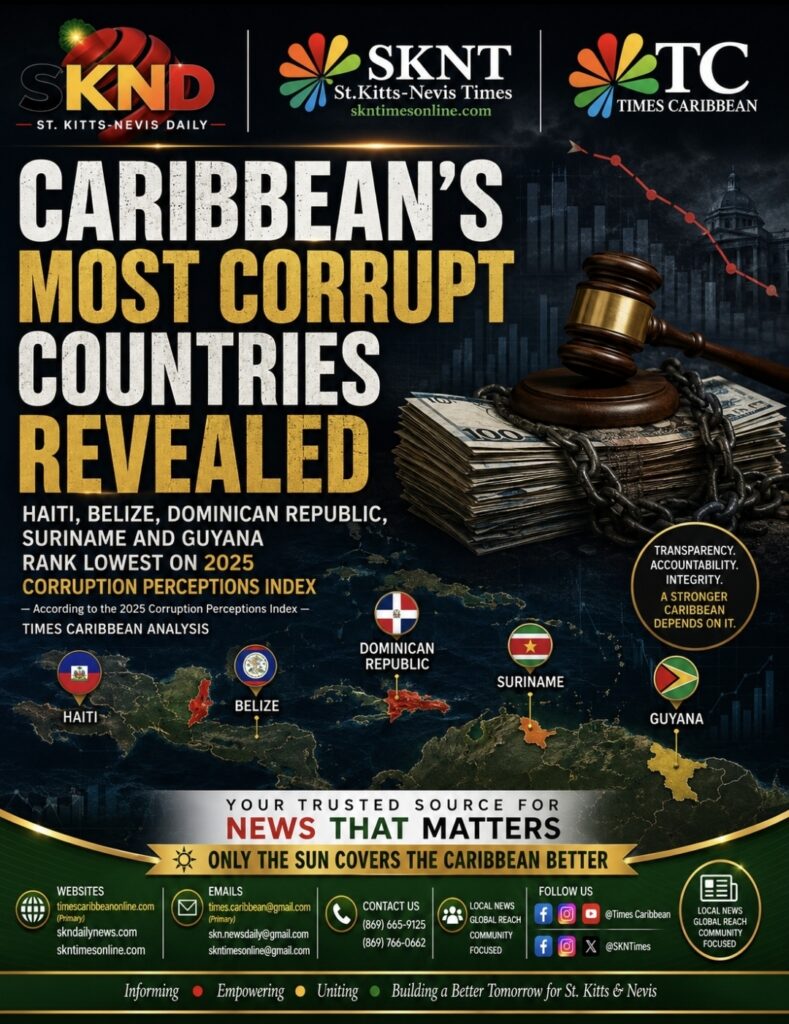
According to the 2025 Corruption Perceptions Index, Haiti remains the Caribbean’s lowest-scoring country by a wide margin, followed by Belize, the Dominican Republic, Suriname, Guyana, Cuba, Trinidad and Tobago, and Jamaica among the region’s lower-ranked performers.
But the story is not only about rankings. It is about the future of governance in the Caribbean.
The countries that strengthen transparency, protect independent oversight, modernize procurement, enforce accountability and protect civic space will be better positioned to attract investment, manage public resources and maintain public trust.
The countries that fail to do so risk more than a poor score on an international index. They risk weakening the very institutions needed to deliver prosperity, justice and stability for their people.
















Leave a comment
You must be logged in to post a comment.