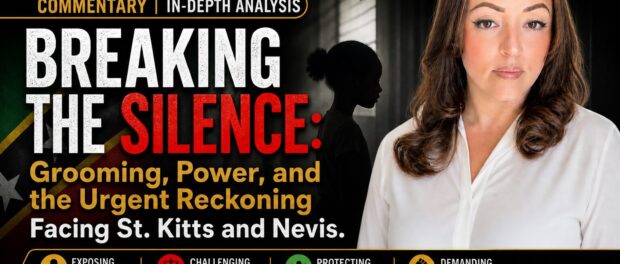
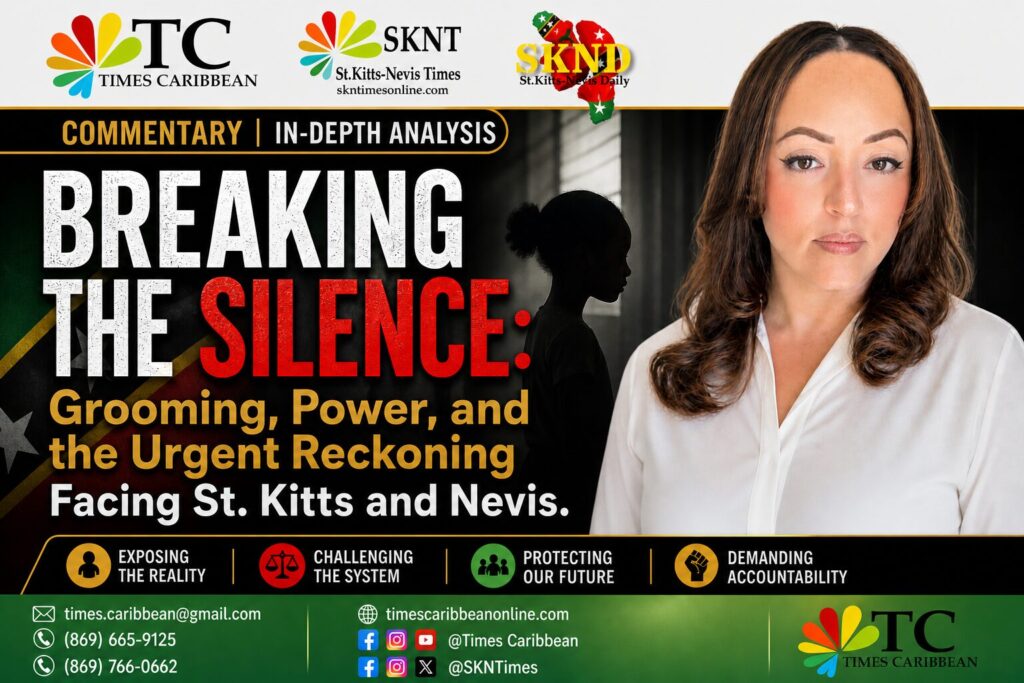
BREAKING THE SILENCE: Grooming, Power, and the Urgent Reckoning Facing St. Kitts and Nevis
TIMES CARIBBEAN | ST. KITTS-NEVIS DAILY
SPECIAL REPORT | IN-DEPTH ANALYSIS
A deeply unsettling commentary by mental health advocate Laura W. has ignited renewed national and regional debate about the alleged normalization of grooming and predatory relationships involving minors in St. Kitts and Nevis—and, more broadly, across parts of the Caribbean.
Her words are not subtle. They are not cautious. They are meant to disrupt.
And they have.
A Culture Under Scrutiny
At the center of the conversation is a disturbing claim: that predatory behavior toward minors has, in some instances, become normalized within segments of society.
Laura W references a chilling phrase—“anything past 12 is lunch”—allegedly used among predators. Whether anecdotal or reflective of a wider underground mindset, its mere existence has provoked outrage, disbelief, and, for many, painful recognition.
Her broader argument is not that such behavior defines the society—but that silence, complicity, and normalization have allowed it to persist in the shadows.
This is where the issue becomes less about isolated incidents and more about systemic failure.
Grooming: Hidden in Plain Sight
Grooming is not always violent. It is often subtle, calculated, and manipulative.
It can look like:
- Gifts: food, phone credit, clothing
- Emotional attention and validation
- Financial assistance to vulnerable families
- Strategic targeting of teenagers navigating identity and self-worth
Laura W’s account of nearly being groomed at age 16 reflects a pattern echoed quietly across communities—where vulnerability intersects with access, and where older individuals exploit both.
Critically, grooming thrives in environments where:
- There is limited sexual education
- Economic hardship creates dependency
- Emotional needs go unmet
- Adults fail to intervene
These are not abstract conditions—they are real socioeconomic factors present in many small island developing states.
The Silence of Adults: Complicity or Constraint?
One of the most pressing questions raised is not just why it happens—but why it is not stopped.
Why do adults who are aware of these relationships often remain silent?
The answers are complex:
- Fear of retaliation or social backlash
- Cultural norms that blur boundaries between adolescence and adulthood
- Distrust in law enforcement or the justice system
- Misguided beliefs that such relationships provide “opportunity” or financial support
More troubling are claims—still largely anecdotal but increasingly discussed—that some parents may enable or overlook such relationships due to economic pressures.
If true, this represents not just a legal issue, but a profound social crisis.
Victim-Blaming and Cultural Narratives
Another layer of the issue lies in how victims are treated.
Across parts of the Caribbean, discussions around underage relationships often devolve into:
- Scrutiny of the girl’s behavior or clothing
- Narratives suggesting “consent” where legal consent cannot exist
- Social stigmatization of victims rather than perpetrators
Laura W highlights a critical point: minors lack the psychological maturity, life experience, and power to engage in truly consensual relationships with adults.
The imbalance is structural. The harm is often long-term.
Mental Health Consequences: The Invisible Damage
The impact of grooming extends far beyond the initial interaction.
Survivors frequently experience:
- Long-term trauma and anxiety
- Distorted perceptions of relationships and self-worth
- Depression and emotional instability
- Difficulty forming healthy adult connections
Laura W’s framing of therapy as “deeply political” underscores a key reality: addressing trauma often requires confronting the cultural and societal norms that allowed it to occur.
In that sense, mental health work becomes not just healing—but resistance.
The Legal and Policy Gap
Calls for reform are growing louder.
Among the proposed measures:
- Harsher penalties for sexual offences involving minors
- A national sex offender registry
- Proximity restrictions preventing offenders from being near schools and youth spaces
- Stronger reporting mechanisms and protections for whistleblowers
- Comprehensive sex education and youth empowerment programs
While St. Kitts and Nevis has laws addressing sexual offences, critics argue enforcement gaps, cultural barriers, and limited public awareness weaken their effectiveness.
Legislation alone, however, is not enough.
A Cultural Turning Point?
What makes this moment significant is not just the allegation—but the openness of the conversation.
For years, these issues have existed in whispers—in schoolyards, communities, and private conversations.
Now, they are entering the public domain.
That shift matters.
Because cultural change begins with:
- Naming the problem
- Challenging normalization
- Protecting the vulnerable over preserving comfort
Laura W embraces the label “disruptor.” In many ways, disruption is exactly what this conversation demands.
The Way Forward: Beyond Outrage
Outrage alone will not solve this issue.
What is required is a coordinated, multi-sector response:
- Government leadership to strengthen laws and enforcement
- Educational reform to equip young people with knowledge and agency
- Community accountability to challenge harmful norms
- Parental engagement to protect rather than expose
- Mental health support systems to aid recovery and prevention
Most importantly, it requires a collective shift in mindset—from tolerance to zero tolerance.
ABOUT LAURA W.
Laura W. is a British-born Kittitian and citizen of St. Kitts and Nevis whose work is deeply rooted in service, healing, advocacy, and empowerment across the Caribbean community.
With an academic background in Caribbean history and psychology, and ongoing doctoral research, Laura brings a rare blend of cultural understanding, psychological expertise, lived experience, and scholarly insight to her work as a Caribbean-focused counsellor, high-performance strategist, consultant, and coach.
Her work is especially centered on women’s wellness, behavioural health, sexuality, spirituality, trauma, and empowerment. As a postgraduate researcher, she explores the intersections of Caribbean spirituality and female sexuality, challenging colonial narratives while honouring the lived realities of Caribbean women.
Laura is also the co-founder and CEO of Liamuiga Women’s Health and Oualie Men’s Health, two non-profit organisations dedicated to addressing health inequities and improving outcomes for men and women across the Caribbean diaspora.
Community remains the heartbeat of everything she does. Through her multidisciplinary expertise in psychology, history, sexuality, spirituality, and research, Laura offers a culturally grounded and academically rigorous approach to Caribbean wellness, healing, and behavioural health.
Conclusion
The claims raised are serious. They demand careful examination, evidence-based responses, and responsible national dialogue.
But they also force an uncomfortable question:
If even a fraction of this is true, what responsibility does society bear for allowing it to persist?
St. Kitts and Nevis now stands at a crossroads—not defined by accusation, but by how it chooses to respond.
Silence is no longer a viable option.
#ProtectYoungPeople #ProtectTeens #ProtectAdolescents #EndGrooming #TimesCaribbean
















Leave a comment
You must be logged in to post a comment.