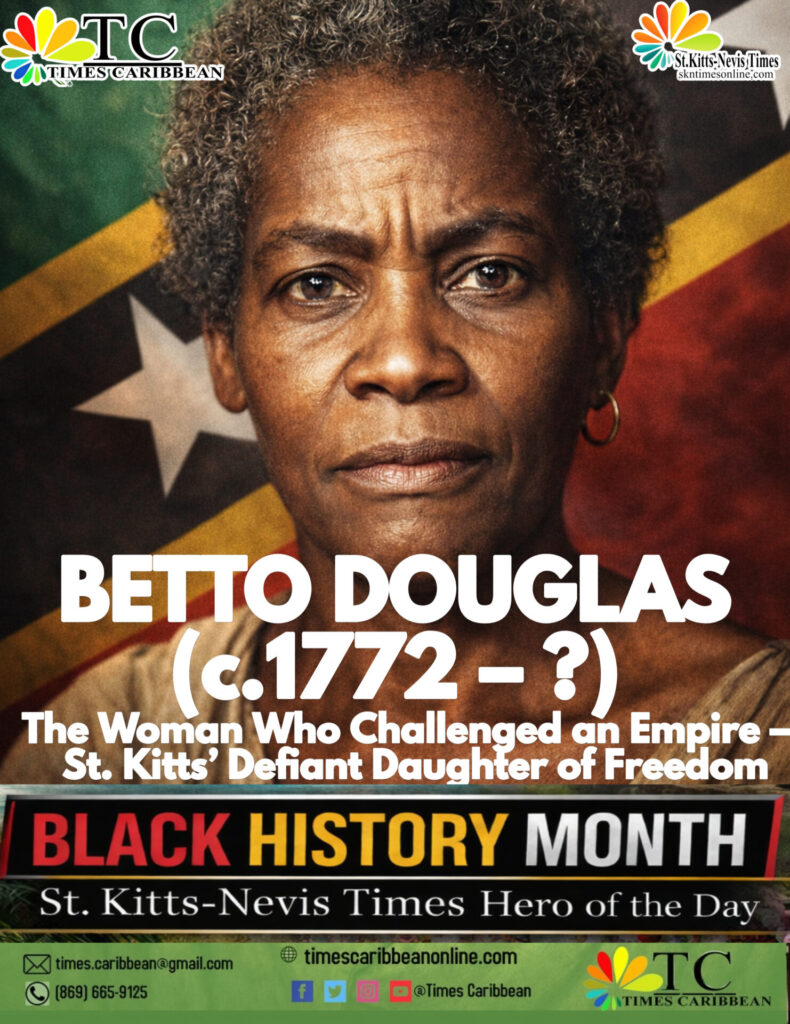
BETTO DOUGLAS (c.1772 – ?)The Woman Who Challenged an Empire — St. Kitts’ Defiant Daughter of Freedom
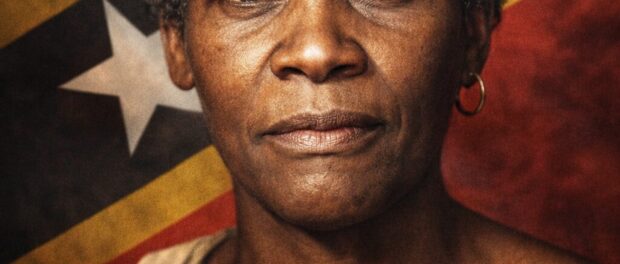
SKN TIMES | BLACK HISTORY MONTH – HERO OF THE DAY
BASSETERRE, ST. KITTS — Long before Emancipation became law in 1833, before proclamations were read and chains were legally struck off, there was a woman on the island of St. Kitts who dared to do the unthinkable.
She challenged slavery — not with weapons, but with words, petitions, law, and unbreakable resolve.
This Black History Month, SKN Times honors Betto Douglas, an enslaved woman whose resistance reverberated from Wingfield Manor Estate in Old Road to the halls of the British Colonial Office — and into the pages of global abolitionist history.
Born into Bondage, Refusing Submission
Betto Douglas was born around 1772 at Wingfield Manor Estate, the property of the absentee Earl of Romney. She was described in the 1817 Slave Register as a “mulatto woman,” aged forty-five, mother of two sons — Cleisby and Sawney Frazer.
But that bureaucratic entry — preserved today in Britain’s Central Slave Registries and enrolled in UNESCO’s Memory of the World Registry — tells only part of the story.
Betto was not merely listed.
She was resisting.
When John George Goldfrap, the estate’s agent, wrote to the Earl seeking permission for her manumission, it seemed freedom was within reach. The Earl agreed in principle. Instructions were allegedly sent to a new agent to arrange her emancipation.
But years passed.
Freedom did not come.
Punishment, Petition and Public Protest
Instead, under a new overseer, Richard Cardin, Betto’s life grew harsher.
She was hired out under strict financial conditions — forced to pay $3.50 per month for housing and rations. When she fell into arrears, she was punished. She testified that food was withheld. She was placed in the stocks — for six months.
Not days.
Not weeks.
Six months.
Yet she refused to steal. Refused prostitution. Refused crime.
Instead, she petitioned.
In 1825, Betto Douglas brought her grievances before Governor Charles William Maxwell. Her testimony described lashes, confinement, and intimidation. Cardin confirmed parts of her punishment but framed it as discipline.
The grand jury ruled against her. She was declared insubordinate.
Governor Maxwell privately acknowledged her treatment was illegal under British law — but “customary” in St. Kitts.
That single contradiction captures the brutality of colonial logic:
Illegal — yet acceptable.
Unjust — yet enforceable.
From Old Road to the World Stage
Refusing silence, Betto took her case further.
By 1827, abolitionist societies in Britain had begun covering her ordeal. The Anti-Slavery Reporter in London amplified her story. South African abolitionist Thomas Pringle wrote about her struggle in the Anti-Slavery Record.
Her name traveled across the Atlantic.
The Female Society for the Relief of British Negro Slaves even raised funds in 1830 to purchase her freedom. The request was denied.
She was again confined to the stocks — this time for six months and eleven days.
Betto Douglas was not simply enduring slavery.
She was exposing it.
The Legal Paradox of Slavery
Her case illuminates a disturbing truth: even when enslaved persons used the legal system, the system was structured against them.
Douglas understood economics. She understood contracts. She understood that she had been promised manumission. Her petitions reveal familiarity with legal principles that colonial courts chose to ignore.
British law theoretically prohibited excessive punishment. Yet local custom permitted it. Her case was treated not as a violation of rights — but as a nuisance complaint.
It was this legal hypocrisy that abolitionists seized upon. Betto became living evidence that reform was insufficient. Slavery itself had to end.
Freedom at the Eleventh Hour
In 1833 — just three months before the passage of the Abolition Act — Betto Douglas was finally granted manumission.
She did not live to see immediate freedom for all. But her persistence had already shaken the moral foundations of empire.
Her resistance demonstrated that enslaved women were not passive victims. They were thinkers. Strategists. Petitioners. Legal challengers.
A National Icon of Resistance
Today, Betto Douglas stands as one of the most powerful symbols of resistance in St. Kitts and Nevis.
Her story is featured at the National Museum of St. Kitts and Nevis. Her name is preserved in Britain’s archives. Her legal struggle remains studied by historians examining Caribbean slavery and abolitionist networks.
She was neither politician nor general.
She commanded no army.
She possessed no vote.
But she possessed courage — and that changed history.
Why Betto Douglas Matters Today
Her life forces uncomfortable questions:
• How often did “custom” override justice?
• How many promises of manumission were delayed indefinitely?
• How many voices were silenced because courts prioritized property over humanity?
Betto Douglas refused to accept that contradiction.
Her resistance was not loud rebellion.
It was strategic defiance.
And that defiance traveled across oceans.
SKN TIMES BLACK HISTORY MONTH HERO OF THE DAY
Betto Douglas
The Enslaved Woman Who Took on an Empire — and Forced It to Answer.
She stood in the stocks.
She stood before governors.
She stood before history.
And she never bowed.
Her legacy is a reminder that freedom was not gifted.
It was demanded.
Petitioned.
Argued.
And fought for — one voice at a time.
















Leave a comment
You must be logged in to post a comment.