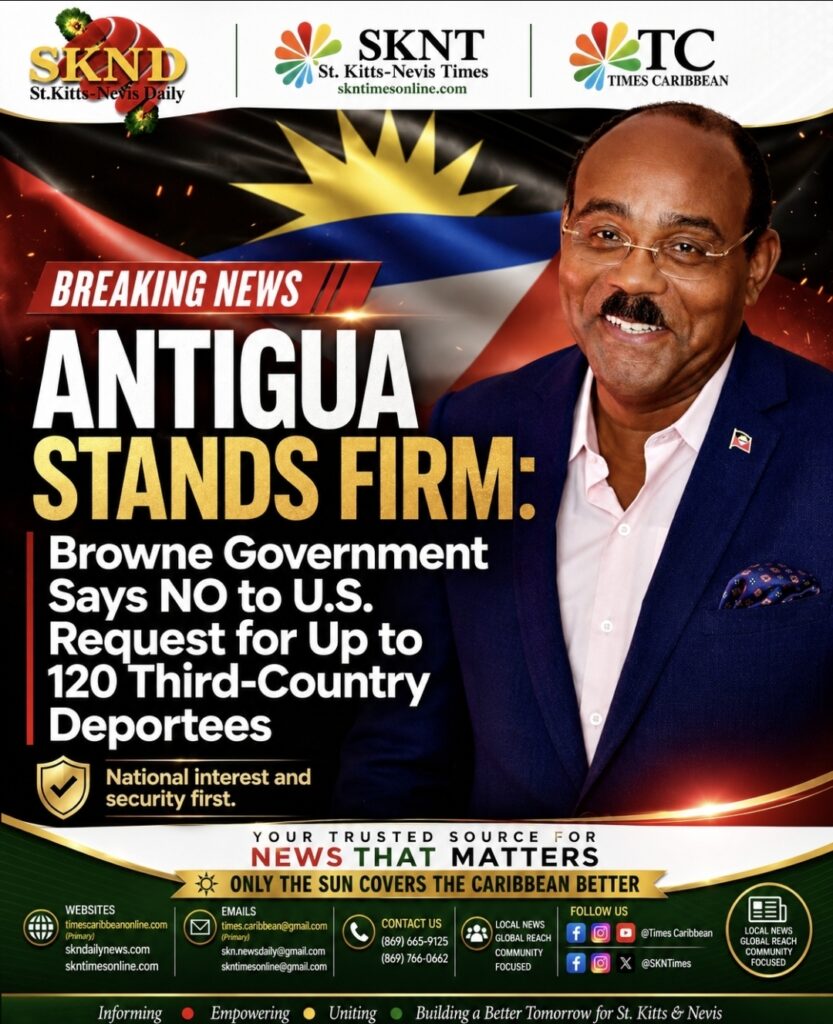
ANTIGUA STANDS FIRM: Browne Government Says NO to U.S. Request for Up to 120 Third-Country Deportees

ST. JOHN’S, Antigua — Antigua and Barbuda has drawn a firm line in the sand, rejecting what Prime Minister Gaston Browne described as an unacceptable U.S. proposal for the twin-island nation to receive up to 120 third-country deportees.
The reported request has sparked major public interest across the Caribbean, as small island states continue to navigate sensitive discussions with the United States over migration, border control, national security, and humanitarian obligations.
Prime Minister Browne made it clear that Antigua and Barbuda had not agreed to become a large-scale destination for third-country nationals removed from the United States. According to the Prime Minister, the government had only considered a very limited arrangement — no more than 10 persons annually — and only under strict conditions, including full vetting, security checks, documentation review, and the country’s absolute right to reject any individual.
But the reported figure of up to 120 persons has dramatically shifted the tone of the talks.
For Browne, the matter is not simply diplomatic. It is national. It is about sovereignty, capacity, security, and the responsibility of a small developing state to protect its people while maintaining respectful international relations.
Antigua and Barbuda, with its limited land space, small population, and already stretched national systems, cannot be expected to absorb numbers that far exceed what was originally discussed, the Prime Minister suggested. He emphasized that while his government values its relationship with Washington, no foreign-policy arrangement can come at the expense of Antigua and Barbuda’s national interest.
The issue has placed a spotlight on a wider regional concern: whether Caribbean nations are being asked to carry burdens far beyond their size, resources, and security capacity.
The Browne administration has reportedly insisted that any arrangement must be limited, transparent, lawful, carefully managed, and subject to Antigua and Barbuda’s full approval on a case-by-case basis. Individuals with concerning backgrounds or unresolved documentation issues would not be accepted.
The development also offers a rare public glimpse into ongoing discussions between the United States and Caribbean governments over the relocation of third-country nationals. While such talks are often handled quietly through diplomatic channels, Antigua and Barbuda’s firm response has now brought the issue into the regional spotlight.
For many observers, Browne’s stance sends a clear message: partnership with powerful nations does not mean automatic compliance. Small states, too, have the right to say no.
The Prime Minister’s position is likely to resonate across the Caribbean, where governments are increasingly being called upon to balance international cooperation with domestic pressures, public safety concerns, economic limitations, and the expectations of their citizens.
In this latest diplomatic test, Antigua and Barbuda has made its position unmistakably clear: cooperation, yes — but not at any cost.
















Leave a comment
You must be logged in to post a comment.