AFTER 47 YEARS, JUSTICE AT LAST! ST. KITTS-BORN VERE HENDRICKSON FINALLY SECURES BRITISH CITIZENSHIP AFTER HOME OFFICE ACKNOWLEDGES HISTORIC NATIONALITY UNFAIRNESS!
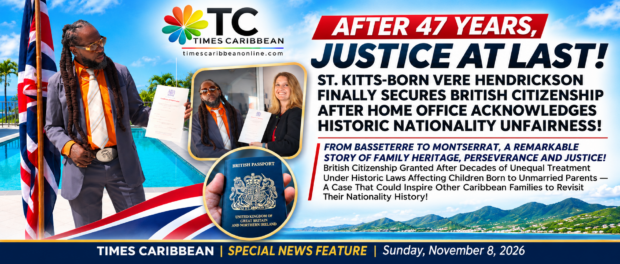
FROM BASSETERRE TO MONTSERRAT, A REMARKABLE STORY OF FAMILY HERITAGE, PERSEVERANCE AND JUSTICE! British Citizenship Granted After Decades of Unequal Treatment Under Historic Laws Affecting Children Born to Unmarried Parents — A Case That Could Inspire Other Caribbean Families to Revisit Their Nationality History!
TIMES CARIBBEAN | SPECIAL NEWS FEATURE | Sunday, November 8, 2026
BASSETERRE, ST. KITTS — For 47 years, Vere Hendrickson lived with the consequences of a British nationality system that had treated him differently from other members of his own family.
Now, that chapter has finally changed.
The St. Kitts-born national has officially become a British citizen following a successful application that prompted the United Kingdom’s Home Office to acknowledge the historical legislative unfairness that had prevented him from benefiting from his father’s British nationality connection.
His citizenship ceremony, held in Montserrat on October 21, 2026, marked a deeply significant personal achievement and highlighted an important issue affecting Caribbean families whose nationality rights were shaped by colonial-era legislation.
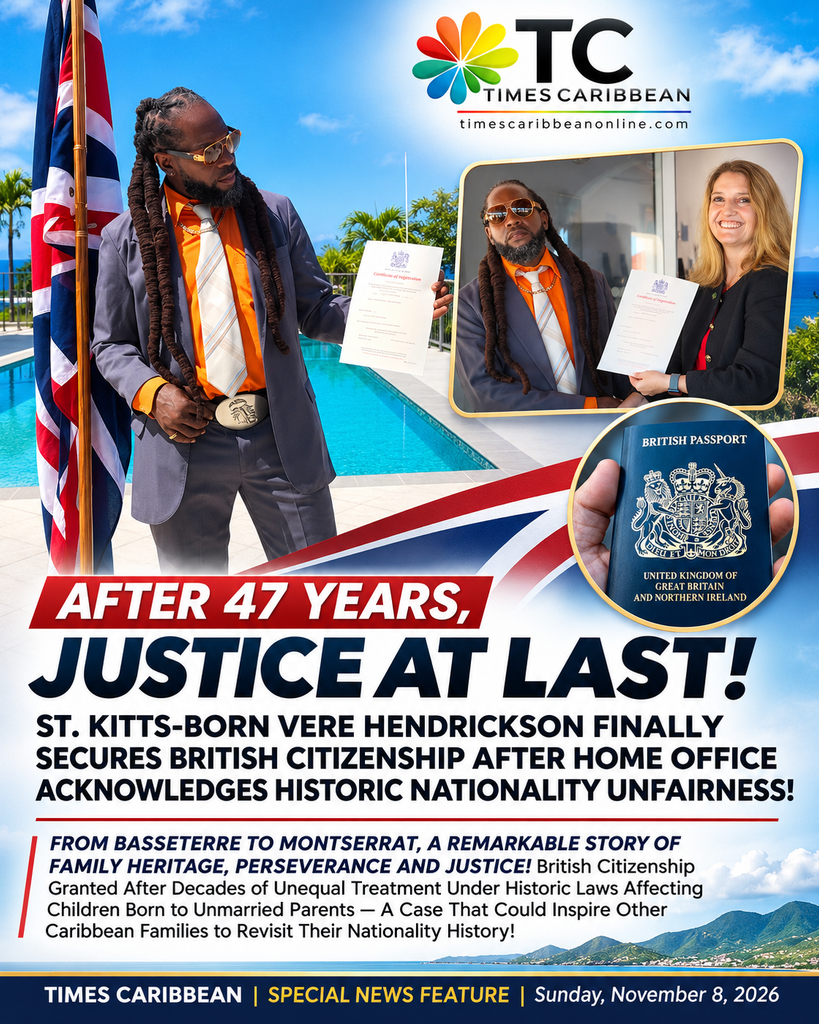
Photographed alongside Montserrat Governor Harriet Cross, Hendrickson proudly displayed his British citizenship certificate, symbolising the conclusion of a decades-long nationality struggle.
ONE FAMILY. DIFFERENT CITIZENSHIP RIGHTS.
Born in Basseterre in 1979, Hendrickson came from a family with deep connections to both St. Kitts and Montserrat.
His paternal grandmother was born in Montserrat, a territory that remained under British sovereignty following the independence of St. Kitts and Nevis on September 19, 1983.
That family connection proved central to his eventual citizenship recognition.
According to an October 24 report published by JAM Radio News, Hendrickson’s father, although born in St. Kitts, retained British territorial nationality through his Montserratian ancestry.
His father and siblings held British citizenship.
But Vere did not enjoy the same outcome.
The reason was not the absence of a British family connection. It was the legal treatment of children whose parents were unmarried.
Under historical nationality laws, children born outside marriage could be prevented from acquiring or retaining nationality through their fathers in circumstances where children of married parents would have qualified.
For Hendrickson, that distinction had consequences lasting well into adulthood.
WHY THE MONTSERRAT CONNECTION WAS SO IMPORTANT
When St. Kitts and Nevis achieved independence in 1983, British nationality arrangements changed significantly.
Individuals who acquired citizenship of the newly independent Federation generally lost British Dependent Territories citizenship unless they qualified to retain that status through connections with another British territory.
Montserrat remained such a territory.
The British Overseas Territories Act 2002 subsequently created an additional pathway. On May 21, 2002, most qualifying British Overseas Territories citizens automatically became British citizens.
Hendrickson’s father’s retained territorial nationality was therefore particularly significant.
However, the discriminatory legal treatment of Hendrickson’s relationship with his father prevented him from enjoying the same nationality outcome.
HOME OFFICE RECONSIDERS EARLIER REFUSAL
The breakthrough came after further representations were submitted to the British Home Office, supported by an examination of Hendrickson’s family nationality history.
According to JAM Radio, the case was pursued by Euen Herbert-Small, who challenged the earlier refusal and presented additional material concerning Hendrickson’s father’s status.
In a decision dated August 4, 2026, the Home Office reportedly confirmed that it had considered further submissions and information obtained from His Majesty’s Passport Office.
The authorities accepted that, had the historical law treated children of unmarried parents equally, Hendrickson would have been able to acquire British citizenship through his father.
The decision reportedly attributed his exclusion to historical legislative unfairness affecting children born outside marriage.
That acknowledgement proved decisive.
His subsequent citizenship registration and ceremony brought a long-awaited conclusion to the matter.
COULD OTHER ST. KITTS AND NEVIS FAMILIES HAVE SIMILAR CLAIMS?
Hendrickson’s experience may encourage other Caribbean families to take a closer look at their nationality histories.
Across St. Kitts, Nevis, Montserrat, Anguilla, the British Virgin Islands and other neighbouring territories, generations of families have maintained connections spanning several islands.
Some of those connections predate Caribbean independence and changes in British nationality legislation.
Records involving parents, grandparents, marriage, birth and previous citizenship status may be important when assessing eligibility.
British nationality legislation now includes provisions designed to address certain historical inequalities, including discriminatory treatment of children born to unmarried parents.
However, having a British parent, grandparent or relative does not automatically establish entitlement to British citizenship.
Each case depends on its particular legal and family circumstances, and specialist nationality advice may be necessary.
Hendrickson’s successful application should therefore not be interpreted as guaranteeing citizenship to everyone with similar Caribbean family connections.
Nevertheless, his experience demonstrates why an earlier refusal may not always be the end of the matter.
A PERSONAL VICTORY WITH WIDER CARIBBEAN SIGNIFICANCE
For Hendrickson, the significance of the occasion reaches far beyond acquiring a new passport.
It represents the recognition of a family connection that had existed throughout his life, but which historical legislation had prevented him from fully benefiting from.
It also highlights how the legacy of British colonial nationality laws continues to affect Caribbean families decades after independence.
JAM Radio has congratulated Hendrickson on his achievement, recognising the importance of his successful application and the broader questions it raises about historical nationality discrimination.
TIMES CARIBBEAN joins in congratulating Vere Hendrickson on this remarkable milestone.
From Basseterre to Montserrat, his journey is a powerful reminder that family history, nationality rights and the pursuit of fair treatment can remain deeply connected across generations.
Forty-seven years after his birth, Vere Hendrickson can finally celebrate the British citizenship that historical legal inequality had placed beyond his reach.
Source acknowledgement: JAM Radio News, reporting by Euen Herbert-Small, October 24, 2026. Additional legal background: UK Home Office nationality guidance and the British Overseas Territories Act 2002.
TIMES CARIBBEAN — Bringing Caribbean Stories to the World.
















Leave a comment
You must be logged in to post a comment.