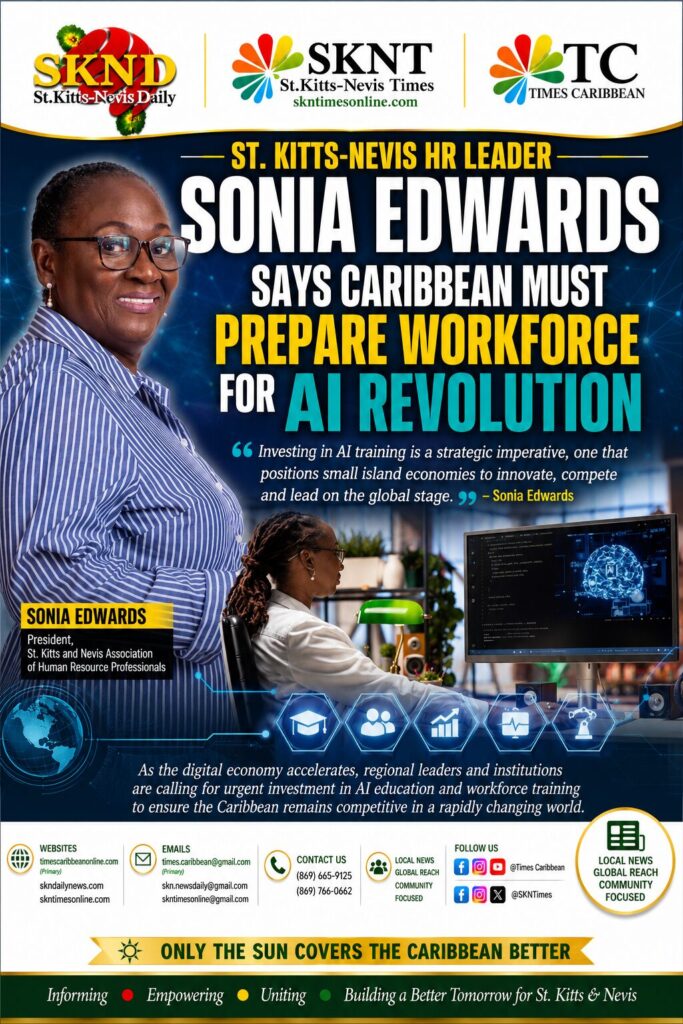
St. Kitts-Nevis HR Leader Sonia Edwards Says Caribbean Must Prepare Workforce for AI Revolution

The Caribbean is being urged to rapidly strengthen artificial intelligence (AI) education and workforce training as global industries accelerate digital transformation and demand for technology-driven skills intensifies.
According to a report from the Caribbean Media Corporation (CMC), US-based DeVry University is expanding its AI-focused education initiative across the region through its “Bridge to Brilliance” programme, which recently marked its first anniversary.
The initiative comes at a time when governments, businesses and educational institutions throughout the Caribbean are increasingly recognizing that AI literacy and digital innovation will play a critical role in shaping future economic growth, competitiveness and workforce resilience.
DeVry University says it plans to integrate AI literacy and practical AI skill development into every course by the end of 2026, positioning students and professionals to better navigate an increasingly AI-driven global economy.
Regional business and human resource leaders say the Caribbean must move quickly to ensure its workforce is adequately prepared for the next wave of technological disruption.
Sonia Edwards described AI readiness as a strategic necessity for small island developing states seeking to remain globally competitive.
“Investing in AI training is a strategic imperative, one that positions small island economies to innovate, compete and lead on the global stage,” Edwards stated.
Edwards warned that countries failing to prioritize AI workforce development could risk falling behind as automation, machine learning and digital systems continue reshaping industries worldwide.
DeVry University’s Vice President of Strategic Partnerships, Scarlett Howery, said the global labour market is already undergoing dramatic transformation.
“As AI continues to reshape the global workforce at an unprecedented pace, the gap between current skills and emerging industry demands is widening,” Howery explained.
She noted that employers are no longer focused solely on recruiting talent, but are increasingly investing in retraining and upskilling existing employees to adapt to rapidly evolving technologies.
The university says the initiative is aimed at helping Caribbean learners access affordable, high-quality education while developing the technical and workplace skills required in sectors such as tourism, agriculture, healthcare, manufacturing, financial services and business management.
Over the past year, DeVry says it has enrolled students from multiple Caribbean territories while strengthening partnerships with employer organizations, chambers of commerce and educational institutions throughout the region.
In Saint Vincent and the Grenadines, the programme has expanded collaboration with the private sector through partnerships with the business community.
Tony Regisford said AI could significantly transform Caribbean economies by improving operational efficiency and unlocking innovation opportunities across major industries.
“AI in the Caribbean has the potential to be transformational,” Regisford stated, highlighting emerging opportunities in tourism, agriculture, manufacturing and service industries.
The “Bridge to Brilliance” programme also includes scholarship opportunities for qualifying students as part of broader efforts to strengthen workforce development and digital inclusion throughout the Caribbean.
Analysts say the growing push toward AI training reflects a wider recognition that small island economies must diversify beyond traditional sectors and embrace emerging technologies to remain sustainable and globally competitive.
As international competition intensifies and digital economies continue expanding, regional leaders are increasingly emphasizing that AI preparedness may soon become one of the defining economic challenges — and opportunities — for the Caribbean.
















Leave a comment
You must be logged in to post a comment.