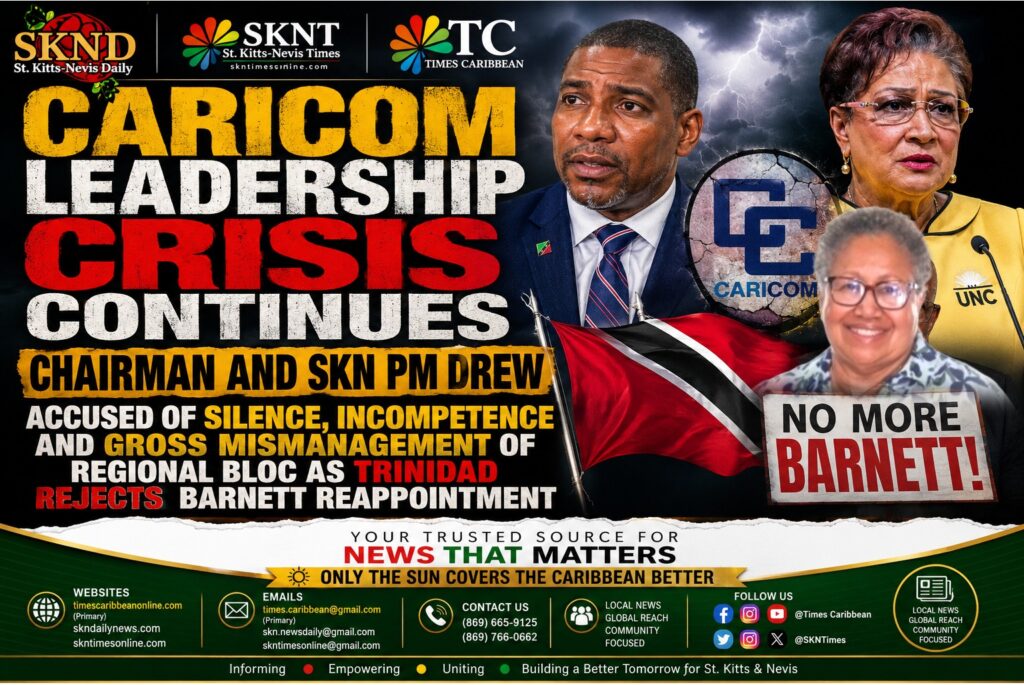
CARICOM LEADERSHIP CRISIS CONTINUES. CHAIRMAN AND SKN PM DREW ACCUSED OF SILENCE, INCOMPETENCE AND GROSS MISMANAGEMENT OF REGIONAL BLOC AS TRINIDAD REJECTS BARNETT REAPPOINTMENT

The Caribbean Community (CARICOM) is facing one of its most serious diplomatic and political ruptures in recent years, as Trinidad and Tobago Prime Minister Kamla Persad-Bissessar has openly declared that her government will not recognize the reappointment of CARICOM Secretary-General Dr. Carla Barnett beyond August 2026 — a move that has now placed CARICOM Chairman Dr. Terrance Drew under mounting regional scrutiny.
Critics across the region say the controversy has exposed what they describe as weak leadership, poor communication, and troubling governance practices at the highest levels of CARICOM, with concerns growing over how the regional body handled the increasingly explosive dispute.
Persad-Bissessar made it abundantly clear this week that Trinidad and Tobago’s position would not change.
“We do not recognise her after August 2026. This is our final position,” she declared.
The dramatic fallout stems from decisions reportedly taken during the 50th Regular Meeting of CARICOM Heads of Government held in St. Kitts and Nevis earlier this year, where Barnett’s reappointment was reportedly advanced while Trinidad and Tobago representatives were absent.
Port of Spain has argued that the matter was not properly placed on the plenary agenda and may have breached established CARICOM procedures under the Revised Treaty of Chaguaramas.
The controversy deepened after Trinidad and Tobago Foreign Affairs Minister Sean Sobers reportedly claimed he received a WhatsApp message disinviting him from a key Nevis retreat linked to the discussions.
Persad-Bissessar has since accused CARICOM officials of withholding information and failing to address repeated requests for transparency and documentation.
According to reports first detailed by the Trinidad Express and regional outlets, Sobers formally wrote to Chairman Drew requesting retreat notes and clarification regarding the alleged disinvitation message but, up to now, no public response has reportedly been issued.
Political observers across the Caribbean have increasingly questioned why CARICOM Chairman Drew has remained publicly silent amid escalating tensions involving one of the region’s largest and most influential economies.
Several regional commentators have suggested the matter has been handled poorly and has now evolved into a major credibility challenge for the regional integration movement.
During a virtual CARICOM session last Friday — convened at the request of Montserrat to address the dispute — representatives from ten of the fifteen member states reportedly participated. Trinidad and Tobago objected to the proceedings, noting that both Persad-Bissessar and Sobers were unavailable due to parliamentary obligations and an official visit by India’s External Affairs Minister Subrahmanyam Jaishankar.
Despite the objections, the majority reportedly agreed that Barnett’s reappointment would stand.
The dispute has now widened beyond procedural disagreements into broader questions about CARICOM’s effectiveness, transparency, and future relevance.
Persad-Bissessar delivered some of her strongest remarks yet when asked whether Trinidad and Tobago feared possible expulsion or isolation from the regional bloc.
“They are free to expel us from CARICOM if they wish to do so,” she said. “Life goes on in Trinidad and Tobago, with or without CARICOM. The world stops for no one.”
She further described CARICOM as “dysfunctional and chaotic,” alleging that key documentation, meeting minutes, and performance appraisals requested by Trinidad and Tobago were never produced.
In another significant geopolitical signal, Persad-Bissessar stated that Trinidad and Tobago was actively expanding trade relationships with the Middle East, South America, India, and Africa and would not depend solely on CARICOM for economic growth.
The Prime Minister also ruled out referring the matter to the Caribbean Court of Justice and reiterated that her administration does not intend to make the CCJ Trinidad and Tobago’s final appellate court.
Meanwhile, reports suggest Jamaican Prime Minister Andrew Holness has quietly attempted mediation efforts to ease tensions and prevent a deeper fracture within the regional body.
The escalating standoff is now being viewed by many analysts as a defining test for CARICOM leadership and unity at a time when the region faces major economic, geopolitical, migration, and security challenges.
For now, however, the silence from Chairman Drew and the absence of a comprehensive public explanation from CARICOM leadership continue to fuel criticism, speculation, and growing calls for accountability across the Caribbean political landscape.
















Leave a comment
You must be logged in to post a comment.