32 YEARS LATER: THE MYSTERY OF THE MAXI II STILL HAUNTS ST. KITTS AND NEVIS

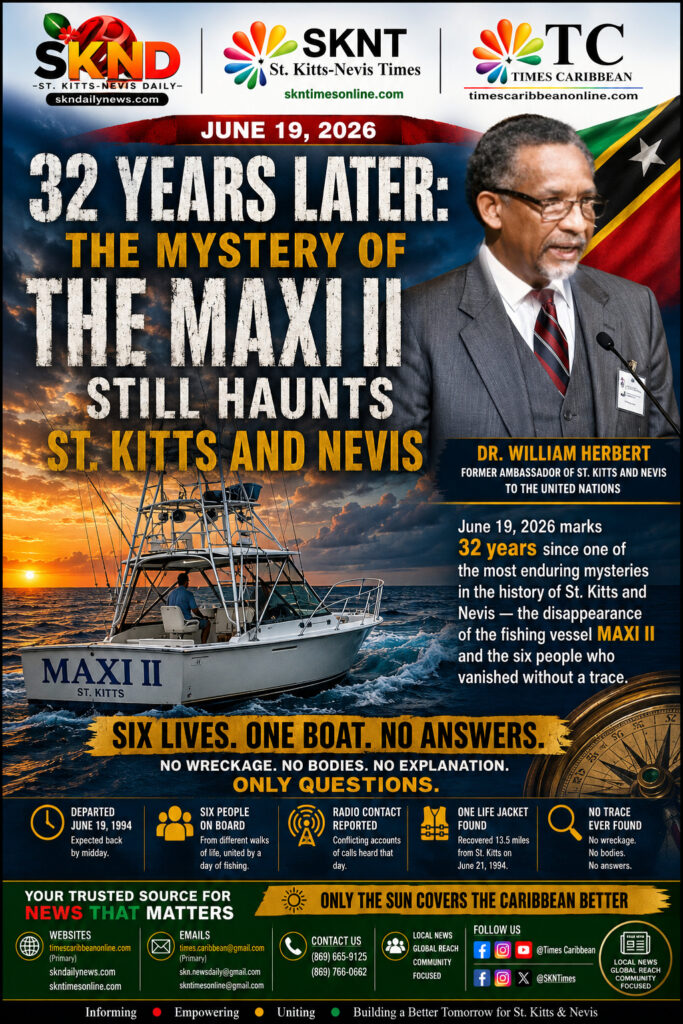
June 19, 2026 marks 32 years since one of the most enduring mysteries in the history of St. Kitts and Nevis — the disappearance of the fishing vessel Maxi II and the six people who vanished without a trace.
On the morning of June 19, 1994, the motor vessel Maxi II departed Basseterre Harbour carrying six passengers on what was expected to be a routine fishing excursion. The vessel was scheduled to return by midday. It never did.
More than three decades later, no wreckage has ever been conclusively identified, no bodies have been recovered, and no definitive explanation has emerged for what happened to those on board.
The six missing persons were:
- Cheryl Herbert
- Michael Blake
- Tristan Blake
- Narayan (Derek) Menon
- Christian Stapleton
Among them was Dr. William Herbert, a prominent attorney, businessman and former Ambassador of St. Kitts and Nevis to the United Nations. Also aboard was eight-year-old Tristan Blake, making the disappearance especially heartbreaking for families and the wider nation.
Scotland Yard Called In
As public concern intensified and questions mounted, the Government of St. Kitts and Nevis requested assistance from Britain’s New Scotland Yard through the Foreign and Commonwealth Office.
Senior officers from the Organised Crime Group of New Scotland Yard subsequently conducted an independent review of the investigation, re-interviewing witnesses, examining available evidence, and assessing both accidental and criminal explanations.
Their findings remain among the most significant official assessments ever conducted into the mystery.
What Scotland Yard Found
The report noted that despite extensive inquiries, investigators were unable to establish what ultimately happened to the vessel.
The officers reviewed witness statements, examined reported sightings, analyzed radio communications allegedly received from the Maxi II, and assessed the possibility of criminal involvement.
One of the report’s most striking conclusions was that investigators found no evidence capable of proving a criminal attack on the vessel.
Scotland Yard observed that for a criminal operation to successfully target the Maxi II, perpetrators would have needed detailed knowledge of the boat’s departure time, intended destination, occupants, and would have had to eliminate all six individuals and dispose of the vessel without leaving any trace.
The report stated that such a scenario appeared highly improbable based on the evidence available.
The Radio Mystery
Among the most puzzling aspects of the case were reports that radio communications may have been received from the Maxi II several hours after it failed to return.
Witnesses reported hearing calls allegedly associated with the vessel on marine radio channels.
However, Scotland Yard investigators found inconsistencies in the accounts and were unable to conclusively verify the transmissions or determine their significance.
The report described this area of the investigation as confusing and ultimately inconclusive.
Sightings That Led Nowhere
Numerous reports emerged in the days following the disappearance claiming that the Maxi II had been spotted in various locations.
One account suggested the vessel was being towed near Anguilla.
Another alleged sighting came from an airline pilot who believed he had observed the boat at sea.
Scotland Yard revisited these reports but concluded that none could be substantiated.
Investigators found no credible evidence that any of the reported sightings explained the disappearance.
The Only Physical Evidence
The only significant physical item recovered during the search was an orange life jacket discovered approximately 13.5 miles from St. Kitts.
The life jacket was examined by forensic specialists in London.
According to the report, no evidence of fire, explosion, burning, or melting was found on the material.
Investigators could not definitively determine whether it originated from the Maxi II.
Questions That Remain
The Scotland Yard report highlighted several unanswered questions, including:
- The exact fishing destination planned for that day.
- Whether mechanical failure could have occurred.
- The significance of the reported radio communications.
- Why no wreckage was ever conclusively located.
- Whether severe sea conditions contributed to the disappearance.
The report also noted differing opinions among local fishermen regarding the vessel’s design and seaworthiness under rough conditions.
No Conclusion — Only Uncertainty
Perhaps the most important finding of the Scotland Yard investigation was its acknowledgment that no firm conclusion could be reached.
The report stated that the absence of bodies, wreckage, and definitive evidence left investigators severely hampered.
As a result, Scotland Yard concluded that it could not determine the circumstances surrounding the disappearance of the Maxi II.
Thirty-two years later, that conclusion remains unchanged.
A Mystery That Endures
For many in St. Kitts and Nevis, the Maxi II remains more than an unsolved maritime disappearance. It is a national mystery that continues to generate discussion, speculation, and reflection.
Families lost loved ones. A nation lost answers.
As June 19, 2026 marks the 32nd anniversary of the disappearance, the Maxi II remains one of the Caribbean’s most enduring unsolved mysteries — a case that continues to haunt the collective memory of St. Kitts and Nevis.
Thirty-two years later, the sea has yet to reveal what happened on that June morning in 1994.
















Leave a comment
You must be logged in to post a comment.