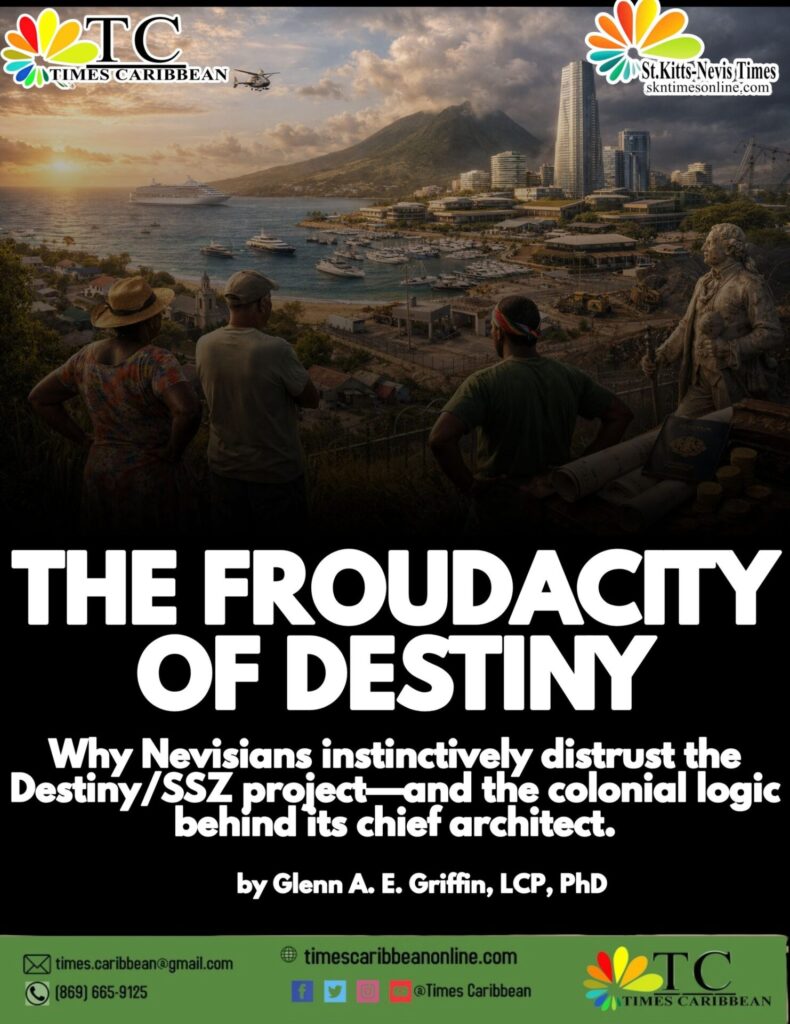
THE FROUDACITY OF DESTINY: Why Nevisians instinctively distrust the Destiny/SSZ project—and the colonial logic behind its chief architect.
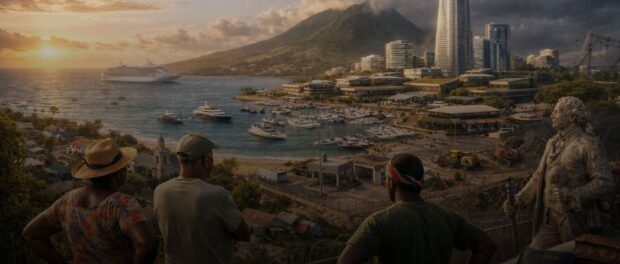
By Glenn A. E. Griffin, LCP, PhD
“There are no people there in the true sense of the word…, with a character and purpose of their own.”
—James Anthony Froude, The English in the West Indies
Nevisians are a politically mature people, forged by emancipation revolts, labor movements, federation struggles, and generations of anti-colonial organizing. We are heirs to a wealth of colonial resistance and owners of an exacting political consciousness. As C.L.R. James noted, West Indians are quick to grasp the workings of power and able “to read the intentions behind the words.”[1] It is therefore unsurprising that Nevisians not only recognize the dubious nature of the Destiny/SSZ project itself but also see Olivier Janssens’ colonial adventurism for exactly what it is.
The Poll/No Polling
A public opinion poll of 450 Nevisians, conducted between December 6ΓÇô14, 2025, and [reported by *Times Caribbean Online*] (https://timescaribbeanonline.com/nevis-slams-destiny…/), found majorities in every federal district opposing Destiny: 67% in Constituency 9, 55% in Constituency 10, and 69% in Constituency 11. These numbers reflect broad public sentiment. But what warrants close examination is what pollsters call a “negative credibility differential”: far more people distrust the crypto libertarian and governance reformer than oppose the project itself.
Roughly 45% of respondents do not oppose Destiny outright; they remain open, undecided, or cautiously receptive. Yet more than 70% say they do not trust Mr. Janssens. Put plainly: nearly half of those who are neutral or even tentatively supportive still distrust the project’s leader. In the most affected constituency, distrust reached a remarkable 83%.
This is what we discern. Nevisians are not opposed to development are opposed to this developer, and his methods. His Froudeian methodology included deliberately not polling Nevisians, imagining that we could simply be disregarded.
The Debt Trap
Eight years before unveiling Destiny to Nevisians, Janssens had already made his ambitions clear in libertarian and crypto-governance circles. In 2017, as co-founder of the Free Society Project, he claimed the initiative could help “indebted governments” create “an economic powerhouse next to their doorstep as a bonus.”[2]
The rhetoric is familiar: “win/win,” “partnership,” “sustainable growth.” Frantz Fanon described this maneuver as “giving to better take.” In “Discourse on Colonialism, Aime Cesaire spoke of the same class of actors who arrive bearing gifts to extract concessions.[3]
Here is the structural problem: Destiny only works if Nevis remains indebted.
By leveraging our fiscal vulnerability, Janssens positions himself to extract concessions no self-governing people would grant if they had economic sovereignty. The long-term success of Destiny requires that Nevis never escape indebtedness. In this sense, he has a structural, ongoing investment in our financial dependence. The more dependent Nevis becomes on external capital to service debt, the more indispensable Destiny becomes, and the easier it is to argue for expanding its regulatory autonomy and territorial footprint.
This is why the offer is so modest. Janssens’ investment is a keystone in the same economic apparatus that produced our seemingly insurmountable national debt parasitizing dynamic with deep historical precedent.
What follows the initial whispered misattributions about our poverty is the sneakiness: reconnaissance, opaque hiring of architectural firms, and the awarding of quasi-governmental roles to benefactors. By October 4, 2023, Dr. Andreas Baumgartner was publicly presenting himself as “Director of SEZ Governance at Destiny in Nevis.”[4] The Nevis Island Administration had never created such a role.
Janssens’ shell company, South Nevis Ltd., was incorporated in Charlestown in mid-2024, more than a year before the SSZ Act was passed and well before Destiny’s public unveiling on October 12, 2025.[5] The sequencing reveals a rehearsed colonization: Destiny’s legal and strategic architecture was constructed out of public view, its land position, governmental apparatus, and structural advantages secured long before Nevisians were informed.
The Name- “pure Empire Nonsense”
“We have a world-changing idea; Nevis can host it,” Janssens announced on October 12, 2025.[6]
Sometime in mid-2023, Janssens retained the architectural firm Skidmore, Owings & Merrill (SOM)the global superpower in monumental, top-down design and architect of the Burj Khalifa in Dubai, the world’s tallest building.[7] That a firm that towers buildings as tall almost as tall Nevis Peak was contracted to design a “low-rise” community on an island the size of Nevis suggests a grandiosity without scaling.
Beyond the matter of scale lies the problem of the name itself. He could have chosen anything, he chose “Destiny,” a word so loaded with imperial claims of ordained purpose that it collapses colonial development into fate. “Destiny” is the bedroom name of colonization.
Americans proclaimed “Manifest Destiny”; Britain heralded “the destiny of our race”; France spoke of its “civilizing destiny”; Spain and Portugal championed their providential maritime destiny; Belgium insisted upon its imperial destiny. In every case, “destiny” claimed the future for colonizers and denied it to the colonized. Nevisians recognize this deployment instantly.
Destiny on the Ground
Jansens’s South Nevis Ltd. Has permanent ownership of more than 1,000 acres of prime south-coast property, removed from Nevisian control forever—this is not a lease or development agreement, it is outright title transfer to a foreign company. Disputes get resolved by international arbitration rather than Nevis courts, handing a private company power over our legal system while pulling commercial cases out of public accountability. Vast tax exemptions and profit-share deals leave Nevis with scraps of revenue as investors take the lion’s share, deepening our reliance on external cash and stretching our national debt even longer.
Libertarian utopians and governance hobbyists have already left a trail of failed enclaves, suspended projects, collapsed charter-city proposals, and abandoned private-city experiments in Africa, Central America, the Pacific, and the Caribbean.[14] Prospera in Honduras became a billion-dollar legal threat against Honduras. Bitcoin City in El Salvador displaced communities and inflamed public mistrust. Destiny follows the same blueprint that has or roadsides littered by CBI white elephant carcasses.
Citizenship by Opportunism
Olivier Janssens has described himself as a long-term resident and “proud Nevisian for almost ten years.” For some Nevisians, the remark provoked laughter; for others, galling disbelief strong enough to evoke the prospect of revoking his Nevis citizenship.
Whatever else it is, Janssens’ Nevisness is a financially strategic purchase. It is an instrumental legal tool deployed to secure exceptional powers for a foreign-based enclave. He is not negotiating Destiny as a Nevisian is attempting to purchase a legal framework that bypasses Nevis’s ordinary democratic processes.
This posture has been at work for nearly a decade: inviting investors, ushering in crypto-conquistadors seeking sovereignty through parasitism masquerading as mutualism, and positioning Nevis as a platform for testing governance models.
Afro-Caribbean cultural inheritance, village networks, diasporic ties, and self-governing practices are treated with belated reassurances and the polite tone that traffics the same disregard. The point is not that we want “a seat at the table.” This remains our table.
Froudacity
Nevisians recognize in Mr. Janssens the oldest and most practiced device of European colonialism: Froudeian disregard, what Trinidadian historian John Jacob Thomas named “Froudacity”.[12] It is the maneuver that accomplishes everything colonial in a single posture: jeopardizing sovereignty, acquiring land on the cheap, and treating a people’s future as incidental to one’s own new-world ambitions.
James Anthony Froude, the 19th-century historian, made no distinction between Caribbean people and the leaders they elected; he believed neither possessed the “purpose” necessary to govern. Elected officials were, in his view, intermediaries who could be bribed, flattered, or maneuvered into legitimating an external vision, rather than the prospects of the people they are elected to serve. Fortunately, as C.L.R. James observed, “The West Indian masses are politically in advance of the politicians who claim to speak for them.”[13] This is as true today as in 1963.
People Here Will Kill It
Whether or not the Special Sustainability Zone Act survives, Destiny is dead in the water. No architectural firm with any sense of history, brand, or bottom line will build against our sovereign collective No. And no one seeking “a sustainable family resort community” will buy into a project born of disregard for their neighbors’ personhood.
For the 40% of Nevisians who remain open to the idea, we offer a simple suggestion: regroup. Try again. Drop the Frouditude, read our history, scale back the empire-grandiosity, choose a better name, make time to answer hard questions without opacity, wear a shirt, and bring real money, enough to retire our colonial/national debt and end the oldest and most exploited CBI program in the world.
That is what a billionaire Nevisian who actually loves Nevis would do.
—
ENDNOTES
[1] C.L.R. James, *The Black Jacobins* (Vintage Books, 1989), Preface.
[2] Free Society Project statement, archived 2017; cited in CryptoInsider, “Inside the Drive for a Voluntary Crypto Community,” 2017.
[3] Aime Cesaire, Discourse on Colonialism (Monthly Review Press, 1972).
[4] SKN Times video: Dr. Andreas Baumgartner, “SEZ Governance for Destiny in Nevis,” October 4, 2023.
[5] Nevis Financial Services Registry: Incorporation record for South Nevis Ltd., mid-2024.
[6] Destiny Project Launch, Charlestown, Nevis, October 12, 2025 (public recording).
[7] Skidmore, Owings & Merrill (SOM) Portfolio: Burj Khalifa Project Summary; referenced in Destiny investor materials, 2023.
[8] [The Daily Herald] (https://www.thedailyherald.sx/…/destiny-project-puts…), December 15, 2025.
[9] Ibid.; also, WinnFM Media SKN, “Destiny Seeks Plenary Approval Agreements,” 2025.
[10] *Times Caribbean Online*, “Nevis Slams Destiny Project in Recent Poll,” December 2025.
[11] World Bank; UNCTAD, World Investment Report 2019: Special Economic Zones; studies on enclave zone spillovers.
[12] John Jacob Thomas, Froudacity: West Indian Fables by James Anthony Froude (1889).
[13] C.L.R. James, *The Black Jacobins*, Chapter 1.
[14] Ryan Hsu, “The Failure of Experimental Private Cities,” *Journal of Political Economy & Development* (2023); Henry Farrell, “Why Seasteading Keeps Failing,” *Crooked Timber* (2020); Mara Hvistendahl, “The Long, Sad History of Libertarian Micro-Nations,” *Wired* (2022).
___
AUTHOR BIO
Glenn A. E. Griffin, LCP, PhD**, is a Nevisian professor and clinician. He holds a doctorate in philosophy and specializes in Caribbean political thought and the psychology of postcoloniality. He is based in Gingerland, Nevis.
















Leave a comment
You must be logged in to post a comment.