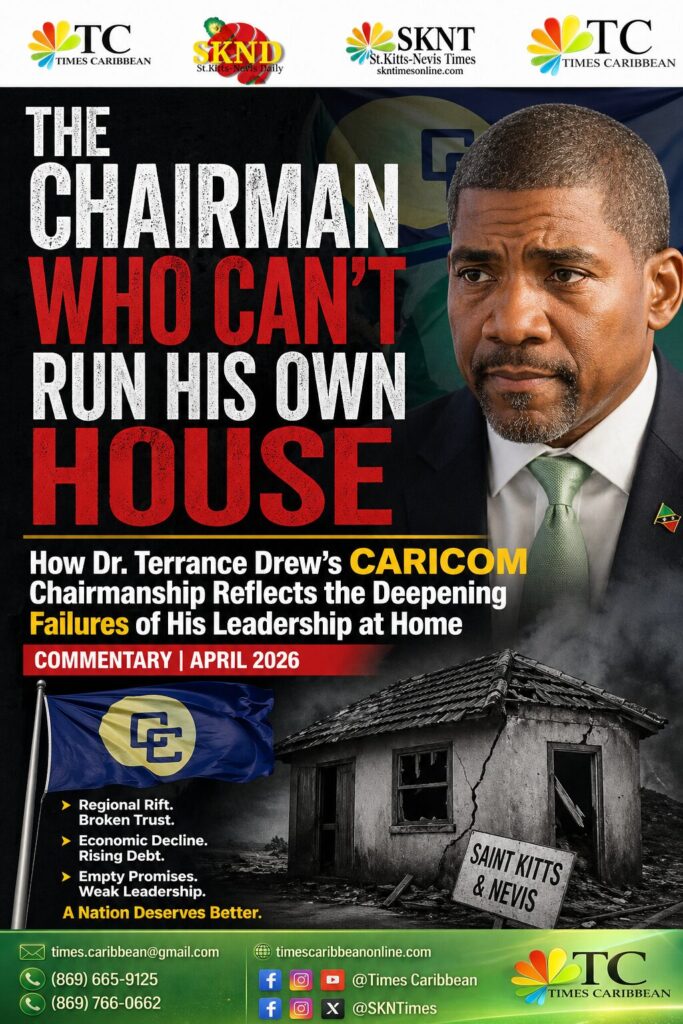
The Chairman Who Can’t Run His Own HouseHow Dr. ’s CARICOM Chairmanship Reflects the Deepening Failures of His Leadership at Home

Contributed Commentary,
There is an unmistakable pattern emerging in the political career of Dr. .
It is the pattern of a man who appears most comfortable on the stage, before cameras, at podiums, in summit halls, delivering polished speeches about unity, resilience, and transformation—while the foundations beneath him steadily weaken.
As Chairman of for the first half of 2026, Dr. Drew inherited an opportunity to elevate both the region and the international standing of . Instead, his tenure has already become synonymous with one of the most serious public ruptures the bloc has faced in decades.
As Prime Minister at home, he presides over an economy the says is under strain, with slowing growth, widening deficits, and declining revenues from what was once one of the most successful economic programmes in the Caribbean.
These are not separate stories.
They are the same story.
A Regional Chairmanship Defined by Discord
When Saint Kitts and Nevis assumed the rotating chairmanship of on January 1, 2026, Dr. Drew spoke of sovereignty, integration, and a stronger Caribbean future. The rhetoric was grand. The tone was statesmanlike.
Yet within weeks, the region was engulfed in controversy following the reappointment process for Secretary-General during the 50th CARICOM Heads of Government Summit hosted in Basseterre.
The absence of the Prime Minister of from the decisive retreat meeting sparked outrage. The government of Trinidad and Tobago publicly rejected the legitimacy of the process, condemning it as flawed and compromised.
That is not a minor disagreement.
That is the region’s largest economy openly challenging the credibility of the very institution Dr. Drew was entrusted to lead.
And it happened under his chairmanship, on his island, at his summit.
Leadership is not tested when speeches are applauded. Leadership is tested when competing interests must be managed, trust must be preserved, and crises must be prevented.
On that score, the record speaks for itself.
At Home, the Numbers Are Growing Louder
While diplomatic fires burned regionally, the domestic economy continued flashing warning signs.
Growth slowed to an estimated 1.5 percent in 2025. Fiscal deficits widened sharply. Public debt climbed. Government cash buffers reportedly declined. Revenues from the once-dominant Citizenship by Investment programme continued to underperform.
For years, the CBI programme gave a rare strategic advantage—an economic tool many countries envied and sought to replicate.
Today, that advantage appears weakened, uncertain, and no longer capable of sustaining public finances as before.
When a country with premium tourism assets, international recognition, a world-known CBI brand, and decades of institutional experience still struggles to maintain fiscal balance, questions must be asked.
Those questions begin and end with governance.
The Drew Formula: Optics Over Outcomes
This is where the pattern becomes impossible to ignore.
Dr. Drew excels in symbolism.
He appears at global forums speaking of partnerships with . He announces bold visions. He projects energy, ambition, and movement.
But beneath the imagery, where are the measurable breakthroughs?
Where is the disciplined fiscal turnaround?
Where is the restored confidence in the CBI model?
Where is the cohesive regional diplomacy expected of a CARICOM Chair?
Where is the sense that government is firmly steering the ship rather than reacting to events after the fact?
Too often, this administration appears consumed by presentation while performance lags behind.
What the CARICOM Crisis Reveals to Citizens
For citizens of , the CARICOM controversy is not distant diplomatic theatre.
It is a mirror.
The same instincts that can create mistrust at a regional summit can create uncertainty at home.
The same preference for style over structure can weaken national finances.
The same tendency toward unilateral political management can erode confidence among partners, investors, and citizens alike.
If process can be mishandled on the international stage, why should the public believe domestic governance is being handled differently?
A Nation at Risk of Squandering Its Advantages
Saint Kitts and Nevis has too many strengths to be drifting.
It has tourism appeal. Strategic geography. Strong human capital. International brand recognition. Financial services potential. Renewable energy opportunities. Deep diaspora networks.
This country should be outperforming many of its peers.
Instead, it increasingly risks becoming an example of how structural advantages can be wasted through weak execution and distracted leadership.
Final Word
The CARICOM chairmanship was supposed to showcase that punches above its weight.
Instead, it has exposed an uncomfortable truth.
The same man leading CARICOM is leading Saint Kitts and Nevis—and both appear burdened by the same flaws: lofty messaging, fragile management, and declining confidence.
A chairman who cannot keep order at the regional table will struggle to keep confidence at the national one.
And unless course is corrected soon, history may remember this period not as the rise of Dr. Drew—but as the moment opportunity slipped through his hands.
















Leave a comment
You must be logged in to post a comment.