ECLAC Growth Forecast Sparks Caribbean Debate: St. Kitts and Nevis Slips Behind Antigua as Regional Winners and Warning Signs Emerge
ECLAC Growth Forecast Sparks Caribbean Debate: St. Kitts and Nevis Slips Behind Antigua as Regional Winners and Warning Signs Emerge
BASSETERRE / BRIDGETOWN / ST. JOHN’S, April 29, 2026 — A newly highlighted economic forecast from the United Nations Economic Commission for Latin America and the Caribbean (ECLAC) is triggering intense discussion across the region after projecting that Antigua and Barbuda will outpace several OECS neighbours in 2026, while St. Kitts and Nevis is expected to slow further, raising urgent questions about competitiveness, tourism momentum, investment flows, and long-term economic strategy.
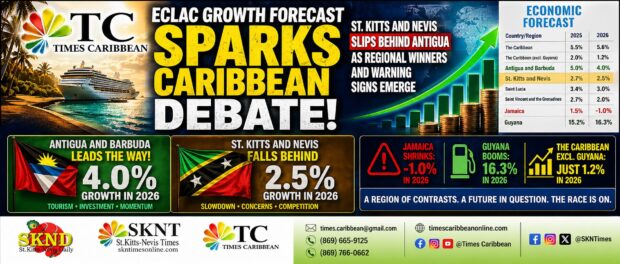
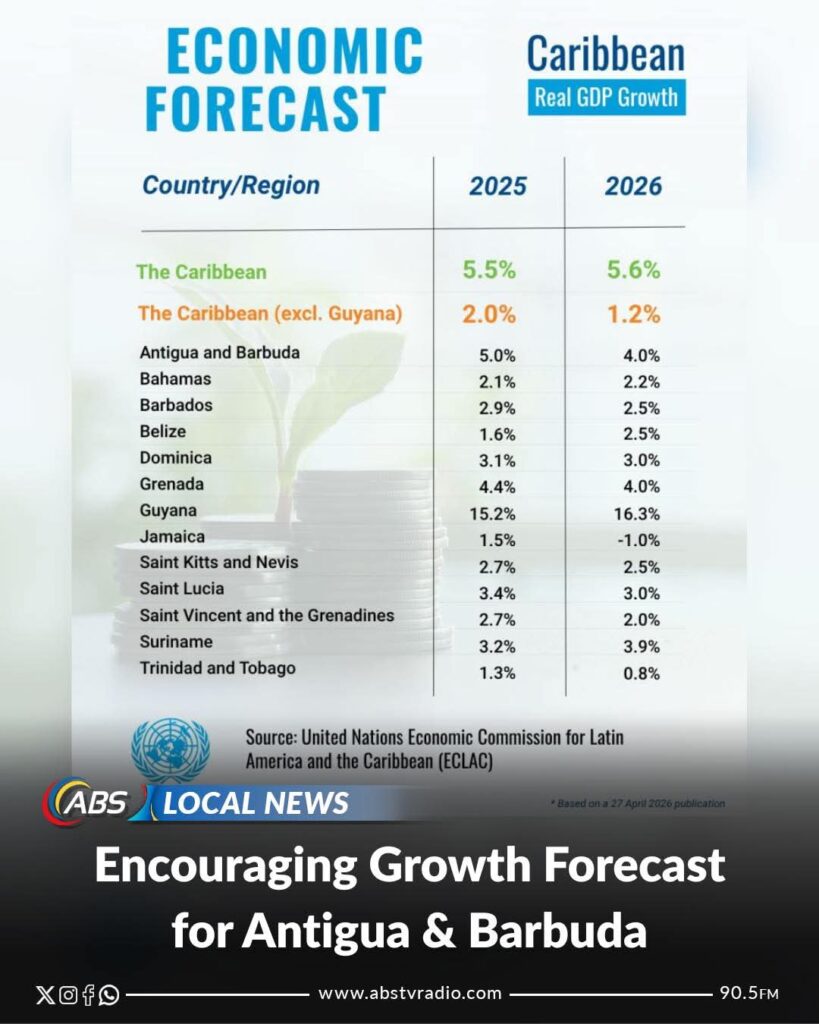
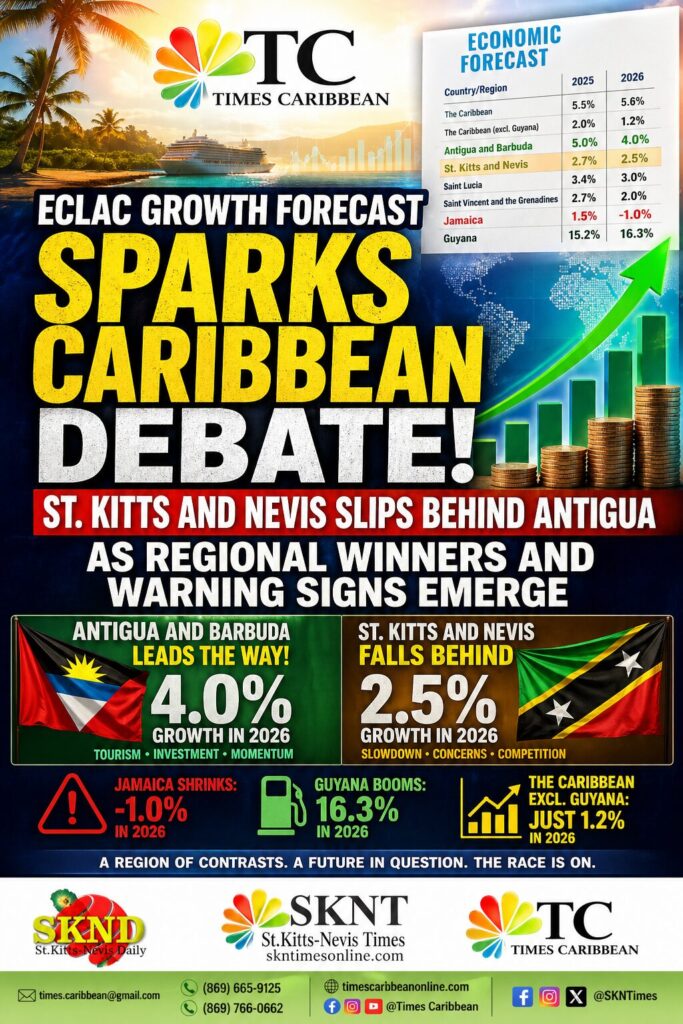
The forecast, based on ECLAC’s April 27, 2026 publication, projects Antigua and Barbuda at 4.0% growth in 2026, compared with 2.5% for St. Kitts and Nevis, 3.0% for Saint Lucia, and 2.0% for St. Vincent and the Grenadines.
While these are still positive numbers for many small island economies, the deeper story lies beneath the percentages: which countries are accelerating, which are plateauing, and which may be quietly losing economic ground.
Antigua Surges as Tourism Machine Powers Ahead
Antigua and Barbuda’s projected 5.0% growth in 2025 followed by 4.0% in 2026 suggests an economy still riding strong tourism recovery, airlift expansion, construction activity, yachting, hospitality investment, and global destination branding.
For many observers, Antigua’s performance reflects what happens when a country aggressively markets itself, upgrades visitor infrastructure, and maintains clear economic momentum.
The headline carried by ABS Local News — “Encouraging Growth Forecast for Antigua & Barbuda” — signals national confidence.
St. Kitts and Nevis: Growth, But Is It Enough?
For St. Kitts and Nevis, ECLAC projects 2.7% growth in 2025, falling slightly to 2.5% in 2026.
That may sound respectable on paper. But in the harsh world of regional competition, a slowdown while neighbours race ahead can become a strategic warning.
Questions now intensify:
- Is the federation generating enough new private sector activity?
- Is tourism growth matching competitors?
- Are foreign direct investments slowing?
- Is public sector expansion masking weaker productive sectors?
- Is the country doing enough in renewable energy, digital economy, exports, and innovation?
For a nation with premium tourism assets, a strategic geographic location, and one of the Caribbean’s most recognizable citizenship brands, 2.5% growth may be viewed by critics as underperformance rather than success.
The Guyana Effect Distorts the Entire Region
The report also reveals one of the Caribbean’s most dramatic realities: Guyana’s oil-fueled boom continues to transform all regional averages.
- Caribbean overall growth: 5.6% in 2026
- Caribbean excluding Guyana: 1.2% in 2026
- Guyana alone: 16.3% in 2026
This means that without Guyana, the wider Caribbean economy appears far weaker than the headline regional number suggests.
In blunt terms: Guyana is carrying the averages while many traditional tourism economies remain vulnerable.
Jamaica Shocker: Negative Growth
Perhaps the most startling figure in the forecast is Jamaica at -1.0% in 2026, signaling contraction.
For one of CARICOM’s largest economies, that sends tremors through the region and reminds policymakers that size alone does not guarantee resilience.
Winners, Drifters, and Watch Zones
Stronger Outlook:
- Guyana – 16.3%
- Antigua & Barbuda – 4.0%
- Grenada – 4.0%
- Suriname – 3.9%
Middle Tier:
- Dominica – 3.0%
- Saint Lucia – 3.0%
- Barbados – 2.5%
- St. Kitts & Nevis – 2.5%
Pressure Zone:
- Bahamas – 2.2%
- St. Vincent – 2.0%
- Trinidad & Tobago – 0.8%
- Jamaica – -1.0%
What This Means for St. Kitts and Nevis
For St. Kitts and Nevis, the numbers may intensify political and economic debate in the months ahead.
Supporters may argue the economy remains stable amid global uncertainty.
Critics may counter that “stable” is no longer enough in a Caribbean where faster-moving nations are attracting more capital, more visitors, and more opportunity.
The central issue is no longer growth alone.
It is relative growth.
Because when your neighbour grows at 4%, and you grow at 2.5%, the gap compounds year after year.
The Caribbean’s New Reality
This ECLAC forecast reveals a region splitting into three lanes:
- Boom economies driven by energy or aggressive tourism expansion
- Moderate economies trying to sustain post-COVID gains
- Stagnation-risk economies vulnerable to debt, slow productivity, and weak diversification
The race is on.
And for small states, every decimal point now matters.
















Leave a comment
You must be logged in to post a comment.