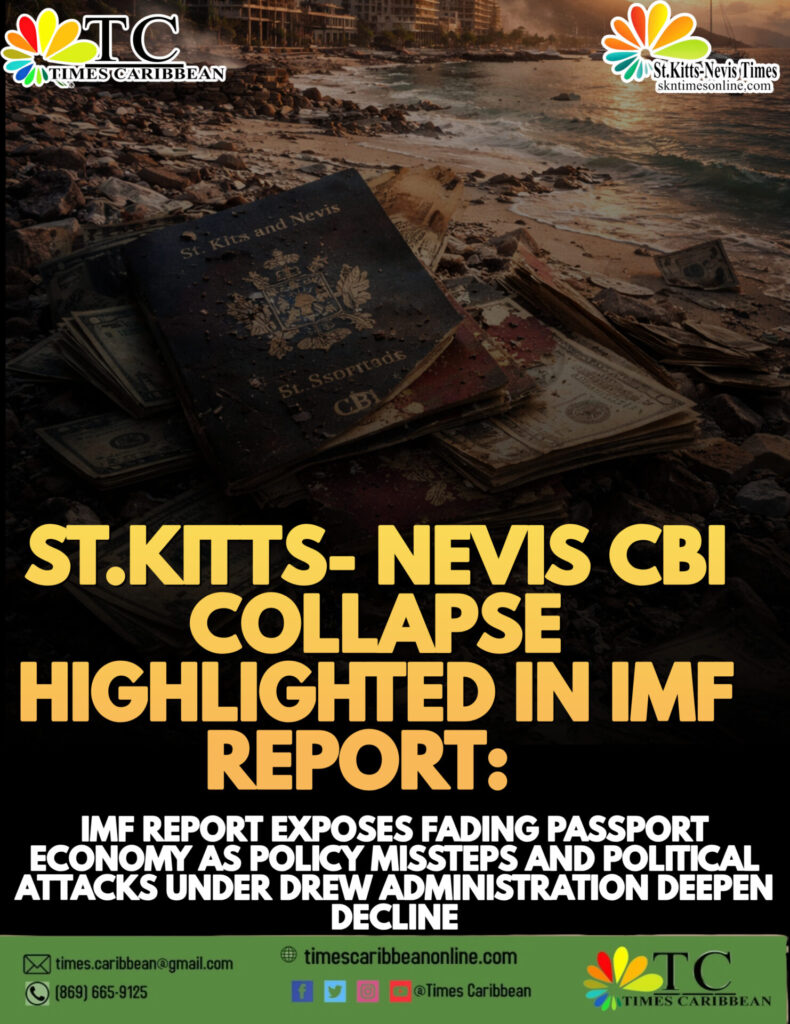
ST.KITTS-NEVIS CBI COLLAPSE: IMF REPORT EXPOSES FADING PASSPORT ECONOMY AS POLICY MISSTEPS AND POLITICAL ATTACKS UNDER DREW ADMINISTRATION DEEPEN DECLINE

Basseterre, St. Kitts — The International Monetary Fund’s latest 2026 Article IV Staff Report has delivered a sobering and deeply troubling assessment of the economic trajectory of St. Kitts and Nevis, confirming what many economic observers have increasingly warned: the once-dominant Citizenship-by-Investment (CBI) programme — long the fiscal backbone of the federation — is now experiencing a dramatic and sustained decline.
According to the IMF’s fiscal analysis, CBI revenues have fallen sharply since 2024, exposing the vulnerability of the country’s public finances and triggering broader concerns about fiscal stability.
The report notes that “the sharp decline in CBI revenue since 2024 reflects weaker-than-expected construction activity and headwinds from low Citizenship-by-Investment (CBI) inflows.”
Even more striking is the IMF’s confirmation that the massive financial windfall generated by the programme in previous years has now largely evaporated.
“The CBI windfall that boosted spending in recent years has faded,” the IMF stated plainly.
For a small island federation whose fiscal expansion in recent years was significantly underwritten by CBI revenues, the implications are profound.
From Global Model to Policy Uncertainty
For much of the last decade, St. Kitts and Nevis was widely regarded as the global benchmark for citizenship-by-investment programmes.
Under the leadership of , the programme generated record inflows that strengthened government reserves, supported infrastructure expansion, reduced national debt, and helped fund social programmes.
International investors flocked to the programme, attracted by its credibility, regulatory structure, and the stability of the federation’s political environment.
However, analysts now argue that a series of controversial policy shifts and political narratives under the administration of Prime Minister have contributed to eroding confidence in the programme.
Several financial observers point to what they describe as ill-advised reforms, inconsistent messaging, and damaging public rhetoric about the programme itself.
Political Rhetoric and the Undermining of Investor Confidence
Critics argue that the government’s own public statements in recent years have at times cast doubt on the credibility of the programme, inadvertently undermining investor confidence in the federation’s most important revenue-generating sector.
Political analysts say that in an effort to discredit the economic success achieved under the previous Team Unity administration, members of the current government repeatedly portrayed the programme as problematic or improperly managed.
Those statements, critics argue, created international reputational risk at a time when the programme was already facing intense scrutiny from global partners including the United States, the European Union, and the United Kingdom.
In the highly competitive global investment-migration industry — where confidence and perception are critical — such rhetoric may have had unintended consequences.
Investor advisors and migration agents, who operate in a highly sensitive regulatory environment, closely monitor political signals coming from host governments.
When uncertainty or internal criticism emerges, investors often redirect capital toward alternative programmes in competing jurisdictions.
International Pressure Meets Domestic Policy Shifts
The IMF report also highlights another major factor affecting the programme: tighter application requirements and stricter due diligence processes introduced amid growing international scrutiny.
According to the IMF:
“The authorities have tightened application requirements and due diligence amid international scrutiny, leading to fewer applications.”
While these reforms were intended to strengthen programme integrity and respond to external pressure, they have also reduced the volume of applications, thereby shrinking the financial pipeline that once fueled government revenue.
The result is a programme now operating in a far more constrained global environment, with lower demand and heightened regulatory oversight.
Economic Ripple Effects Across the Federation
The slowdown in CBI inflows is already reverberating through key sectors of the economy.
Construction — historically one of the biggest beneficiaries of CBI-related real estate investments — has experienced weaker-than-expected activity, according to the IMF.
Luxury developments tied to CBI investment options once drove employment, contractor work, and economic circulation across the islands.
But with fewer investors entering the programme, the construction pipeline has slowed significantly.
This slowdown has contributed to the broader deceleration of the national economy, with the IMF estimating that real GDP growth slowed to approximately 1.5 percent in 2025.
For a country that once enjoyed rapid expansion during the height of the CBI boom, this slowdown is particularly concerning.
Fiscal Consequences Now Emerging
Perhaps most alarming is the fiscal implication of the programme’s decline.
The IMF report effectively signals that the government can no longer rely on large CBI inflows to finance spending at the levels seen in recent years.
Without those revenues, policymakers must confront difficult choices regarding:
• government spending levels
• fiscal deficits
• public debt sustainability
• long-term economic diversification.
The IMF analysis suggests that the federation must now transition away from dependence on a single volatile revenue stream.
A Turning Point for the Federation
The message emerging from the IMF’s latest assessment is unmistakable.
St. Kitts and Nevis stands at a critical economic crossroads.
The Citizenship-by-Investment programme — once the financial engine that transformed the country’s fiscal fortunes — is now facing declining inflows, increased global scrutiny, and a more complex regulatory landscape.
Whether the programme can recover will depend not only on international conditions but also on domestic policy consistency, investor confidence, and the credibility of the federation’s economic management.
For many observers, the IMF’s findings underscore a broader lesson:
Economic success built on investor confidence can be fragile — and once shaken, restoring that confidence can prove far more difficult than maintaining it in the first place.
As St. Kitts and Nevis navigates this new fiscal reality, the country must now determine how to rebuild trust in one of its most critical economic pillars — while simultaneously preparing for a future in which the era of effortless CBI windfalls may be permanently behind it.
















Leave a comment
You must be logged in to post a comment.