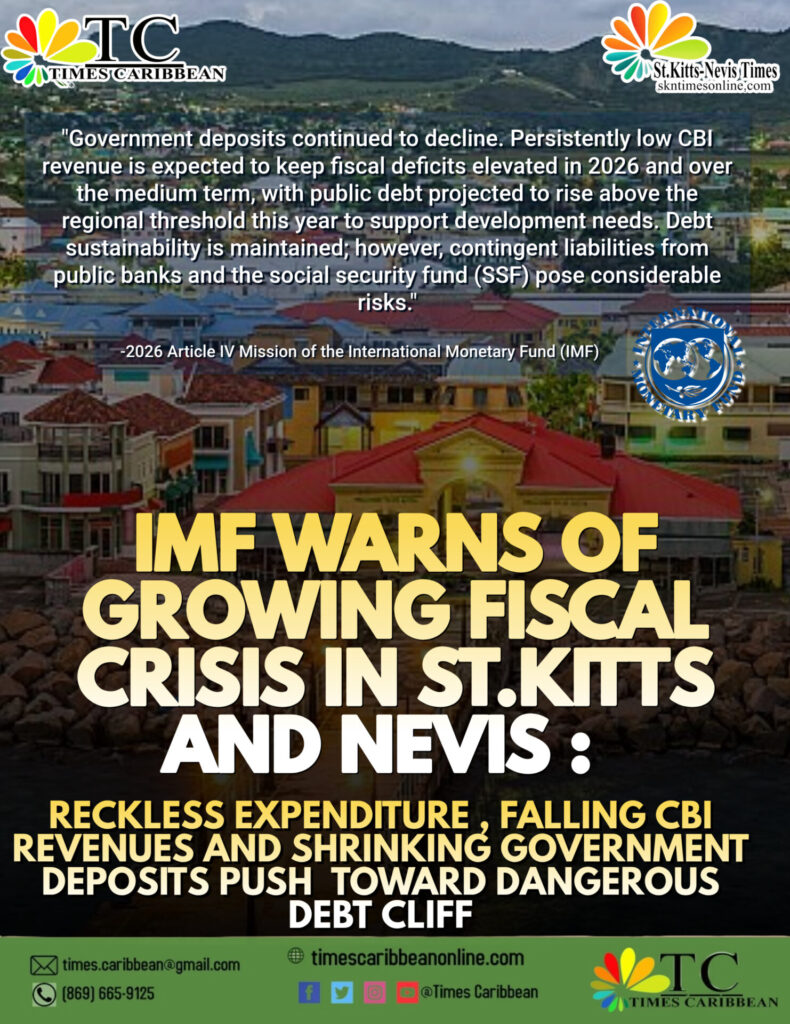
IMF WARNS OF GROWING FISCAL CRISIS IN ST.KITTS AND NEVIS : RECKLESS EXPENDITURE , FALLING CBI REVENUES AND SHRINKING GOVERNMENT DEPOSITS PUSH TOWARD DANGEROUS DEBT CLIFF
BASSETERRE, St. Kitts — A sobering assessment from the 2026 Article IV Mission of the International Monetary Fund (IMF) has raised serious alarm bells about the fiscal trajectory of St. Kitts and Nevis, warning that the country is entering a period of heightened economic vulnerability marked by shrinking government deposits, persistently weak Citizenship-by-Investment (CBI) revenues, and a looming rise in public debt above the Eastern Caribbean’s recommended threshold.
The IMF’s Staff Concluding Statement paints a deeply concerning picture of the Federation’s fiscal position, highlighting a convergence of structural pressures that could threaten long-term financial stability if not urgently addressed.
At the heart of the IMF’s warning is a critical development: government cash buffers are steadily eroding.
According to the mission’s assessment, government deposits have continued to decline, reducing the financial cushion that historically helped the government absorb shocks and finance major public initiatives.
For a small island economy heavily exposed to global market fluctuations, natural disasters, and tourism volatility, dwindling fiscal reserves represent a troubling signal.
Economic analysts warn that shrinking government deposits limit the administration’s flexibility to respond to economic downturns or emergencies, potentially forcing greater reliance on borrowing.
Collapse of the CBI Cash Engine
Perhaps the most significant factor behind the fiscal pressure is the continued slump in revenue from the Citizenship-by-Investment (CBI) programme, which for years served as one of the government’s most powerful financial lifelines.
The IMF report notes that persistently low CBI inflows are expected to keep fiscal deficits elevated not only in 2026 but well into the medium term.
This represents a dramatic shift from the previous decade when the CBI programme generated billions of dollars in inflows that fueled public spending, infrastructure projects, and social programmes.
However, tighter international scrutiny, regulatory reforms, increased competition from other jurisdictions, and structural changes within the programme have dramatically reduced inflows.
The result: a widening gap between government revenues and expenditures.
Debt Levels Set to Breach Regional Safety Limits
Compounding the fiscal strain is the IMF’s projection that public debt will rise above the Eastern Caribbean Currency Union’s regional benchmark this year.
The ECCU has long maintained a recommended public debt-to-GDP threshold of 60 percent, considered a prudent limit for small island economies vulnerable to external shocks.
The IMF now expects St. Kitts and Nevis to surpass that threshold, largely driven by increased borrowing to finance development initiatives and offset revenue shortfalls.
While the Fund notes that debt sustainability is technically maintained, the language used by the mission suggests a fragile balance.
In essence, the country is not yet in crisis—but the margin for error is shrinking.
Hidden Financial Risks Lurking in the System
Beyond the headline debt figures, the IMF also flagged significant contingent liabilities that could potentially destabilize public finances if left unmanaged.
Two institutions were singled out as potential sources of risk:
- Public sector banks, which could require state support under adverse economic conditions.
- The Social Security Fund (SSF), a cornerstone of the Federation’s pension and social insurance system.
The IMF warned that financial pressures within these institutions could translate into fiscal liabilities for the government, placing additional strain on already stretched public finances.
For economists, this represents a crucial warning.
Contingent liabilities are often described as “hidden debt”—financial obligations that may not appear in official government debt statistics but could suddenly materialize during economic stress.
A Fragile Economic Balancing Act
The IMF’s assessment underscores a delicate balancing act facing policymakers.
On one hand, the government continues to pursue ambitious development initiatives aimed at transforming the country through infrastructure projects, renewable energy investments, and tourism expansion.
On the other, the fiscal space required to sustain those ambitions is becoming increasingly constrained.
With CBI revenues no longer providing the financial windfall they once did, the government may soon face difficult policy choices:
- Reduce spending
- Increase taxes or fees
- Borrow more aggressively
- Or accelerate structural economic reforms
Each option carries political and economic consequences.
A Warning That Cannot Be Ignored
While the IMF stopped short of declaring an imminent fiscal crisis, the tone of the report leaves little room for complacency.
The Federation’s economic model—once heavily buoyed by extraordinary CBI inflows—now appears to be entering a period of structural adjustment.
For St. Kitts and Nevis, the message from the IMF is unmistakable:
The era of easy money may be over.
And unless decisive fiscal reforms, economic diversification, and stronger financial oversight are implemented, the country could find itself navigating increasingly turbulent economic waters in the years ahead.
















Leave a comment
You must be logged in to post a comment.