Sovereignty, Security and the CARICOM Crossroads
COMMENTARY By Paul Sarran
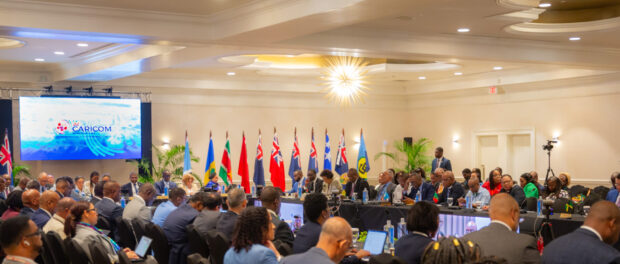
The Fiftieth (50th) Regular Meeting of the Conference of Heads of Government of CARICOM, convened in Saint Kitts and Nevis from 24–27 February 2026, will likely be remembered as a defining political moment for Trinidad and Tobago. At that regional table, Prime Minister Kamla Persad-Bissessar made it unmistakably clear: Trinidad and Tobago will no longer automatically align itself with every foreign and security position adopted by the Caribbean Community.
Her now widely quoted phrase — “Who vex loss” — resonated beyond the conference hall. It captured a domestic mood shaped by fatigue, frustration, and a growing insistence that national interests must take precedence over diplomatic convention.
For years, a segment of the population believed Trinidad and Tobago operated in what critics described as “yes man” mode — locally, regionally, and internationally. Decisions were often justified in the name of unity, but many citizens questioned whether such alignment consistently advanced national security or economic stability. At this Summit, the Prime Minister signaled a recalibration, not a retreat. She affirmed that Trinidad and Tobago would craft foreign and security policies grounded in sovereignty and national necessity.
As a young political scientist, I observed a leadership style rooted in clarity rather than confrontation. Leadership sometimes demands candour. When the Prime Minister referenced CARICOM’s past posture toward Nicolás Maduro’s government — particularly amid tensions affecting Trinidad and Tobago and Guyana — she raised a difficult but legitimate question: can regional unity endure if member states feel their security concerns are sidelined?
At the grassroots level, the issue is simpler. If threats to your home are minimized, trust erodes. The Prime Minister argued that Trinidad and Tobago must defend its sovereignty “as we see fit,” especially in light of narcotics trafficking, arms flows, and irregular migration that continue to strain national systems.
Illegal migration is not an abstract debate. Estimates suggest tens of thousands of undocumented migrants reside in Trinidad and Tobago. In a nation of approximately 1.4 million people, the pressure on healthcare, education, housing, and social services is tangible. Taxpayers feel it. When crime rates remain high and social services are stretched thin, citizens inevitably question whether deeper regional integration should advance before domestic stability is secured.
Perhaps the most controversial aspect of her address was the decision to delay full implementation of free movement under the CARICOM Single Market and Economy (CSME). The Prime Minister explicitly linked this to border control and crime prevention. With murder rates having reached alarming levels in recent years, she maintained that securing communities must precede expanding mobility frameworks.
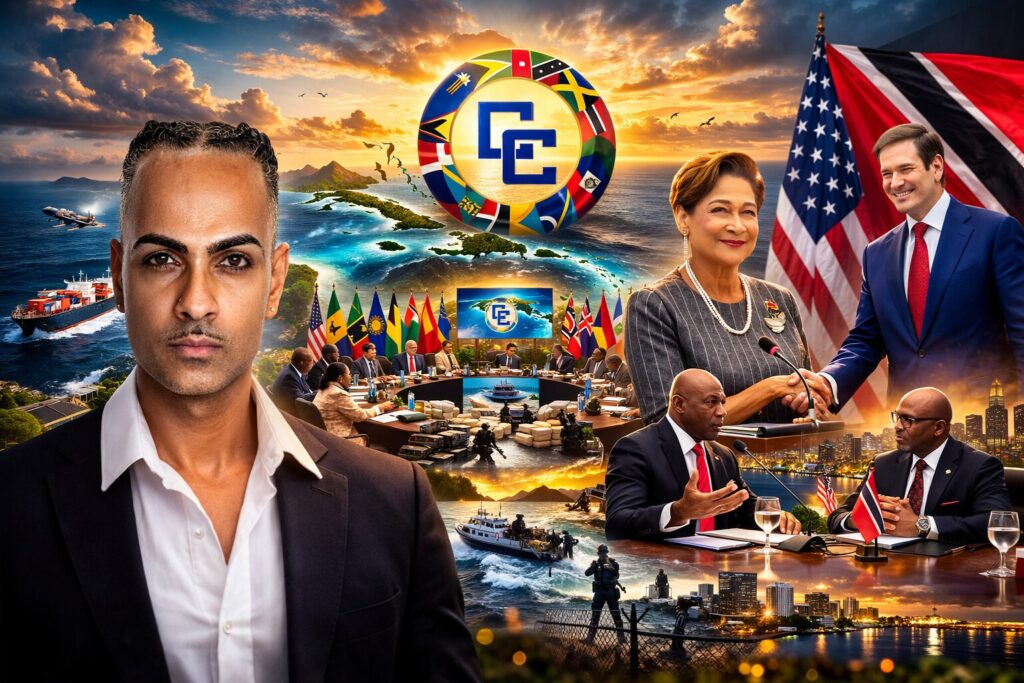
Many citizens support that caution. Security is immediate and personal. Families affected by gang violence and drug-related crime demand decisive action. The Prime Minister also credited cooperation with the United States — including engagement with President Donald Trump and Secretary of State Marco Rubio — as contributing to reductions in murders during 2025. Whether one agrees with that alignment or not, her central argument was straightforward: combating narco-trafficking is a regional defense strategy, not a betrayal of Caribbean solidarity.
Yet balance remains essential. While postponing full free movement may address immediate security anxieties, Trinidad and Tobago continues to grapple with brain drain and underemployment. Skilled nationals migrate in search of opportunity. Young graduates confront limited job prospects. Regional integration was designed to expand economic space, create mobility for talent, and strengthen competitiveness within a globalized economy.
If caution becomes prolonged isolation, unintended consequences may follow. Crime and economic stagnation are often intertwined. Limited opportunity fuels vulnerability to illicit networks. Therefore, the debate over free movement should not be permanently foreclosed; it should evolve alongside measurable improvements in border management, intelligence coordination, and crime reduction.
Another notable gesture was the inclusion of Tobago House of Assembly Chief Secretary Farley Augustine at the Summit. That invitation symbolized internal unity. Tobago’s developmental priorities are distinct, and its participation reinforced the principle that sovereignty begins with domestic cohesion.
Importantly, the Prime Minister reaffirmed Trinidad and Tobago’s commitment to CARICOM. Withdrawal was never the objective. Instead, she called for a Community that respects national sovereignty, avoids partisan entanglement in domestic politics, and strengthens transparency and collective security coordination.
For CARICOM, this moment invites introspection. Unity must respond to contemporary realities — migration pressures, organized crime, economic uncertainty — rather than rely solely on diplomatic symbolism. For Trinidad and Tobago, sovereignty must be matched by disciplined governance. If integration is paused in the name of security, measurable progress on crime reduction and border enforcement must follow. Citizens will judge outcomes, not rhetoric.
The 50th CARICOM Summit marked a political inflection point. Prime Minister Kamla Persad-Bissessar chose clarity over comfort. Whether one agrees with her positions or not, the conversation she ignited — about sovereignty, security, and integration — will shape Trinidad and Tobago’s role within the Caribbean family for years to come.
Paul Sarran holds a BSc in Political Science from The University of the West Indies.
















Leave a comment
You must be logged in to post a comment.