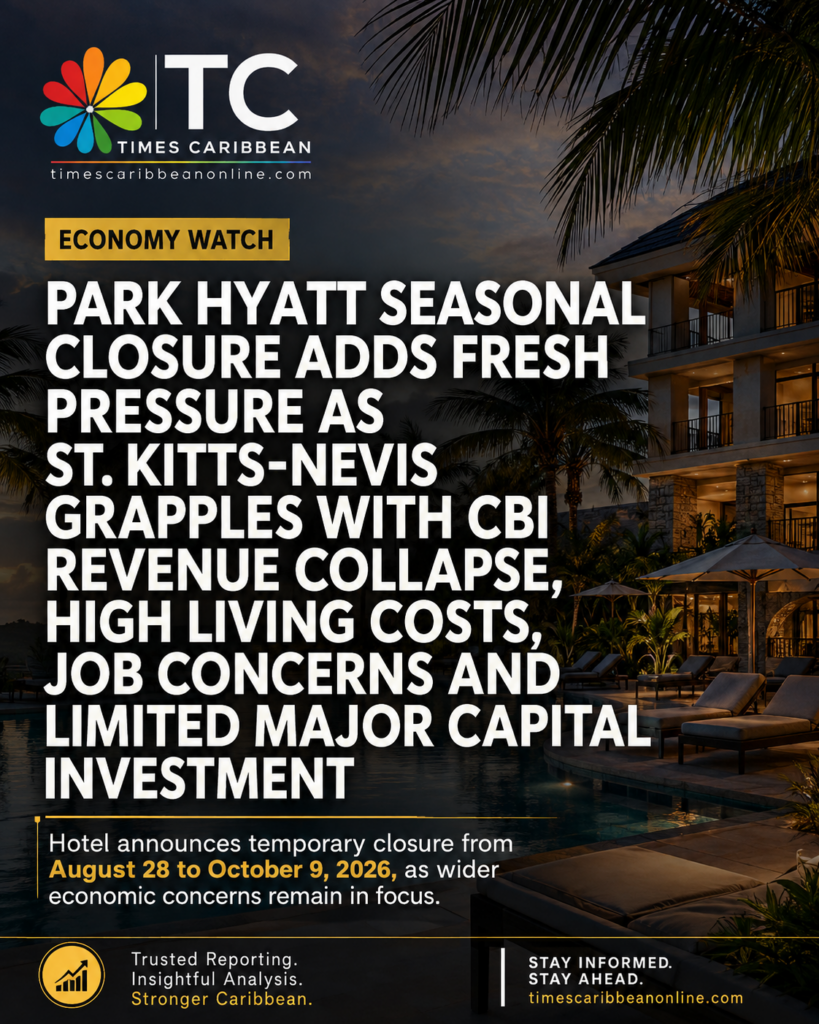
PARK HYATT SEASONAL CLOSURE ADDS FRESH PRESSURE AS ST. KITTS-NEVIS GRAPPLES WITH CBI REVENUE COLLAPSE, HIGH LIVING COSTS, JOB CONCERNS AND LIMITED MAJOR CAPITAL INVESTMENT
TIMES CARIBBEAN ANALYSIS | BASSETERRE, ST. KITTS — August 23, 2026
St. Kitts and Nevis could be heading into an even more difficult economic stretch.
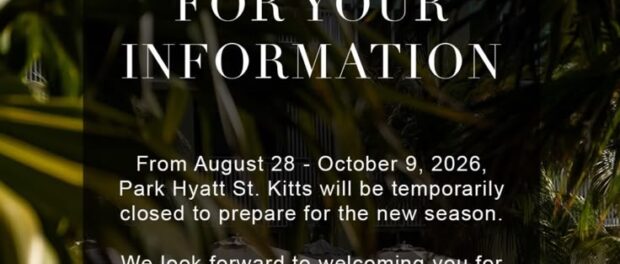
The announced seasonal closure of the Park Hyatt St. Kitts Christophe Harbour for the coming months is expected to temporarily remove another important source of wages, purchasing power and economic activity at a time when many households say they are already struggling with high living costs and tight disposable incomes.
For workers, this is not simply about a hotel closing during the traditionally slower tourism period.
It is about paychecks.
And when hundreds of household expenses continue arriving whether a worker is earning or not, even a temporary interruption in income can carry serious consequences.
The wider economic backdrop makes the development even more concerning.
The latest assessment from the International Monetary Fund confirms that the Federation is not experiencing the kind of robust expansion that would easily absorb another employment shock. The IMF estimates that real economic growth slowed to just 1.5 percent in 2025, down from 1.7 percent in 2024, with weaker-than-expected construction activity and low Citizenship by Investment inflows among the factors weighing on performance.
So while describing the economy as being in outright collapse would go beyond the available evidence, describing it as an economy facing serious fiscal and growth pressures is increasingly difficult to dispute.
CBI REVENUE HAS FALLEN DRAMATICALLY
Perhaps the biggest warning sign is the extraordinary decline in Citizenship by Investment revenue.
According to the IMF, CBI revenue represented almost 26 percent of GDP in 2022. By 2024, that figure had fallen to 8.6 percent. In 2025, it dropped further to just 5.3 percent of GDP.
That is a seismic change for a small economy that had become heavily dependent on those inflows.
The IMF says the decline has contributed to substantial fiscal pressures. The overall fiscal deficit reached 11.7 percent of GDP in 2025, while government deposits continued to fall and public debt stood at 58.4 percent of GDP. The Fund has warned that persistently low CBI revenues could keep deficits elevated and reduce the Government’s ability to respond to future shocks and development needs.
That matters now.
Because when private-sector wages are interrupted, a healthy economy normally provides alternatives — construction projects, expanding businesses, new investments and employment opportunities elsewhere.
Many residents are questioning whether enough of those alternatives presently exist.
BIG PROMISES. MUCH SLOWER DELIVERY.
The Drew administration has announced several ambitious projects since taking office, including 2,400 climate-smart homes, a new climate-smart hospital, major tourism developments and other infrastructure initiatives.
But the pace at which several flagship projects have translated into widespread employment and visible completed development has become a legitimate subject of public debate.
Government information currently describes the 2,400-home initiative as under construction, with about 100 homes rising at several locations. That is progress, but it remains a fraction of the original four-year 2,400-home ambition announced in 2023.
The Government’s own Sustainable Island State Agenda continues to list several major undertakings as either “in the pipeline” or at varying stages of implementation.
The desalination programme represents one of the more visible major infrastructure initiatives now under construction, while Government information also points to housing, renewable-energy and other works underway.
So it would be inaccurate to suggest that absolutely no capital investment is occurring.
But the harder economic question is different:
Is enough investment happening, quickly enough and at sufficient scale, to generate the volume of jobs and disposable income the country now needs?
That is where the Park Hyatt development becomes especially significant.
THE REAL IMPACT WILL BE FELT AT HOME
A hotel employee without several months of regular earnings still has rent or a mortgage.
There is still food to buy.
School expenses remain.
Transportation costs remain.
Electricity and water bills remain.
Some workers are reportedly already dealing with utility arrears or disconnections, according to concerns communicated to Times Caribbean. Those individual circumstances have not been independently verified, but the broader issue highlights the vulnerability of households living from one pay period to the next.
For those families, a seasonal closure can become a personal financial emergency.
And there is a multiplier effect.
Park Hyatt workers spend money in supermarkets, restaurants, shops, taxis, bars, salons and small businesses. They pay landlords. They purchase fuel. They support relatives.
When that money temporarily disappears, the impact travels.
One lost paycheck can touch several businesses.
Multiply that across a significant workforce and the slowdown spreads quickly.
THE ECONOMY NEEDS NEW ENGINES
There is another uncomfortable reality.
St. Kitts and Nevis cannot simply wait for CBI revenues to return to their extraordinary 2021–2023 levels.
The IMF itself has stressed the importance of diversification, fiscal adjustment and stronger productive investment. Its 2026 assessment says the country’s reduced financial buffers now limit its capacity to respond to shocks, while risks to near-term economic growth remain tilted to the downside.
Tourism remains resilient. That is good news.
But resilience at the national level does not pay the electricity bill of a hotel worker temporarily without regular income.
This is where economic statistics meet kitchen-table reality.
The Park Hyatt closure is seasonal and should therefore not be presented as the permanent loss of one of St. Kitts’ flagship resorts. But its timing exposes something much bigger: the Federation remains highly vulnerable whenever a major employer temporarily reduces economic activity.
That vulnerability becomes more serious when CBI revenues have plunged, fiscal deficits are elevated, construction growth has underperformed expectations and several transformational projects have yet to reach the scale originally anticipated.
Tough months may therefore lie ahead for some households.
And the central issue facing policymakers is no longer simply how many projects can be announced.
It is how quickly investment can be converted into real construction, real businesses, real jobs and reliable household income.
Because for families facing months with reduced earnings, economic promises cannot settle this month’s bills.
They need economic activity now.
















Leave a comment
You must be logged in to post a comment.