OVER 300 HEALTHCARE PROFESSIONALS REGISTERED — SO WHY ARE LESS THAN 25% ABLE TO ACCEPT NEW SWOOSH HEALTH CARDS?

TIMES CARIBBEAN | SKN TIMES | ST. KITTS-NEVIS DAILY
Questions Mount Over Preparedness, Access, and the Risk of Creating a Two-Tier Healthcare System in St. Kitts and Nevis
BASSETERRE, St. Kitts — Serious concerns are being raised across St. Kitts and Nevis following revelations that despite the Federation reportedly having more than 300 registered healthcare professionals and providers — including approximately 81 licensed physicians — fewer than 25 percent appear to be currently approved or equipped to accept the newly introduced Swoosh health insurance cards.
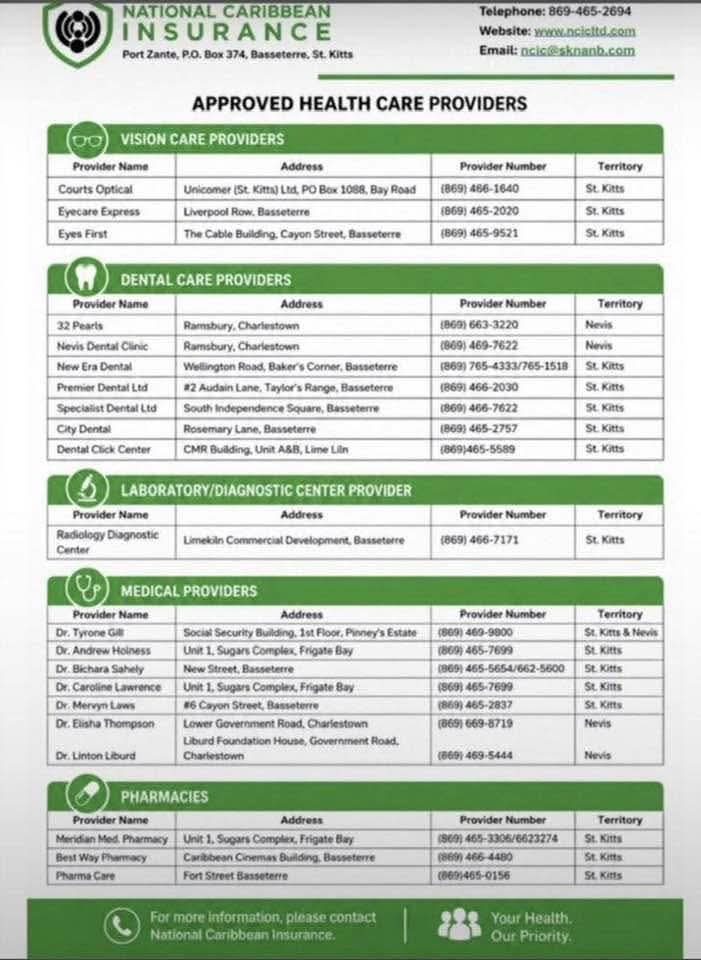
The situation has ignited frustration, confusion, and growing public criticism, with many citizens questioning how a healthcare initiative promoted as transformational could launch without widespread provider integration across the Federation’s medical sector.
Available information indicates that while St. Kitts and Nevis boasts one of the highest physician-to-population ratios in the Caribbean, the list of providers presently approved under certain private insurance arrangements remains strikingly limited when compared to the broader healthcare landscape.
The contrast is difficult to ignore.
On one hand, official and publicly available information points to approximately 81 registered medical doctors, alongside hundreds of nurses, pharmacists, and allied health professionals operating throughout the Federation. Yet the approved provider list currently circulating publicly appears to include only a relatively small network of doctors, pharmacies, dental clinics, and diagnostic facilities.
Critics say the disparity exposes what they describe as a dangerous gap between political announcements and operational readiness.
BIG PROMISES — SMALL NETWORK?
For many citizens, the core question is simple:
How can a modern national healthcare financing or insurance initiative function effectively if a majority of medical professionals and healthcare facilities are not yet integrated into the system?
Healthcare observers argue that unless broad provider participation exists, patients may encounter major limitations in where they can seek treatment, fill prescriptions, obtain diagnostic testing, or access specialized care.
Several residents have reportedly expressed concern that patients could be forced to choose between paying out-of-pocket at non-participating clinics or enduring delays trying to locate approved providers.
Others fear the situation may unintentionally create a fragmented healthcare environment where access becomes dependent not on medical need — but on whether a provider has been onboarded into the system.
Critics have further questioned whether sufficient consultations were conducted with private practitioners, pharmacies, laboratories, dentists, and specialists before rollout efforts accelerated.
A SYSTEM UNDER PRESSURE
The issue arrives at a time when St. Kitts and Nevis is already grappling with broader healthcare pressures, including long wait times, staff shortages in some sectors, infrastructure concerns, rising healthcare costs, and increased demand for specialized services.
Healthcare professionals privately speaking on the matter have reportedly raised concerns about reimbursement structures, technological readiness, administrative processes, and uncertainty surrounding how smoothly claims and payments will operate under the new arrangement.
Some observers argue that unless rapid expansion occurs, the burden could become concentrated on a small number of participating providers, potentially leading to overcrowding, appointment bottlenecks, and reduced efficiency.
“This cannot simply be about issuing cards and hosting launch ceremonies,” one healthcare stakeholder reportedly commented. “A healthcare system succeeds only when patients can actually use it seamlessly across the country.”
THE NUMBERS THAT ARE RAISING EYEBROWS
Publicly circulating figures indicate:
- Approximately 81 registered physicians in St. Kitts and Nevis
- Hundreds of additional healthcare workers and allied professionals
- Multiple clinics, pharmacies, dental facilities, and laboratories operating across both islands
Yet the currently circulated approved-provider listing appears comparatively narrow, with participation limited to select entities.
If accurate, critics say this would mean that well under one-quarter of the Federation’s broader healthcare provider ecosystem is presently accessible through the approved network.
That statistic alone has triggered intense public debate.
PUBLIC CONFIDENCE AT STAKE
Analysts warn that healthcare reform initiatives rise or fall on public trust.
If citizens begin perceiving the system as inaccessible, politically driven, poorly coordinated, or operationally incomplete, confidence could erode rapidly.
There are also growing calls for authorities to publicly clarify:
- How many providers have formally applied
- How many have been approved
- How many are pending onboarding
- What criteria are being used
- Whether additional providers are expected in coming weeks or months
- What technological or compliance barriers currently exist
Transparency, many argue, is now essential.
THE BIGGER QUESTION
Beyond the immediate controversy lies a much larger national concern:
Was the healthcare infrastructure truly ready for implementation at the scale being publicly promoted?
Critics say the current situation risks reinforcing a troubling pattern in national governance — grand announcements unveiled before systems, logistics, staffing, partnerships, and operational readiness are fully in place.
Supporters of the initiative, meanwhile, are expected to argue that onboarding healthcare providers is an evolving process and that expansion will continue over time.
However, for many citizens already struggling with healthcare affordability and accessibility, patience may be wearing thin.
Because in healthcare, perception matters — but functionality matters even more.
And right now, many citizens are asking whether the rollout is delivering genuine healthcare transformation… or simply another ambitious promise moving faster than the system behind it.

















Leave a comment
You must be logged in to post a comment.