ONLY 1 OF 5 COAST GUARD VESSELS CURRENTLY OPERATIONAL AS FISHERMEN AND PRIVATE BOATS HELP AVERT APPLE SYDER FERRY DISASTER
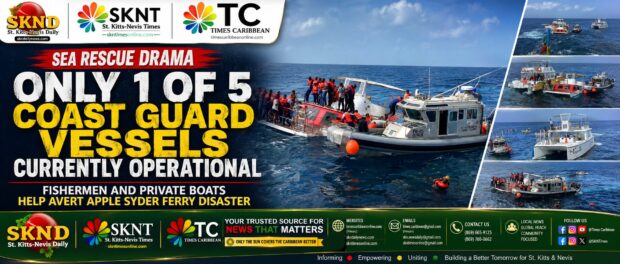
BASSETERRE, ST. KITTS, June 29, 2026 — St. Kitts and Nevis is today giving thanks that every passenger and crew member aboard the MV Apple Syder was safely rescued after a terrifying maritime emergency near Basseterre. But behind the relief, praise, and official statements, one devastating question now demands urgent national attention: how did a twin-island Federation reportedly enter a major ferry emergency with only one of five Coast Guard vessels currently operational?
The Apple Syder incident could have ended in unimaginable heartbreak. Instead, according to available reports and eyewitness accounts, fishermen, private vessels, the MV Makana, emergency responders, and the St. Kitts and Nevis Coast Guard moved quickly to help bring passengers to safety.
That swift response saved lives. The fishermen and private boat operators who answered the call deserve national recognition. The crew of the MV Makana deserves commendation. The Coast Guard officers who responded with the vessel available to them deserve praise for doing their duty under pressure.
But praise for brave responders cannot be allowed to bury the bigger scandal now facing the country.
Reports and public concerns now suggest that only one Coast Guard vessel was operational and able to assist during the Apple Syder emergency, despite the St. Kitts and Nevis Defence Force Coast Guard flotilla being associated with a fleet of five primary vessels tasked with protecting territorial waters, drug interdiction, maritime surveillance, and search and rescue.
That reported gap is not minor. It is not technical. It is not something to be brushed aside with a public relations statement.
It is a national safety concern.
The Coast Guard’s active fleet inventory has been understood to include two nearshore interceptors, 33-foot high-speed SAFE Boats designed to serve as core response and interdiction assets. These vessels reportedly underwent full mid-life overhauls and engine replacements through a U.S. Southern Command-supported modernization initiative.
The fleet also includes one Zodiac rigid-hull inflatable boat, used for rapid tactical deployments, shallow-water tracking, and boarding operations; one Boston Whaler, commonly deployed for coastal surveillance, harbour security, and local emergency response; and one offshore patrol vessel or main cutter intended for longer-range maritime patrols extending into the Exclusive Economic Zone.
The long-serving cutter Stalwart, reportedly 38 years old, had already been decommissioned for replacement as part of the effort to upgrade the country’s disaster relief, humanitarian response, and maritime security capabilities.
That is the background. Now comes the troubling question.
If the Federation has a five-vessel Coast Guard framework, why was only one vessel reportedly operational at the moment passengers were depending on the state’s emergency response system to save their lives?
Who allowed the fleet to reach this point?
Where are the other vessels?
Are they down for maintenance? Awaiting parts? Decommissioned without replacement? Parked, inactive, or otherwise unavailable? Was the public ever told that the nation’s maritime response capacity had been reduced so sharply?
These are not partisan questions. These are life-and-death questions in a country where thousands of residents, workers, students, tourists, businesspeople, and families depend on inter-island sea travel between St. Kitts and Nevis.
Monday’s emergency exposed a frightening reality: when the Apple Syder began taking on water, the country did not only rely on official assets. It relied heavily on community courage. Fishermen, private vessels, and nearby marine operators became part of the rescue chain.
Their response was heroic. But national safety cannot depend on luck, proximity, and the goodwill of private citizens.
St. Kitts and Nevis is surrounded by water. The ferry route between Basseterre and Charlestown is not a luxury route; it is a national lifeline. A proper maritime safety system must be ready before disaster strikes, not scrambling after a vessel is already in distress.
The Government has expressed gratitude that all aboard the Apple Syder are safe. It has commended the Coast Guard, emergency responders, hospital staff, civilians, fishermen, and the crew of the MV Makana. That gratitude is appropriate.
But gratitude is not accountability.
The country now needs a full public explanation from the relevant authorities. The people deserve to know exactly how many Coast Guard vessels are currently operational, how many are not operational, how long they have been out of service, what caused the downtime, what repairs are needed, how much those repairs will cost, and when full fleet readiness will be restored.
The nation also deserves to know whether ferry safety inspections are being conducted rigorously, whether emergency evacuation standards are being reviewed, whether communication systems functioned properly, and whether the Coast Guard had the necessary equipment, manpower, and vessels to respond at the level required.
This incident should trigger an immediate maritime safety review covering the Apple Syder, ferry operations, Coast Guard fleet readiness, vessel maintenance records, emergency response protocols, harbour coordination, passenger safety systems, and inter-island rescue capacity.
Anything less would be reckless.
The Apple Syder passengers were spared. Families were not plunged into mourning. A national tragedy was avoided.
But the fact that tragedy was avoided must not become an excuse for silence.
If only one of five Coast Guard vessels was operational during a real ferry emergency, then St. Kitts and Nevis has a serious readiness problem that must be addressed immediately and transparently.
The fishermen and private vessels helped save the day.
Now the Government must answer for the system.
















Leave a comment
You must be logged in to post a comment.