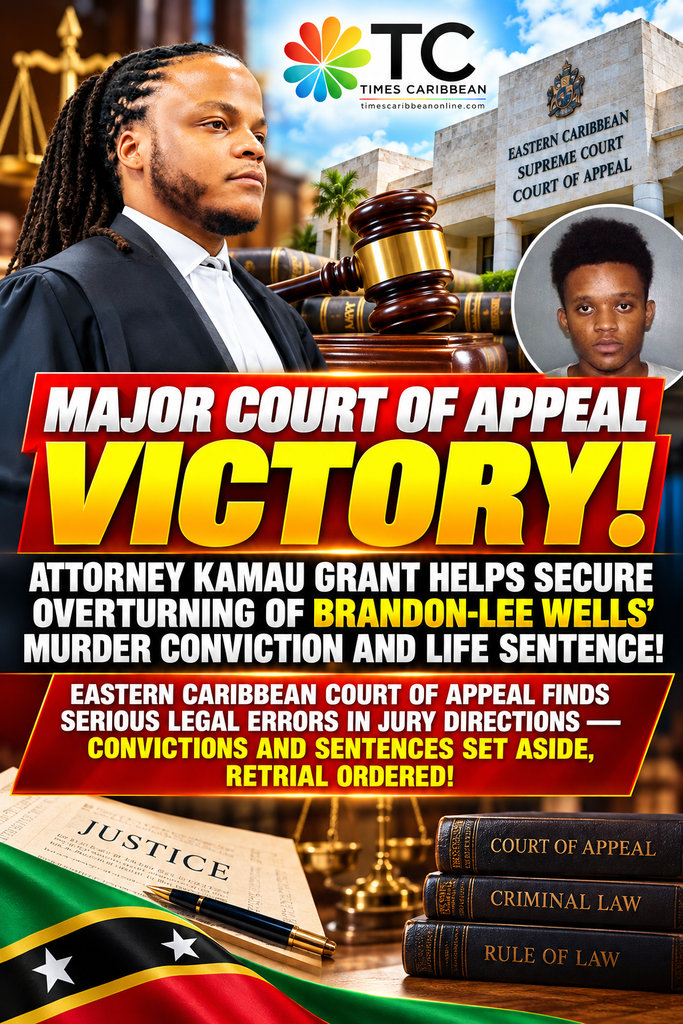
MAJOR COURT OF APPEAL VICTORY! ATTORNEY KAMAU GRANT HELPS SECURE OVERTURNING OF BRANDON-LEE WELLS’ MURDER CONVICTION AND LIFE SENTENCE!
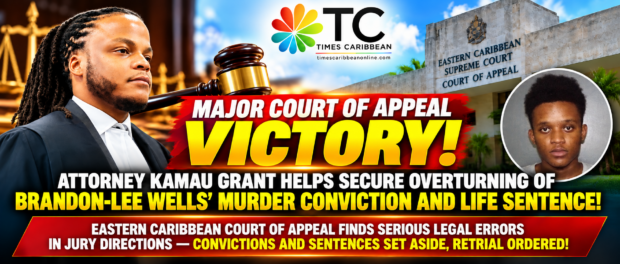
EASTERN CARIBBEAN COURT OF APPEAL FINDS SERIOUS LEGAL ERRORS IN JURY DIRECTIONS — CONVICTIONS AND SENTENCES SET ASIDE, RETRIAL ORDERED!
TIMES CARIBBEAN | BREAKING LEGAL NEWS | OCTOBER 27, 2026
BASSETERRE, ST. KITTS — St. Kitts and Nevis Attorney Kamau Grant has been named among the lawyers on a successful appellate defence team following a significant ruling by the Eastern Caribbean Court of Appeal, which has overturned the murder conviction and life sentence imposed on Brandon-Lee Wells in the 2017 Leanna Napoleon case.
In a judgment delivered on October 20, 2026, and filed on October 27, the Court of Appeal set aside Wells’ convictions for murder and attempting to pervert the course of justice after finding a serious legal error in the trial judge’s directions to the jury concerning an alleged oral confession.
The ruling represents a major legal success for the defence team, which included Attorney Kamau Grant, appearing alongside Chesley Hamilton and Johsiah Imo.
The court accepted a central ground of the team’s appeal: that the trial judge had failed to properly direct the jury on evidence capable of corroborating the alleged confession.
That finding proved decisive.
ATTORNEY KAMAU GRANT PART OF SUCCESSFUL LEGAL CHALLENGE
The 98-page judgment identifies Mr. Chesley Hamilton, Mr. Kamau Grant and Mr. Johsiah Imo as counsel appearing for Wells.
Their appeal raised two substantial questions concerning the treatment of evidence during the original trial.
The first challenged whether the jury had received adequate warnings about evidence from a prosecution witness who was an admitted accomplice.
The second challenged the adequacy of the trial judge’s directions concerning an alleged oral confession attributed to Wells while he was in police custody.
Although the Court of Appeal rejected the first ground, the second ground succeeded, resulting in both convictions and sentences being overturned.
The successful argument centred on the trial judge’s failure to identify for the jury what evidence, if any, could independently support the alleged confession.
The Court of Appeal determined that this omission constituted a serious error of law.
For Grant and his colleagues, the decision represents a substantial appellate achievement in a case that has attracted national attention for nearly a decade.
THE UNRECORDED CONFESSION AT THE CENTRE OF THE APPEAL
The prosecution’s original case relied heavily on two sources of evidence.
One was the deposition of Judanja Edmeade, an admitted accomplice who was unavailable for cross-examination at trial.
The other was an alleged oral confession reportedly made by Wells to Detective Constable Detroit Henry in the presence of Major Campbell on June 17, 2017.
However, the alleged confession was neither electronically recorded nor signed or acknowledged in writing by Wells.
The written statement itself was not admitted into evidence, although testimony concerning the alleged oral admissions was permitted.
The appellate judges concluded that, while the trial judge had given substantial warnings about the reliability of this evidence, he failed to address a separate and essential issue.
What independent evidence, if any, supported the alleged confession, and how should the jury assess it?
The appellate court determined that the trial judge was required to assist the jury in identifying evidence capable of corroborating the alleged statements.
His failure to do so was a serious omission.
COURT FINDS SUBSTANTIAL MISCARRIAGE OF JUSTICE
In its findings, the Court of Appeal concluded that the errors in the trial judge’s summation amounted to a substantial miscarriage of justice.
Justice of Appeal Gerard St. C. Farara, who delivered the judgment, stated:
“I am unconvinced that a jury properly directed would have convicted the appellant.”
The court therefore declined to apply the statutory provision that could otherwise have allowed the convictions to stand despite the identified errors.
That determination was central to the success of the appeal advanced by Wells’ legal representatives.
The ruling was supported by Justices of Appeal P. Nicola Byer and Gertel Thom.
LIFE SENTENCE AND SECOND CONVICTION SET ASIDE
Wells had been convicted on October 11, 2019, following a jury trial arising from the death of his maternal half-sister, Leanna Napoleon, in May 2017.
On November 6, 2020, he was sentenced to life imprisonment for murder and five years for attempting to pervert the course of justice, with the sentences running concurrently.
The Court of Appeal has now formally set aside both convictions and their associated sentences.
However, the ruling does not amount to an acquittal or a finding that Wells is innocent.
The appellate judges ordered a retrial, to take place as expeditiously as practically feasible, subject to the Director of Public Prosecutions’ assessment of whether a fresh trial remains possible.
The court also directed that Wells remain in custody pending a new trial unless a court grants him bail following an application.
IMPORTANT DECISION FOR CRIMINAL JUSTICE IN ST. KITTS AND NEVIS
Beyond the outcome for Wells, the decision addresses significant questions about the responsibility of trial judges when directing juries on disputed oral confessions.
It reinforces the distinction between simply warning jurors to exercise caution and properly identifying evidence that may support an alleged admission.
That distinction ultimately determined the appeal.
For Attorney Kamau Grant and the wider defence team, the successful challenge demonstrates the importance of rigorous legal advocacy, careful examination of trial procedures and the right of every accused person to have their case determined according to law.
The Court of Appeal’s ruling leaves the prosecution with the decision on how to proceed with the ordered retrial.
The original convictions have been overturned. The legal proceedings, however, are not necessarily over.
And for St. Kitts and Nevis, this latest ruling stands as a significant reminder that proper jury directions, procedural fairness and adherence to the rules of evidence remain fundamental to the administration of justice.
TIMES CARIBBEAN — YOUR TRUSTED SOURCE FOR CARIBBEAN NEWS, LAW AND CURRENT AFFAIRS.
Source: Eastern Caribbean Supreme Court, Court of Appeal, Brandon-Lee Wells v. The Director of Public Prosecutions, SKBHCRAP2020/0007, judgment delivered October 20, 2026.
















Leave a comment
You must be logged in to post a comment.