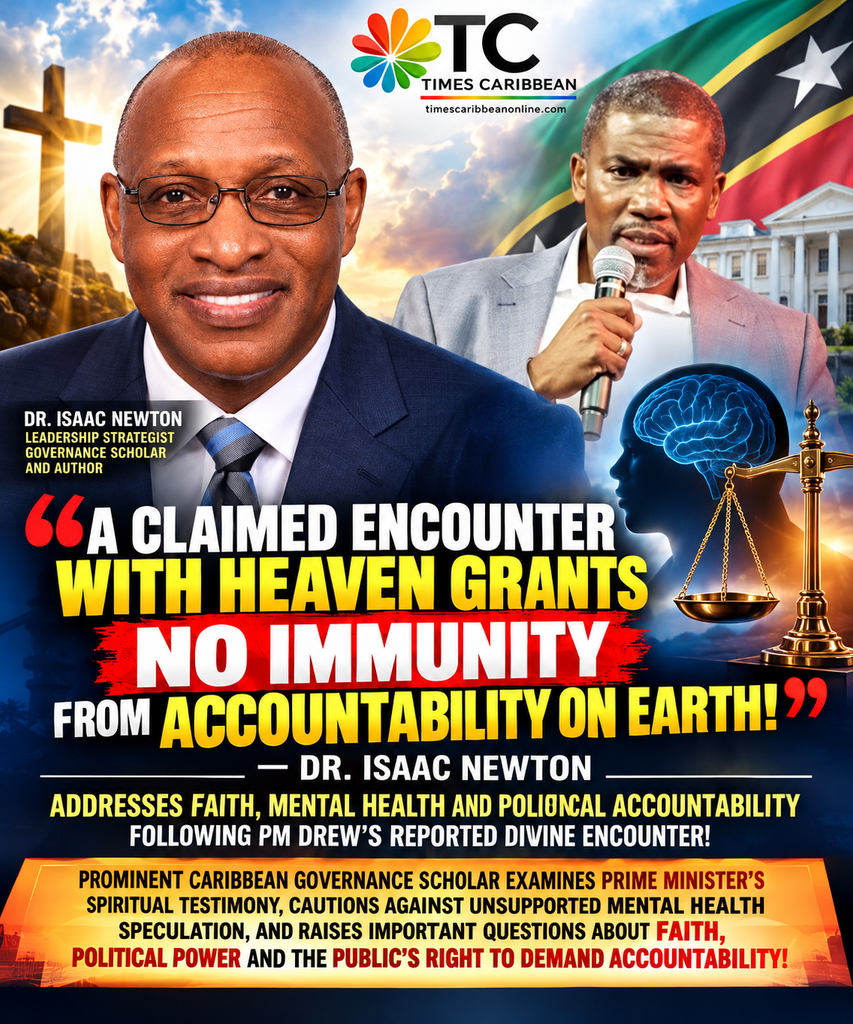
“A CLAIMED ENCOUNTER WITH HEAVEN GRANTS NO IMMUNITY FROM ACCOUNTABILITY ON EARTH!” — DR. ISAAC NEWTON WEIGHS IN ON PM DREW’S REPORTED DIVINE ENCOUNTER
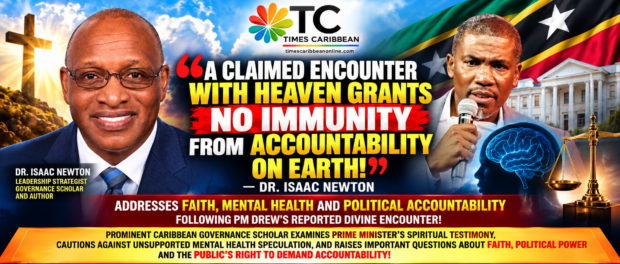
PROMINENT CARIBBEAN GOVERNANCE SCHOLAR RAISES QUESTIONS ABOUT FAITH, POLITICAL POWER AND PUBLIC ACCOUNTABILITY FOLLOWING PRIME MINISTER DR. TERRANCE DREW’S SPIRITUAL TESTIMONY DURING HIS RECOVERY FROM A STROKE
BASSETERRE, ST. KITTS AND NEVIS, OCTOBER 28, 2026 — Can a political leader’s deeply personal encounter with God become a matter of legitimate public discussion? And where should citizens draw the line between respecting a Prime Minister’s religious convictions and holding his government accountable?
These are among the questions raised by respected Caribbean leadership strategist, governance scholar and author Dr. Isaac Newton, whose thought-provoking commentary on Prime Minister Dr. Terrance Drew’s reported spiritual experience during his recent medical crisis has brought renewed attention to the relationship between faith, leadership and democratic responsibility.
In a commentary published on October 27, titled When A Prime Minister Says, ‘I Saw God’: Where Does Faith End and Power Begin?, Newton examines the political and ethical implications of a head of government’s personal testimony of divine intervention.
His central argument is unmistakable: Personal faith deserves respect, but no spiritual experience should place an elected official beyond legitimate public scrutiny.
A PERSONAL TESTIMONY BECOMES A PUBLIC CONVERSATION
Prime Minister Drew returned to St. Kitts and Nevis on Saturday, October 24, following overseas medical treatment and rehabilitation after suffering a stroke in August.
The following evening, a national thanksgiving service was held at National Heroes Park, where the Prime Minister expressed gratitude for his recovery and spoke extensively about his faith.
According to regional media reports, Dr. Drew recounted what he understood to be a personal spiritual encounter during his illness, including a message he believed he received from God and a vision concerning the condition of the world.
His testimony formed part of a wider message of gratitude, hope, prayer and renewed commitment to public service.
For many religious citizens, such expressions of faith are familiar and meaningful, particularly during moments of illness and recovery.
But Newton’s commentary introduces another dimension.
What happens when the person sharing that testimony also exercises the highest political authority in the country?
FAITH DESERVES RESPECT. POWER DEMANDS ACCOUNTABILITY.
Newton makes an important distinction between an individual’s right to religious belief and a political leader’s responsibility to the public.
He neither dismisses Dr. Drew’s reported experience nor attempts to determine whether it was genuinely divine.
Instead, he argues that the spiritual interpretation of a medical crisis remains a matter of personal conviction, while political leadership must continue to be assessed through decisions, conduct, transparency and results.
The distinction matters.
A Prime Minister is entitled to believe that God guided him through a difficult medical experience. Citizens are equally entitled to ask questions about government decisions, healthcare services, national spending, public administration and the delivery of commitments.
These rights are not mutually exclusive.
Newton’s analysis does not establish that Dr. Drew has sought to use his religious testimony to avoid criticism. Rather, it identifies a wider democratic concern: the potential for personal religious conviction to become entangled with political loyalty.
In societies where faith plays a central role in everyday life, that relationship deserves thoughtful examination.
WHEN RELIGIOUS DEVOTION AND POLITICAL LOYALTY INTERSECT
Across St. Kitts and Nevis and the wider Caribbean, religion remains an important part of public culture.
Political leaders regularly participate in worship services, national thanksgiving ceremonies and other religious observances.
For believers, prayer and public expressions of gratitude can encourage unity, compassion and humility.
Newton acknowledges the positive influence religion can have on leadership.
However, his commentary also raises a caution about circumstances in which admiration for a leader’s religious convictions could discourage legitimate questions about that leader’s public responsibilities.
The concern is not whether citizens should respect their Prime Minister’s faith.
It is whether political disagreements can remain open to reasoned discussion without being confused with disagreements about religion itself.
Respecting a leader’s spiritual testimony does not require surrendering the right to question that leader’s policies.
That principle applies regardless of which political party holds office.
FAITH AND MEDICINE ARE NOT COMPETING VERDICTS
Another significant feature of Newton’s commentary is his rejection of attempts to use Dr. Drew’s medical treatment as evidence either for or against the Prime Minister’s reported spiritual experience.
The distinction is particularly relevant given the Prime Minister’s treatment in St. Kitts, Martinique and the United States.
Newton argues that medical science and religious belief address different aspects of the human experience.
Medical professionals assess physical conditions through clinical evidence, treatment and rehabilitation. Religious believers may interpret those same experiences through prayer, gratitude and spiritual meaning.
One does not automatically invalidate the other.
Equally important, Newton cautions against drawing conclusions about the Prime Minister’s mental health from his reported testimony.
Such speculation would be unsupported by the account itself and would distract from the governance issues his commentary seeks to examine.
His argument is about public leadership.
Not medical diagnosis.
Not religious ridicule.
And not an attempt to determine whether a personal spiritual experience occurred.
DOES A SECOND CHANCE AT LIFE CHANGE THE RESPONSIBILITY TO LEAD?
Perhaps the most compelling element of Newton’s analysis concerns what a life-changing experience should mean for those entrusted with political authority.
A leader who believes he has received another opportunity to live may emerge with a renewed appreciation for humility, compassion and service.
But how should that personal transformation be reflected in public leadership?
Newton encourages citizens to examine whether religious conviction strengthens a leader’s willingness to listen, acknowledge concerns, accept correction and respond responsibly to the people.
These are questions that can be evaluated without passing judgment on anyone’s personal relationship with God.
For St. Kitts and Nevis, the discussion also offers an opportunity to examine broader issues of governance, particularly the relationship between political authority, public confidence and institutional accountability.
The Prime Minister’s medical recovery is a personal and national occasion that many citizens have welcomed.
The performance of the government, however, remains a separate matter of public assessment.
Both realities can coexist.
A MESSAGE THAT EXTENDS BEYOND DR. DREW
Although Newton’s commentary was prompted by Prime Minister Drew’s testimony, its underlying argument reaches well beyond any single politician or administration.
It presents a standard for leadership that applies equally to governments and oppositions, ministers and parliamentarians, and political figures who openly identify with religious traditions.
The question is not simply whether a leader speaks about God.
It is whether the values that leader publicly embraces are reflected in ethical conduct, respect for institutions and responsibility to citizens.
For supporters of the Prime Minister, his testimony may represent a sincere expression of gratitude following a difficult personal experience.
For others, Newton’s commentary provides a framework for discussing how religious narratives and political authority should interact.
Neither perspective requires ridicule or personal hostility.
A healthy democratic conversation allows space for religious belief, respectful disagreement and legitimate examination of public decisions.
THE BIGGER QUESTION FOR ST. KITTS AND NEVIS
Dr. Isaac Newton’s intervention ultimately raises an important distinction between spiritual conviction and democratic legitimacy.
Religious faith can inspire leaders to act with greater humility, empathy and purpose.
But the authority to govern comes with responsibilities that remain subject to public examination.
Citizens are not required to determine the spiritual meaning of Dr. Drew’s experience before evaluating his government’s decisions.
Nor should the Prime Minister’s expression of gratitude be interpreted, without evidence, as an attempt to discourage criticism.
The question is whether personal faith and public accountability can reinforce one another while remaining distinct.
Newton’s message invites reflection on that question at a moment when St. Kitts and Nevis is discussing its Prime Minister’s recovery, return to office and renewed commitment to leadership.
For believers, the testimony may be deeply meaningful.
For citizens, accountability remains a continuing democratic responsibility.
And for those entrusted with political power, the challenge is to demonstrate how deeply held values translate into the everyday practice of public service.
The ultimate measure of leadership is not a claimed spiritual encounter, but the actions, decisions and responsibilities that follow it.
EDITOR’S NOTE — ABOUT DR. ISAAC NEWTON
Dr. Isaac Newton is a leadership strategist, governance scholar and author specialising in institutional excellence, ethical leadership and human development.
His educational background includes the University of the Southern Caribbean, Oakwood University, Princeton, Columbia and Harvard.
He is the author of Fix It Preacher, Face Life Squarely and Intimate Intimacy, and co-author of Steps to Good Governance, Daring to Hope, When Nations Kneel and The Belief Code.
His commentary, When A Prime Minister Says, ‘I Saw God’: Where Does Faith End and Power Begin?, was published on October 27, 2026.
TIMES CARIBBEAN | INDEPENDENT NEWS & ANALYSIS
This article examines Dr. Newton’s published commentary and its implications for public leadership. His observations are presented as governance analysis, not as findings of misconduct by the Prime Minister. The precise wording “I saw God” is drawn from the commentary’s title and is not independently established here as a verbatim quotation from Dr. Drew.
















Leave a comment
You must be logged in to post a comment.