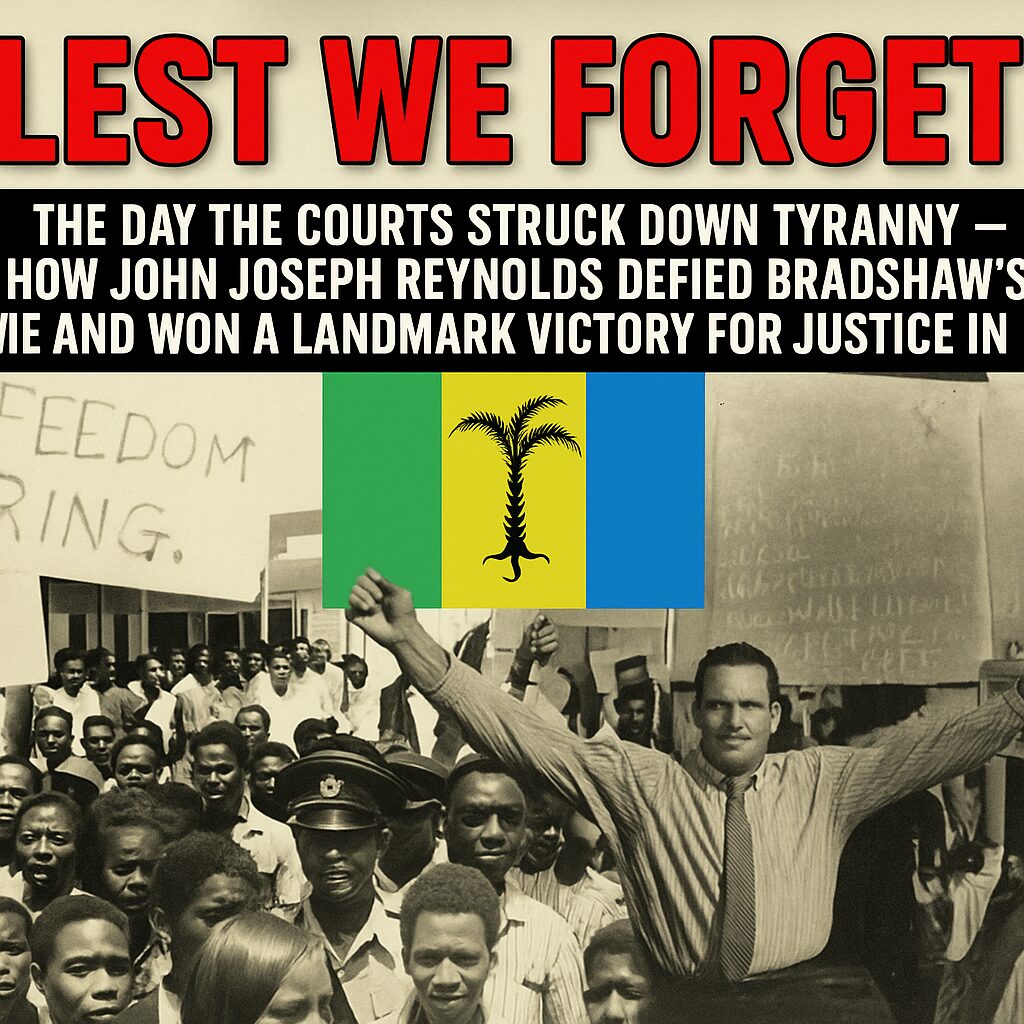
LEST WE FORGET: The Day the Courts Struck Down Tyranny — How John Joseph Reynolds Defied Bradshaw’s Regime and Won a Landmark Victory for Justice in St. Kitts-Nevis
by Sheldon Pemberton,
Unlawfully jailed. Stripped of dignity. Left to rot in squalor.
But in the face of political persecution and unconstitutional abuse of power, John Joseph Reynolds stood tall — and the Eastern Caribbean Court of Appeal stood with him.
This is not just a case from 1977 — it is a cautionary tale and a constitutional triumph.
One that reminds us all: No government is above the law.
#LestWeForget #ReynoldsVsTheState #CivilLibertiesMatter #JusticePrevails #SKNHistory #KnowYourRights #PAM #BradshawEraExposed
Case Summary: Attorney-General v. John Joseph Reynolds (1977)
Court: Eastern Caribbean Court of Appeal
Decision Date: November 28, 1977
Appeal No.: Civil Appeal No. 2 of 1976
⸻
Background
In 1967, during a period of political unrest in Saint Christopher, Nevis and Anguilla, the ruling Labour Government, led by Premier Robert Bradshaw, declared a state of emergency. Using Emergency Powers Regulations, the government targeted political opponents—including John Joseph Reynolds, a retired police inspector and member of the opposition People’s Action Movement (PAM).
Reynolds was arrested on June 11, 1967, by order of the Governor’s Deputy, B.F. Dias, and imprisoned under degrading and humiliating conditions for two months—without formal charges or evidence.
Legal Issue and Outcome
Reynolds sued the government for false imprisonment and initially won $5,000 in damages. The government, through the Attorney-General, appealed—arguing that:
• The Emergency Powers Regulations (1967) and the
• Indemnity Act (1968) shielded the state from legal liability.
However, the Court of Appeal upheld the original ruling and went further—declaring both the Regulations and the Indemnity Act unconstitutional, as they violated fundamental rights under the Constitution.
Final Judgment:
• Appeal dismissed.
• Indemnity Act struck down.
• Reynolds awarded $18,000 in total, including aggravated and exemplary damages for unlawful detention and inhumane treatment.
Key Individuals and Their Roles
Name Description
John Joseph Reynolds Respondent; retired police inspector; member of PAM; unlawfully detained.
Robert Bradshaw Premier and head of the ruling Labour Party; responsible for invoking the emergency powers.
B.F. Dias Governor’s Deputy; signed Reynolds’ detention order.
Inspector Delsol Arrested Reynolds on June 11, 1967.
Cecil Hewlett Chaired detention tribunal; later served as a Supreme Court Judge.
Joseph Archibald Senior Crown Counsel; represented the government at tribunal hearings.
F. Kelsick Legal counsel for Reynolds.
Mr. Kawaja Represented Reynolds at detention review hearings.
Mr. Renville Represented co-detainee Henry S. Charles.
James Gaskell, Livingstone Sadio, Shefton Warner, Mr. Boon, Mr. Dickenson Fellow detainees held under the emergency powers.
Justice E.L. St. Bernard, Justice N.A. Peterkin, Justice R.A. Nedd Justices of Appeal who ruled on the case.
Justice Glasgow High Court judge who issued the original $5,000 damages ruling.
The Government at the Time
• Name: Government of Saint Christopher, Nevis and Anguilla
• Ruling Party: St. Kitts-Nevis-Anguilla Labour Party (SKNALP)
• Premier: Robert Bradshaw
Key Violations and Concerns (June 10–11, 1967)
1. Abuse of Power
The government used vague and sweeping emergency powers to detain political opponents, bypassing courts and due process.
2. Political Persecution
Reynolds’ affiliation with PAM made him a target. His arrest was politically motivated, not based on legitimate public safety concerns.
3. No Evidence, No Justice
At the tribunal hearing, Senior Crown Counsel admitted there was no evidence against Reynolds, yet he remained detained for weeks.
4. Degrading Conditions
Reynolds endured two months in squalor—defecating in open gutters, bathing in roofless cells, and housed with other prisoners in unsafe, overcrowded conditions.
5. Unconstitutional Shielding
The Indemnity Act (1968) attempted to grant retroactive immunity to state actors—blocking citizens from seeking justice. The court ruled this unconstitutional, affirming that no government is above the Constitution.
Why This Case Matters
This case was a landmark victory for civil liberties in Saint Kitts and Nevis. It reasserted:
• The supremacy of constitutional rights over political expediency,
• The importance of judicial review even during emergencies, and
• The need for accountability in the face of state abuse.
Reynolds’ courage—and the court’s integrity—helped preserve the rule of law.
















Leave a comment
You must be logged in to post a comment.