CARICOM CHAIR DREW’S UN MESSAGE REVEALED AS DIRECT COUNTERTO U.S. MILITARY ACTION IN VENEZUELA
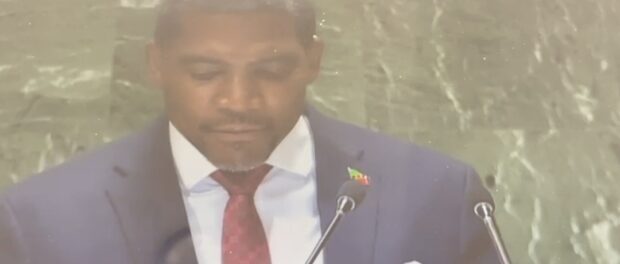
In the eye of a geopolitical storm now engulfing the Western Hemisphere, **Prime Minister Dr. Terrance Drew of St. Kitts and Nevis — serving as the Chairman of the Caribbean Community (CARICOM) — has emerged not just as a regional leader, but as a principled voice of resistance against unilateral military intervention in the Caribbean’s southern neighbourhood.�
CARICOM
What at first appeared to be routine diplomatic language at UN General Assembly’s 80th session has now taken on seismic significance in the wake of the United States’ military intervention in Venezuela. Under the weight of recent events, Drew’s speech now reads less as platitude and more as clear strategic opposition to the use of force — especially when applied without regional consent or multilateral legitimacy.
The Caribbean’s Voice of Peace — Now in Global Tension
In his address at the UN, Drew stated:
“In the Caribbean, we continue to call for and guard our zone of peace. The Argyll Declaration serves as a shining example of how we in the Caribbean manage security challenges… The international community would do well to follow this approach… inject new life into our diplomacy.”
For a region historically buffeted by colonial intervention and outside influence, the deliberate invocation of “dialogue and cooperation” was no rhetorical accident — it was sovereignty asserting itself in global forums. Drew’s emphasis on peaceful engagement and regional mechanisms — exemplified by the Argyll Declaration — now contrasts starkly with the unfolding violence in Venezuela. In essence, it signals CARICOM’s rejection of militarized templates for resolving interstate conflicts.�
CARICOM
CARICOM Under Drew: A Region Taking a Stand
Dr. Terrance Drew’s chairmanship of CARICOM, effective from January 1 to June 30, 2026, situates him squarely at the helm of Caribbean diplomacy at this critical moment.�
CARICOM
As Chairman of the Conference of Heads of Government, Drew is not merely a figurehead — he is the spokesperson and policy coordinator for the region. His stewardship comes at a time when CARICOM must navigate:
Geopolitical fracturing among member states over foreign policy approaches.�
RJR News
External pressure from global powers seeking alignment or strategic leverage.
Security threats emanating from the region’s immediate proximity to Venezuela’s political crisis.
It is in this context that Drew’s UNGA message — advocating dialogue and diplomacy — takes on new force: it defines CARICOM’s preferred strategic posture and implicitly critiques militarized interventions that may destabilize the region.
A Deliberate Rejection of Militant Solutions
Although Prime Minister Drew avoided naming the United States directly in his UN remarks, the subtext is unmistakable: the Caribbean rejects the framing of force as a solution. His appeal for renewed diplomacy and peaceful conflict resolution sharply contrasts with the language of military intervention.
Here’s why this matters:
CARICOM’s longstanding “Zone of Peace” doctrine positions the region as inherently opposed to external use of force in the hemisphere unless multilaterally sanctioned.
Drew’s framing elevates regional agency — Caribbean nations must speak with one voice, not be spoken for by great powers.�
Jamaica Gleaner
The speech is now being interpreted by diplomats and analysts not as neutral language, but as silent rebuke of U.S. unilateralism in Venezuela.
In practical terms, Drew’s rhetoric is a diplomatic line in the sand: military force undermines the very security and stability the Caribbean seeks to protect.
Strategic Caribbean Leadership at a Critical Juncture
Prime Minister Drew’s leadership of CARICOM at this moment places the Caribbean at a unique crossroads:
Soft power over hard power: By elevating diplomacy and cooperation, Drew is redefining Caribbean influence on the international stage.
Unity amid internal debate: Even as member states navigate divergent views on foreign affairs, Drew’s chairmanship prioritizes cohesion and coordinated action.
Moral authority in geopolitics: Small-state diplomacy — rooted in peaceful dispute resolution — now directly challenges bigger powers’ assumptions about security and intervention.
In stark terms, what was once considered Caribbean idealism is now being cast as strategic realism — and possibly the most compelling regional response to what threatens to be a destabilizing military intervention on the continent’s doorstep.
From Diplomacy to Defense of Regional Norms
As CARICOM Chairman, Drew’s most significant legacy may well be his insistence that:
Peace before power. Dialogue before drones. Cooperation before confrontation.
In a world increasingly polarized and volatile, the Caribbean — guided by Drew’s vocal commitment to peace — is staking a claim not for isolation, but for principled leadership.
If the global community is to avoid cascading conflict, perhaps the lessons emanating from a tiny federation in the Caribbean — and voiced clearly by its leader — should be taken seriously.
Because in defending peace, Dr. Terrance Drew is defending the future of the Caribbean itself — and, arguably, the very norms that make international life civilized.
















Leave a comment
You must be logged in to post a comment.