KIM COLLINS: THE SPRINT THAT PUT ST. KITTS AND NEVIS ON THE WORLD MAP
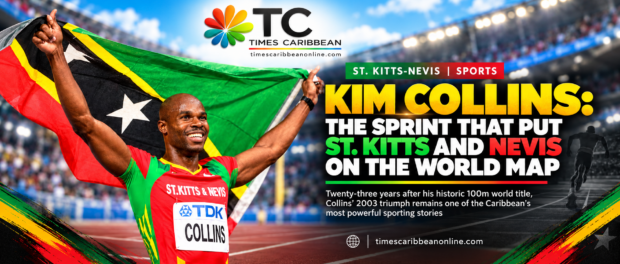
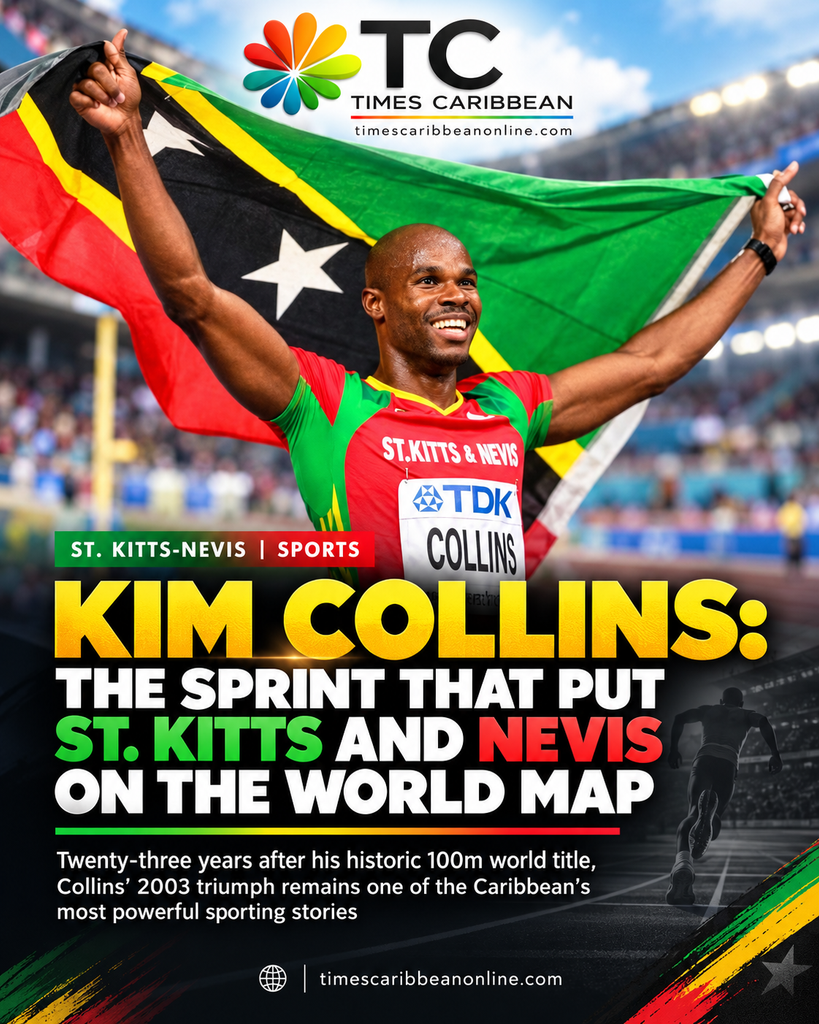
Twenty-three years after his historic 100m world title, Collins’ 2003 triumph remains one of the Caribbean’s most powerful sporting stories
BASSETERRE, ST. KITTS — Before August 2003, millions of sports fans around the world had probably never heard of St. Kitts and Nevis.
Then Kim Collins stepped onto the track.
Seconds later, everything changed.
At the 2003 World Championships in Paris, Collins stunned the athletics world by winning the men’s 100 metres, becoming world champion and delivering one of the greatest sporting achievements in the history of St. Kitts and Nevis.
For a tiny Caribbean nation that had gained independence only 20 years earlier, Collins’ victory was much bigger than a medal.
It was a moment of national arrival.
At the time, Collins reflected on what his achievement meant for his homeland, saying the victory was among the biggest things to happen for St. Kitts and Nevis since independence.
His message was simple, but powerful.
“You don’t have to be from a big country, a rich country, a rich family.”
And almost overnight, people around the world were asking the same question:
Where is St. Kitts and Nevis?
Maps were being searched. The letters SKN suddenly carried meaning on the international sporting stage.
For Kittitians and Nevisians, they carried pride.
FROM SMALL ISLANDS TO THE TOP OF THE WORLD
Collins’ achievement represented something every small country understands.
Population size does not determine ambition.
Resources do not automatically determine greatness.
On the biggest stage in international athletics, Collins lined up against athletes representing countries with vastly larger populations, deeper sporting programmes and significantly greater resources.
But when the race was over, the gold medal belonged to St. Kitts and Nevis.
He crossed the line in 10.07 seconds, edging a remarkably close final and becoming the first athlete from the Federation to win a World Championship title.
It remains one of the defining moments in Caribbean track and field.
And for St. Kitts and Nevis, it remains historic.
MORE THAN A RACE
Sport has always carried something deeper than competition.
Athletes compete as individuals, but at major championships they also carry flags, national colours and the hopes of people thousands of miles away.
For Collins, that responsibility was clear.
His victory became an international introduction to a country many spectators had never encountered before.
That is the power of sport.
One athlete can do in ten seconds what years of advertising sometimes struggle to accomplish.
Collins made people notice.
And he gave St. Kitts and Nevis a sporting identity that travelled far beyond the Caribbean.
THE SAME SPIRIT SEEN THROUGHOUT OLYMPIC HISTORY
Collins’ story belongs to a much wider tradition of athletes whose performances become inseparable from national pride.
Perhaps one of the best examples came at the 1968 Olympic Games in Mexico City, when Tanzanian marathon runner John Stephen Akhwari finished the race despite being badly injured.
He came in long after the leaders.
But he finished.
His explanation became one of the most memorable statements in Olympic history:
“My country did not send me to Mexico City to start the race. They sent me to finish.”
Akhwari did not win a medal.
Yet decades later, his name remains synonymous with perseverance, commitment and pride in representing his country.
That same sense of responsibility has been visible everywhere — from football stadiums to Olympic arenas, volleyball courts and athletics tracks.
Athletes understand that when they compete internationally, the name written across their uniform often means more than their own.
KIM COLLINS CARRIED SKN
For St. Kitts and Nevis, Collins became that figure.
He represented possibility.
He showed young athletes from small Caribbean islands that the size of their country did not have to limit the size of their dreams.
And he did it without the advantages traditionally associated with major sporting powers.
There were no excuses.
No fear of the bigger nations.
Just eight lanes, one finish line and an athlete from St. Kitts and Nevis believing he belonged.
He did.
A LEGACY THAT STILL MATTERS
More than two decades later, Kim Collins’ 2003 World Championship title remains deeply embedded in the national sporting consciousness.
His career would stretch across several Olympic Games and World Championships, with Collins continuing to compete at an elite level well into his 30s and 40s.
But Paris 2003 stands apart.
That was the day an athlete from one of the smallest independent countries in the Western Hemisphere stood at the centre of world athletics.
The flag went up.
The anthem was heard.
And the world learned three letters.
SKN.
For generations of Kittitians and Nevisians, Kim Collins did much more than win a race.
He showed the world exactly where St. Kitts and Nevis belonged.
TIMES CARIBBEAN
















Leave a comment
You must be logged in to post a comment.