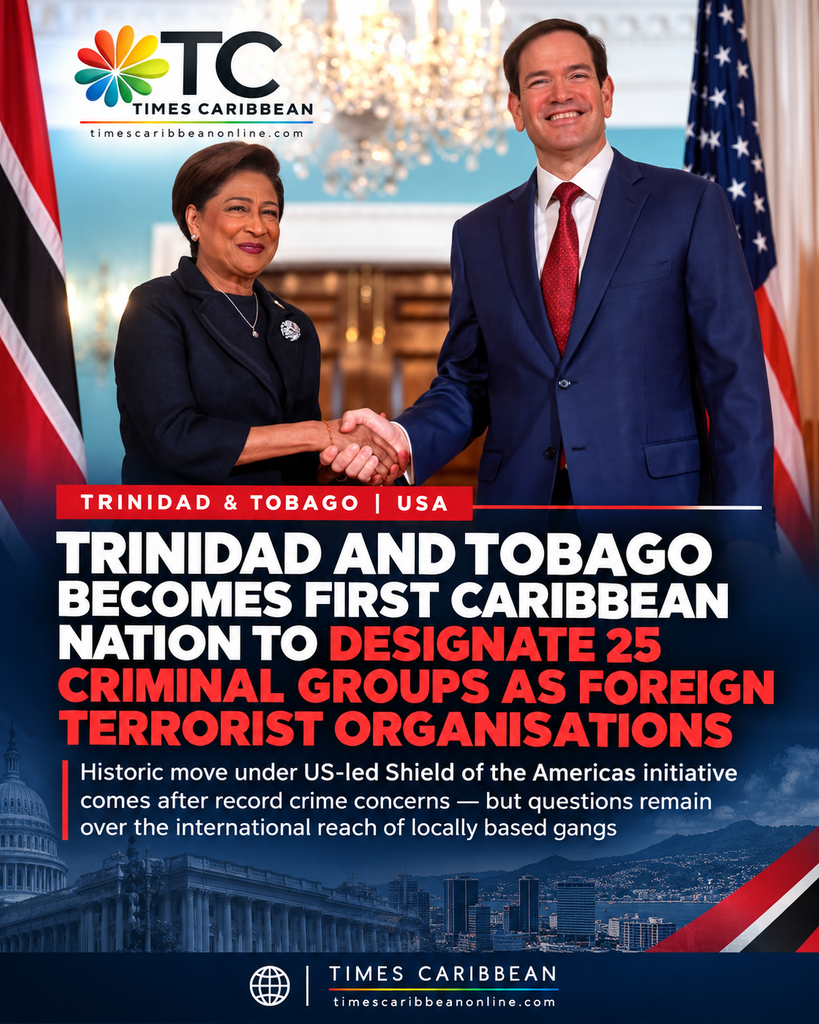
TRINIDAD AND TOBAGO BECOMES FIRST CARIBBEAN NATION TO DESIGNATE 25 CRIMINAL GROUPS AS FOREIGN TERRORIST ORGANISATIONS
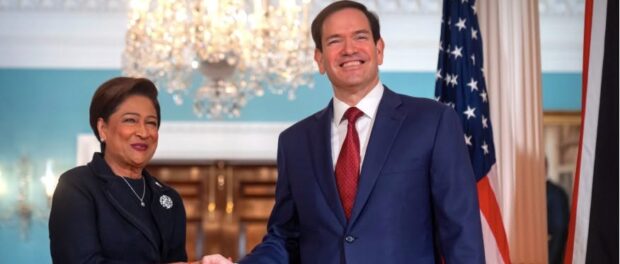
Historic move under US-led Shield of the Americas initiative comes after record crime concerns — but questions remain over the international reach of locally based gangs
PORT OF SPAIN, TRINIDAD AND TOBAGO — Trinidad and Tobago has taken one of the Caribbean’s most significant security steps in recent years, becoming the first country participating in the United States-led Shield of the Americas initiative to join Washington in designating 25 criminal organisations as foreign terrorist organisations.
The United States Embassy in Port of Spain confirmed the development this week, describing it as a major step in regional cooperation aimed at confronting organised crime and what US officials have described as “narco-terrorism.”
Trinidad and Tobago joined the Shield of the Americas initiative at its inaugural summit in Doral, Florida, on March 7, 2026, with Prime Minister Kamla Persad-Bissessar participating alongside other regional leaders.
According to a statement made by Persad-Bissessar to Trinidad and Tobago’s Parliament following that summit, participating governments agreed to strengthen intelligence sharing, border and maritime security, efforts against illicit firearms trafficking and measures targeting the financing and territorial operations of criminal organisations.
And Trinidad and Tobago has now gone a step further.
The latest statement from the US Embassy says 25 criminal organisations have been designated. An earlier Trinidad Guardian report referred to 24 groups, meaning there has been some variation in the publicly reported number, but the most recent US Embassy account places the figure at 25.
THE CRIME BACKDROP
The decision comes against a troubling backdrop.
Prime Minister Persad-Bissessar has previously highlighted Trinidad and Tobago’s 2024 murder figures while discussing the regional threat posed by organised crime. The country recorded 623 murders in 2024, according to figures cited by the Prime Minister — an extraordinary number for a population of roughly 1.4 million.
She said more than 40 per cent were gang-related, with firearms and narcotics playing a significant role.
In March 2026, the Government declared another nationwide State of Emergency following what authorities described as a spike in serious criminal activity. The US State Department subsequently cited crime and security concerns in its April travel advisory for Trinidad and Tobago.
For a country that has struggled for years with organised gangs, firearms trafficking, narcotics routes and violent crime, the Government is clearly signalling a tougher security posture.
But the new designation also raises an important legal and policy question.
HOW “FOREIGN” ARE THE LOCAL GANGS?
Calling a criminal organisation a foreign terrorist organisation carries considerably different implications from identifying it simply as a domestic street gang.
The central question is whether the designated Trinidad and Tobago-based groups have demonstrated sufficient international structure, financing, trafficking connections or cross-border operations to justify being placed within that framework.
Public reporting confirming the designation has not, so far, provided detailed evidence outlining the international operations of each of the 25 groups.
That does not necessarily mean such evidence does not exist. Intelligence involving organised crime networks is frequently not disclosed publicly.
Trinidad and Tobago also sits close to Venezuela and along established Caribbean trafficking corridors. Persad-Bissessar told Parliament earlier this year that criminal networks operating across the hemisphere do not respect national borders and argued that closer intelligence cooperation was therefore necessary.
Still, the distinction matters.
Are these primarily Trinidad-based gangs with connections to international trafficking networks?
Are some operating directly across borders?
Or does the designation represent a broader policy decision to bring powerful domestic criminal groups under the emerging security framework being promoted by Washington?
Those questions are likely to become increasingly important as the Shield of the Americas initiative develops.
TRINIDAD MOVES CLOSER TO WASHINGTON ON SECURITY
What is much clearer is the growing security relationship between Port of Spain and Washington.
US Assistant Secretary of State for Western Hemisphere Affairs Juan Pablo Segura publicly praised Trinidad and Tobago for becoming the first Shield of the Americas participant to follow the United States in making the 25 designations.
The US Embassy said the countries are pursuing a shared mission focused on confronting organised criminal networks and strengthening community security.
The broader Shield of the Americas framework envisages increased intelligence sharing, coordination against trafficking routes, financial disruption of criminal networks and closer cooperation among security forces.
That represents a notable shift in the regional security architecture.
For decades, Caribbean governments largely treated street gangs, organised crime and terrorism as distinct categories.
That boundary may now be changing.
WHAT HAPPENS NEXT?
Potentially, the most consequential part of a terrorism designation is not the terminology itself.
It is what governments can do afterward.
Trinidad and Tobago already has mechanisms under its Anti-Terrorism Act through which designated individuals and entities can become subject to financial monitoring and asset restrictions. The country’s Financial Intelligence Unit reported extensive use of terrorist-entity listings and court orders over the decade ending in 2025.
That raises the possibility that the latest approach could eventually place additional pressure on the financing, assets, associates and international connections of designated criminal organisations, depending on how the Government applies the law.
And that could be where the real impact is felt.
For residents exhausted by years of serious crime, tougher action against organised criminal groups will likely attract significant public attention.
Supporters of the approach are likely to see expanded intelligence sharing, financial scrutiny and international cooperation as additional tools for law enforcement.
Others may want clearer answers about the evidentiary threshold used to classify locally based criminal groups under a foreign-terrorism framework, along with safeguards surrounding the use of expanded security powers.
One thing is certain.
Trinidad and Tobago has entered new territory in its campaign against organised crime — and the rest of the Caribbean will be watching closely.
TIMES CARIBBEAN
















Leave a comment
You must be logged in to post a comment.