CHAIRMAN AND PM AT ODDS AS PERSAD-BISSESSAR’S DOCUMENT CHALLENGES DR. DREW’S ACCOUNT OF CARICOM RETREAT
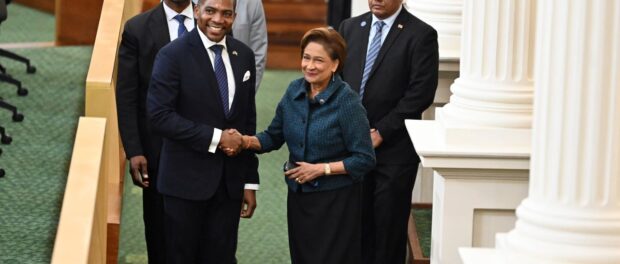
DOCUMENT VS NARRATIVE: CARICOM EMAIL THRUSTS DREW INTO REGIONAL ACCOUNTABILITY TEST
A newly surfaced document has intensified scrutiny surrounding the leadership of CARICOM Chairman, , shifting the debate from political interpretation to documented fact.
At the center of the unfolding controversy is an official email from the CARICOM Secretariat—released publicly by —which outlines arrangements for a high-level retreat. The directive within that communication appears unambiguous: attendance was limited strictly to Heads of Government and the CARICOM Secretary-General.
That clarity is precisely what has made the situation so consequential.
For days, differing accounts and explanations circulated across the region regarding what transpired at the retreat. However, the emergence of a written instruction has introduced a fixed point of reference—one that now invites public examination and comparison against the events that followed.
Importantly, this development does not merely reflect a disagreement among leaders. It highlights a disconnect between what was formally communicated and how those instructions were ultimately interpreted or applied. In any governance structure—particularly one as consensus-driven as —such discrepancies carry weight.
To be clear, the issue is not necessarily one of intent, but of execution.
As Chairman, Dr. Drew’s responsibility extends beyond presiding over meetings. The role demands coordination, clarity, and the ability to ensure that all Heads of Government operate with a shared understanding of decisions and protocols. When a directive as specific as “Heads only” results in varying interpretations across the leadership of multiple sovereign states, it raises legitimate concerns about communication channels and oversight mechanisms.
At the same time, fairness requires acknowledging the complexity of regional diplomacy. CARICOM operates through consensus, informal dialogue, and evolving discussions that can, at times, blur rigid procedural lines. Misalignments can occur—not always as a result of negligence, but sometimes due to the fluid nature of multilateral engagement.
Yet, that context does not diminish the importance of accountability.
The release of the email by Prime Minister Persad-Bissessar has effectively elevated the issue beyond political rhetoric. It has introduced documentary evidence into the public domain, compelling a shift from speculation to verification. In doing so, it has also placed pressure on CARICOM’s leadership—particularly its Chairman—to provide clarity.
Key questions now emerge:
If the instruction was clearly defined, how did divergent expectations take hold?
At what stage, if any, was the discrepancy identified?
And most critically, what corrective mechanisms exist to ensure that such breakdowns do not recur?
These are not trivial matters. They go directly to the credibility of CARICOM’s decision-making framework and the confidence member states place in its processes.
Ultimately, this moment represents more than a procedural dispute. It is a test of leadership, transparency, and institutional discipline at the highest level of regional governance.
For Dr. Drew, the challenge now is not simply to respond—but to restore confidence in the clarity and coherence of CARICOM’s internal operations.
And for the Caribbean Community, the stakes are equally significant: ensuring that its mechanisms remain robust, reliable, and worthy of the trust placed in them by its people.

















Leave a comment
You must be logged in to post a comment.