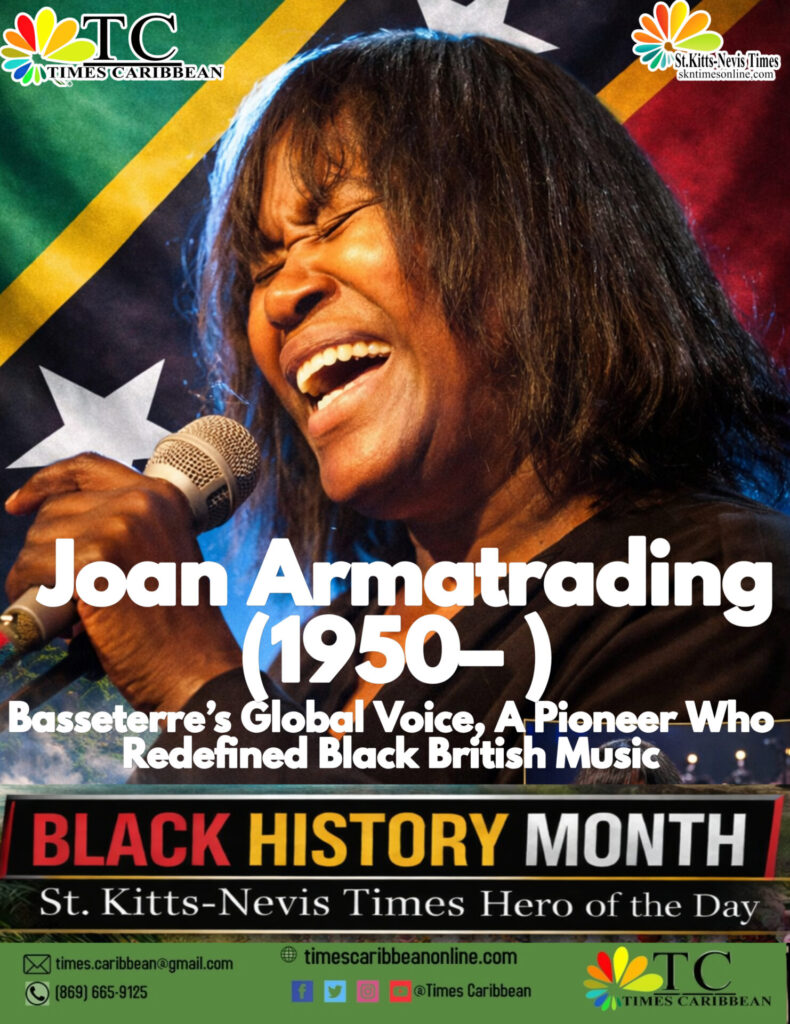
Joan Armatrading (1950– ): Basseterre’s Global Voice, A Pioneer Who Redefined Black British Music
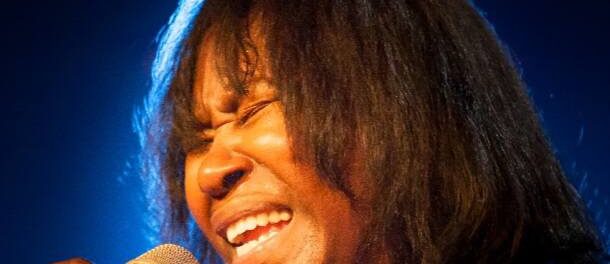
SKN TIMES | BLACK HISTORY MONTH HERO OF THE DAY 🇰🇳
In this sacred season of reflection and pride, SKN Times proudly salutes a daughter of Basseterre whose voice crossed oceans, genres, and generations — Joan Anita Barbara Armatrading, CBE.
Born on 9 December 1950 in Basseterre, St. Kitts, the third of six children, Armatrading’s journey began far from the grand concert halls and international stages she would later command. Her father was a carpenter; her mother, a housewife. At age three, her parents migrated to Birmingham, England, part of the great Caribbean migration shaping post-war Britain. Joan was sent to live with her grandmother in Antigua — a formative separation that sharpened her independence and inner world.
When she joined her parents in Birmingham at seven years old, she entered a Britain grappling with race, identity, and change. Yet from modest beginnings in Brookfields, a quiet revolution was forming.
From Pawn Shop Guitar to Global Stages
At 14, Armatrading began writing songs — setting her own limericks to melodies on a piano purchased by her mother as decorative furniture. Soon after, her mother exchanged two prams for a £3 pawn shop guitar. That humble instrument would become one of the most powerful storytelling tools of the late 20th century.
By 15, she had left school to support her family. She even lost her first office job for bringing her guitar to work and playing during tea breaks. The act was telling: music was not a hobby — it was destiny.
Her early performances in Birmingham clubs and at university concerts showcased an artist who sang only her own material — a bold declaration of creative autonomy at a time when few Black British women were even given platforms.
Breaking Barriers in the 1970s
Her 1972 debut album Whatever’s for Us marked the beginning of a career that would challenge industry norms. Though tensions dissolved her partnership with lyricist Pam Nestor, Armatrading emerged as the undeniable creative force — writing, composing, performing, and shaping her own sound.
Between 1972 and 1976, she became a regular on the legendary John Peel Show on BBC Radio 1 — a critical platform for emerging talent.
Then came 1976.
Her self-titled album Joan Armatrading, produced by Glyn Johns, launched her into the UK Top 20 and delivered the classic hit “Love and Affection.” It was sophisticated, introspective, jazz-inflected — and revolutionary.
Joan Armatrading became the first Black British female singer-songwriter to achieve international success — not through gimmickry, but through lyrical depth and musical integrity.
Her follow-ups — Show Some Emotion (1977) and To the Limit (1978) — cemented her reputation as a serious artist. Songs like “Down to Zero,” “Willow,” and “Tall in the Saddle” became staples of her live performances.
Her haunting composition “Flight of the Wild Geese” underscored the 1978 war film The Wild Geese, demonstrating her cinematic sensibility.
In 1977, she appeared on NBC’s Saturday Night Live, further expanding her global footprint.
Reinvention and Resilience
The 1980 album Me Myself I signaled a sonic shift toward rock and pop, becoming her highest-charting album in both the UK and the US. Hits like “Drop the Pilot” reinforced her mainstream appeal.
Yet Armatrading was never content with predictability. She produced her own albums in the late 1980s, taking full control of her creative output — a rare move for women in the industry at the time.
Though commercial peaks fluctuated, her artistic credibility never did. In 2007, her blues album Into the Blues debuted at No. 1 on the US Billboard Blues Chart — making her the first UK female artist to achieve that feat — and earned her a Grammy nomination.
She would go on to:
- Perform solo world tours.
- Release Live at the Royal Albert Hall.
- Support emerging singer-songwriters through her own label.
- Compose music for an all-female production of Shakespeare’s The Tempest.
- Publish a book of lyrics, The Weakness in Me.
- Compose Symphony No. 1, premiered in 2023 by the Chineke! Orchestra.
- Continue releasing new albums into 2024, including How Did This Happen and What Does It Now Mean.
Few artists sustain relevance for over five decades. Fewer still redefine themselves across folk, jazz, rock, blues, classical, and theatrical composition.
Joan Armatrading did.
The Kittitian Legacy
Though raised in Britain, Armatrading’s birthplace matters. She is a daughter of Basseterre — a symbol of the Caribbean diaspora’s intellectual and artistic power. Her success is a reminder that migration did not dilute Caribbean excellence; it amplified it.
She was appointed CBE (Commander of the Order of the British Empire), yet her deeper honor lies in influence — the generations of Black British artists who now walk through doors she forced open.
The Verdict of History
Joan Armatrading did not chase celebrity — she pursued mastery.
She did not imitate trends — she authored them.
She did not wait for permission — she created her own stage.
From a £3 pawn shop guitar to symphonic premieres at London’s Southbank Centre, her life testifies to discipline, authenticity, and fearless reinvention.
This Black History Month, SKN Times celebrates Joan Anita Barbara Armatrading — Basseterre-born, globally revered — as our Hero of the Day.
A voice that began in the Caribbean.
A sound that changed the world.
















Leave a comment
You must be logged in to post a comment.