IMF REPORT REVEALS ECONOMIC SLOWDOWN: REAL GDP GROWTH IN ST. KITTS AND NEVIS SLUMPED TO 1.5% IN 2025 AMID FALLING CBI INFLOWS AND WEAK CONSTRUCTION
Basseterre, St. Kitts — A sobering assessment of the St. Kitts and Nevis economy has emerged from the International Monetary Fund’s 2026 Article IV Mission, revealing troubling signals beneath what government officials have often portrayed as a resilient economic recovery.
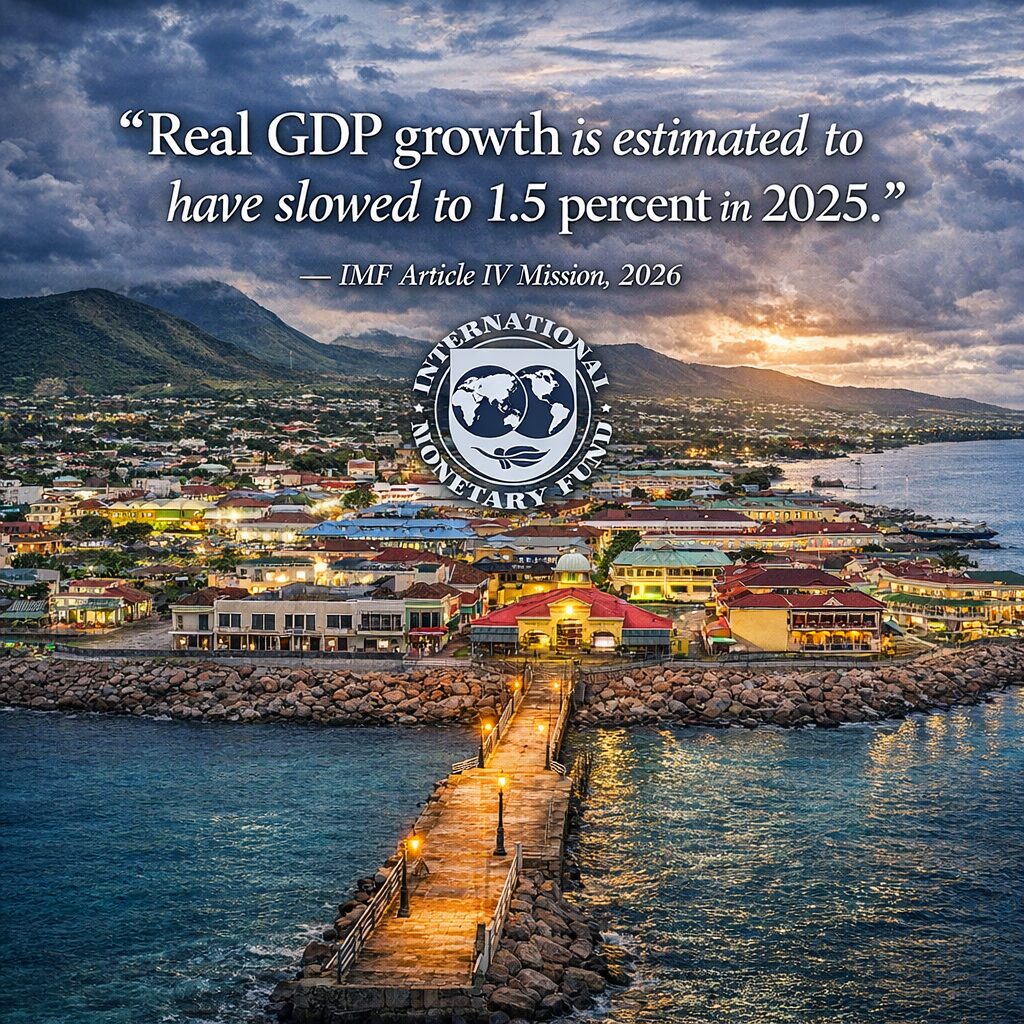
According to the IMF’s latest staff concluding statement, real GDP growth in St. Kitts and Nevis slowed to an estimated 1.5 percent in 2025, a sharp signal that the country’s economic momentum has weakened amid structural vulnerabilities and declining revenue streams.
While projections suggest growth could edge up to 2.2 percent in 2026, economists warn that the modest improvement reflects a fragile recovery rather than a strong or sustainable economic expansion.
A Slowing Economy in a Fragile Post-Pandemic Landscape
The IMF report highlights that the 2025 slowdown was driven primarily by weaker-than-expected construction activity, a sector historically regarded as one of the main engines of economic growth in the Federation.
Construction has long been heavily dependent on Citizenship-by-Investment (CBI) inflows, which finance luxury developments, resort projects, and large-scale real estate investments. However, the IMF notes that lower-than-expected CBI inflows have created significant headwinds, contributing to a cooling of development activity across the islands.
This slowdown has occurred despite the recovery of the tourism sector, which has rebounded since the pandemic years. The IMF’s analysis suggests that tourism alone has not been strong enough to offset declines in other sectors that traditionally drive domestic investment and job creation.
Economic observers note that this imbalance highlights a deeper structural issue within the national economy: St. Kitts and Nevis remains heavily dependent on a narrow set of industries, particularly tourism and CBI-linked construction.
Fiscal Pressures and Consolidation Weigh on Growth
Another factor restraining economic expansion is fiscal consolidation, as the government attempts to tighten spending following years of elevated public expenditure fueled by strong CBI revenues.
The IMF report suggests that as the CBI windfall of previous years fades, the government’s fiscal position faces mounting pressure. Reduced inflows mean the country can no longer rely on the same level of non-tax revenue that once financed ambitious infrastructure projects, social programs, and capital investments.
The resulting fiscal adjustment is expected to limit public spending growth, further dampening economic momentum in the short term.
Modest Growth Projections Offer Little Comfort
While the IMF forecasts growth rising to 2.2 percent in 2026, the projected improvement appears modest when viewed against global benchmarks and the economic needs of small island states.
Even more concerning for analysts is the medium-term growth projection of approximately 2.5 percent, which suggests that the economy may remain trapped in a low-growth cycle unless deeper structural reforms are implemented.
For a small developing state facing rising climate risks, infrastructure demands, and increasing cost-of-living pressures, growth at this level may be insufficient to generate the revenue needed for long-term national development.
Inflation Remains Low — But Reflects Weak Demand
The IMF estimates inflation at 1.5 percent at the end of 2025, with a gradual rise to around 1.8 percent in 2026.
While low inflation can sometimes be interpreted as a sign of economic stability, analysts caution that in this case it may also reflect muted domestic demand and slowing economic activity.
Lower global energy and food prices have helped keep inflation subdued, but the report indicates that price stability alone does not compensate for the broader challenges facing the country’s economic outlook.
Structural Vulnerabilities Persist
The IMF’s findings underscore several structural vulnerabilities that continue to shape the economic trajectory of St. Kitts and Nevis:
• Heavy dependence on the Citizenship-by-Investment programme
• Limited economic diversification beyond tourism and construction
• Exposure to fluctuations in global capital flows and investment sentiment
• Fiscal pressures as extraordinary revenues decline
These vulnerabilities, economists warn, leave the Federation particularly exposed to external shocks, including global economic slowdowns, geopolitical instability, or shifts in international regulatory scrutiny of investment migration programmes.
A Critical Moment for Economic Policy
The IMF report arrives at a moment when the country is attempting to reposition itself under the government’s Sustainable Island State Agenda, which emphasizes renewable energy development, agricultural revitalization, and economic diversification.
The Fund notes that future growth may be supported by renewable energy investments, agricultural expansion, and continued tourism recovery, but these sectors will require sustained investment and policy consistency to deliver meaningful economic transformation.
Until those initiatives fully materialize, however, the IMF assessment suggests that the St. Kitts and Nevis economy remains in a delicate balancing act — navigating slowing growth, reduced CBI inflows, and tightening fiscal space.
For policymakers, the message embedded in the IMF’s latest analysis is clear: the era of easy revenue from CBI-driven expansion may be fading, and the Federation must now confront the harder task of building a more diversified and resilient economy.
















Leave a comment
You must be logged in to post a comment.