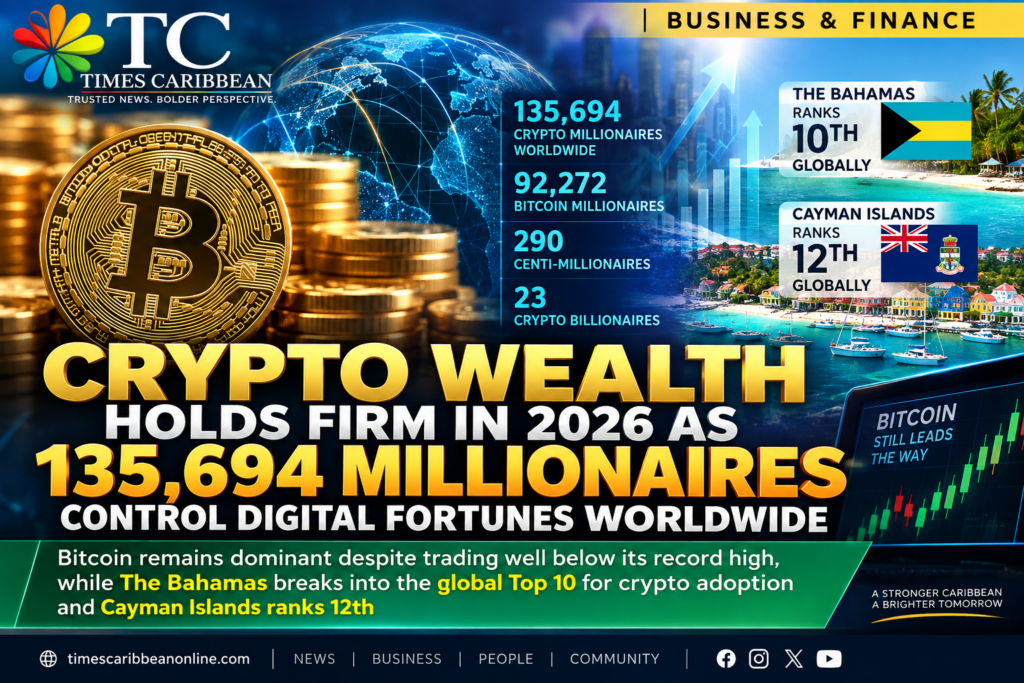
CRYPTO WEALTH HOLDS FIRM IN 2026 AS 135,694 MILLIONAIRES CONTROL DIGITAL FORTUNES WORLDWIDE

Bitcoin remains dominant despite trading well below its record high, while The Bahamas breaks into the global Top 10 for crypto adoption and Cayman Islands ranks 12th
TIMES CARIBBEAN BUSINESS & FINANCE | September 9, 2026
The global cryptocurrency market may be well below its record-setting highs, but digital wealth remains massive — and increasingly global.
A new Crypto Wealth Report 2026 from international residence and citizenship advisory firm Henley & Partners estimates that there are now 135,694 crypto millionaires worldwide, including 92,272 people whose Bitcoin holdings alone are worth at least US$1 million.
And the numbers become even more striking further up the wealth ladder.
The report identifies 290 crypto centi-millionaires, each holding digital assets worth at least US$100 million. Of those, 151 hold that level of wealth in Bitcoin. At the very top sit 23 crypto billionaires, nine of whom reportedly hold billion-dollar Bitcoin fortunes.
Worldwide ownership is also expanding. Henley estimates that approximately 742 million people now hold some form of digital asset, with around 371 million holding Bitcoin.
US$2.6 TRILLION MARKET DESPITE BITCOIN RETREAT
The figures come despite a major retreat from Bitcoin’s previous record levels.
As of August 31, 2026, Henley estimates the global crypto market at approximately US$2.6 trillion, with Bitcoin accounting for around US$1.6 trillion.
Bitcoin was trading roughly 38% below its October 2025 peak, according to the report, after recovering from a deeper mid-year slide.
But compared with previous major Bitcoin downturns, the current correction has been relatively modest. Henley noted that market declines following Bitcoin’s 2011, 2013, 2017 and 2021 peaks each exceeded 75%.
That suggests something significant.
Crypto wealth has taken a hit. It has not disappeared.
THE CARIBBEAN ENTERS THE GLOBAL CRYPTO CONVERSATION
For the Caribbean, one of the standout findings comes from the accompanying Henley Crypto Adoption Index 2026, which examines 36 jurisdictions and evaluates regulatory conditions, taxation, infrastructure, innovation and public adoption using more than 900 data points.
The Bahamas is now ranked 10th globally, placing the Caribbean jurisdiction among some of the world’s strongest environments for crypto adoption.
The Cayman Islands ranks 12th, making it another notable Caribbean entrant in the 2026 index. Both The Bahamas and Cayman Islands are listed among this year’s newcomers.
Singapore remains number one for the fourth consecutive year, followed by the United Arab Emirates, Hong Kong, the United States and Switzerland.
Malta ranks sixth, with Thailand, the United Kingdom, Cyprus and The Bahamas completing the Top 10.
The Caribbean rankings matter because the global competition for digital wealth is no longer simply about where cryptocurrency businesses are incorporated.
It is increasingly about where wealthy crypto holders choose to live, establish tax residence, invest and raise their families.
CRYPTO WEALTH IS CHANGING GLOBAL MOBILITY
Henley & Partners says it has recorded growing interest from wealthy cryptocurrency holders looking at residence and citizenship options as they determine where to locate themselves and their wider financial affairs.
Dominic Volek, Group Head of Private Clients at Henley & Partners, summed up the changing landscape by noting that while cryptocurrency itself may operate across borders, its owners still function within national tax, legal and regulatory systems.
That reality is creating a new competition among countries.
Governments are not only trying to attract capital. They are increasingly trying to attract the people who control it.
The report also suggests that wealthy crypto investors tend to be younger and more geographically mobile than traditional private-banking clients. Henley describes them as the first generation to build substantial fortunes in an asset class that was never naturally tied to one country.
REGULATION IS CATCHING UP
The days of cryptocurrency existing largely outside conventional financial reporting systems are also rapidly changing.
According to the report, 76 jurisdictions have signed up to the OECD’s reporting framework for crypto assets, with the first exchanges of information among 46 jurisdictions expected in September 2027.
That development could make tax residence, regulatory transparency and jurisdictional planning even more important for major digital-asset holders.
Crypto may move in seconds.
People do not.
And governments increasingly want to know where both the money — and the owner — belong.
A NEW MAP OF GLOBAL WEALTH
The 2026 report paints a picture of a cryptocurrency sector that has matured considerably from its speculative early years.
Bitcoin remains volatile. Prices still rise and fall sharply.
But hundreds of millions of people now hold digital assets, thousands have accumulated multimillion-dollar fortunes, and governments around the world are competing to create regulatory, tax and residency systems capable of attracting the industry’s wealthiest participants.
For the Caribbean, the appearance of The Bahamas in the global Top 10 and Cayman Islands at number 12 places the region squarely inside that international competition.
The next phase of the crypto story may therefore be about much more than price.
It could increasingly be about where the world’s digital millionaires choose to call home.
















Leave a comment
You must be logged in to post a comment.