Could Your Family Tree Reveal a British Citizenship Claim Once Thought Impossible?
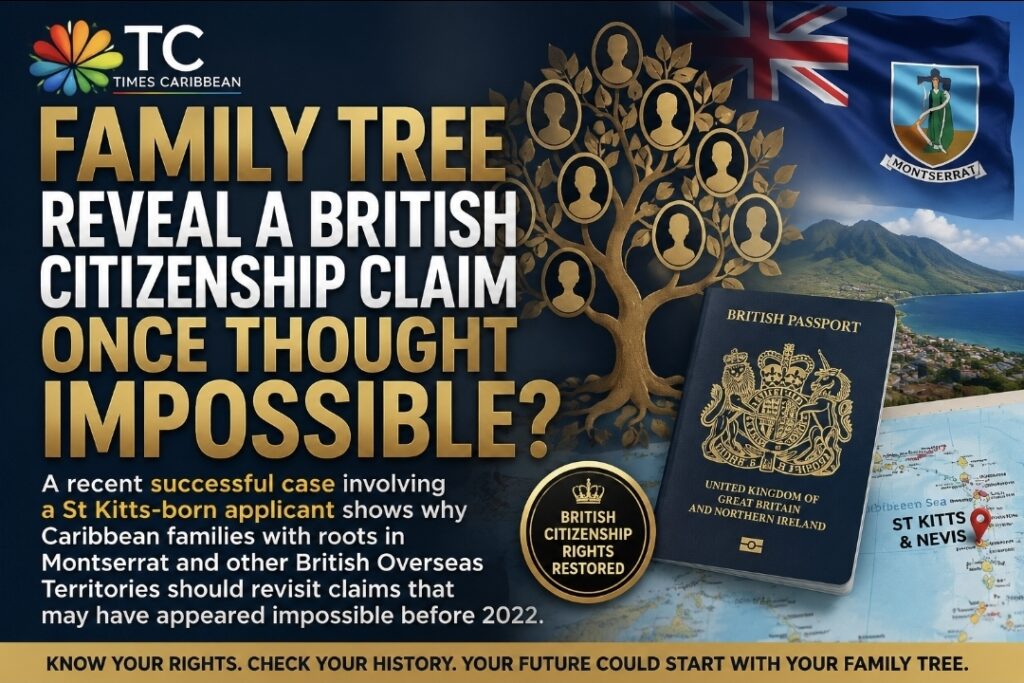
A recent successful case involving a St Kitts-born applicant shows why Caribbean families with roots in Montserrat and other British Overseas Territories should revisit claims that may have appeared impossible before 2022.
By Euen Herbert-Small
A British citizenship claim may be hiding in your family tree.
For some people in St Kitts and Nevis, the decisive connection may not be where they were born, but where their father, mother, grandparent or even an earlier ancestor was born—and whether an old British nationality law prevented that family connection from being recognised.
Many people previously explored British citizenship and were told that they did not qualify. Others never investigated because their parents were unmarried, their connection came through a woman, or their family’s British link was through another Caribbean island.
That earlier answer may no longer be correct.
A law intended to correct past discrimination
The Nationality and Borders Act 2022 introduced important remedial provisions into British nationality law.
One of these, allows an adult to be registered as a British citizen where they would have been—or would have been able to become—British but for:
- historical legislative unfairness;
- an act or omission of a public authority; or
- exceptional circumstances relating to the person.
The law recognises past discrimination between men and women and between children whose parents were married and those whose parents were not.
A corresponding provision, applies to certain claims to British Overseas Territories citizenship.
These provisions do not mean that every descendant of a British person will qualify. They do, however, require the UK Home Office to consider an important question:
What would have happened if the applicant and their family had been treated equally under British nationality law?
A successful St Kitts case
The importance of this question can be seen in a recent successful case involving a man born in St Kitts before independence.
His father was also born in St Kitts, but his paternal grandmother was born in Montserrat. Because Montserrat remained a British dependent territory, that family connection enabled his father to retain British territorial nationality when St Kitts and Nevis became independent.
His father later became a British Overseas Territories citizen and then a British citizen.
However, the applicant’s father was not married to his mother.
Under the nationality law operating at the time, he could not benefit from his father’s British status in the same way as children whose parents were married. His paternal siblings were able to benefit from the same father and the same family line because their parents were married.
The application was initially refused because the Home Office was not satisfied with parts of the documentary evidence connecting the generations.
Following my intervention and further representations, and my request for a review of records held by His Majesty’s Passport Office, the Home Office confirmed that the applicant’s father had retained the relevant British territorial status through his Montserrat-born mother.
On 4 August 2026, the Home Office accepted that, had British nationality law treated children of unmarried parents in the same way as children of married parents, the applicant would have been able to acquire British citizenship through his father.
His application was approved.
The case demonstrates why people should not assume that an old refusal or the absence of an obvious route before 2022, necessarily ends the matter.
Why connections between the islands matter
Caribbean family trees frequently extend across several islands.
A person born in St Kitts or Nevis may have a parent or grandparent from:
- Montserrat;
- Anguilla;
- the British Virgin Islands;
- the Cayman Islands;
- Turks and Caicos;
- Bermuda; or the United Kingdom; or
- another territory that remained under British sovereignty.
When former British colonies became independent, many people lost their citizenship of the United Kingdom and Colonies or British Dependent Territories citizenship. Others retained British nationality because they, a parent or a grandparent had a qualifying connection to the United Kingdom or a place that remained a British territory.
Historically, however, those connections were not always treated equally. Nationality could often be transmitted through a man but not a woman, or through a married father but not an unmarried father.
As a result, one child in a family might have acquired or retained British nationality while a sibling, relying on the same parent or grandparent, was excluded.
The remedial provisions introduced through the Nationality and Borders Act 2022 may now allow some of those cases to be reconsidered.
Who should examine their family history?
A fresh assessment may be worthwhile where:
- a parent or grandparent was born, registered or naturalised in the United Kingdom or a British Overseas Territory;
- a British father was not married to the applicant’s mother;
- a British mother or grandmother could not transmit nationality on the same terms as a man;
- siblings or close relatives obtained British passports through the same parent or grandparent;
- the family held old British, CUKC, BDTC or BOTC passports or registration certificates; or
- a claim was previously refused, abandoned or considered impossible before the 2022 reforms.
The fact that a person was born in an independent Caribbean country does not necessarily prevent a claim. The nationality status and birthplace of parents and grandparents may be equally important.
Start asking questions
The first step is not necessarily completing an application. It is reconstructing the family’s history.
Ask older relatives:
- Where were your parents and grandparents born?
- Did anyone hold an old British passport?
- Did a parent or sibling become British?
- Was a father named on the birth certificate but unmarried to the mother?
- Did a grandmother come from Montserrat or another British territory?
Families should look for long-form birth certificates, marriage certificates, old passports, naturalisation or registration certificates, correspondence from British authorities and evidence showing that another relative obtained British status through the same ancestral line.
Differences in names, spellings or dates in old Caribbean records may create difficulties, but they do not always make a claim impossible. The recent St Kitts and Nevis case demonstrates the importance of examining the complete body of evidence, including passport and nationality records already held by British authorities.
A connection to a British Overseas Territory does not automatically guarantee British citizenship. Every case depends on the relevant dates, family relationships, historic nationality laws and independence legislation.
But nobody should dismiss a possible claim simply because the connection passes through a grandmother, an unmarried father or another Caribbean island.
The document that changes the answer may already be in an old suitcase, a family Bible, a government registry, or in the passport history of a parent, grandparent or sibling.
Book a consultation
To arrange a British Nationality Guidance Consultation and have your family history assessed, visit:
Book a British Nationality Guidance Consultation
This article provides general information. British nationality claims are fact-specific, and a consultation or family connection does not guarantee eligibility or a successful application.
About the author
Euen Herbert-Small is a British nationality researcher and Historical Legislative Unfairness campaigner, focusing on its effect on members and descendants of the Windrush generation and former British colonies.
















Leave a comment
You must be logged in to post a comment.