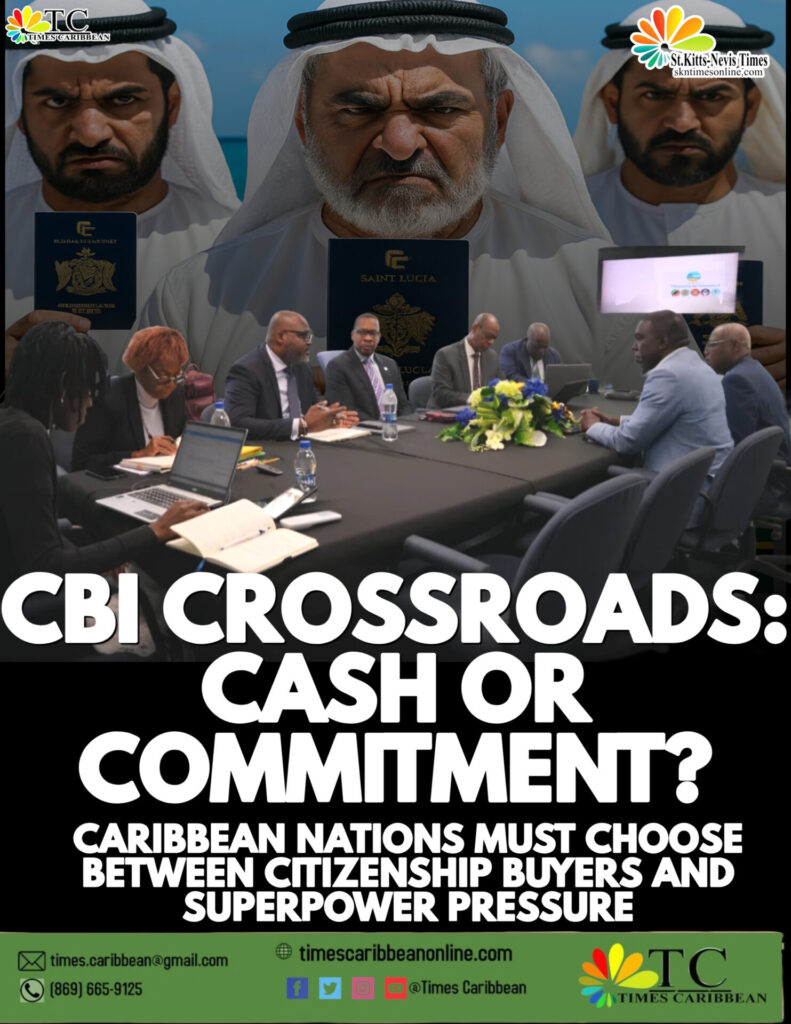
CBI CROSSROADS: CASH OR COMMITMENT? CARIBBEAN NATIONS MUST CHOOSE BETWEEN CITIZENSHIP BUYERS AND SUPERPOWER PRESSURE

By Times Caribbean Global News Desk
July 7, 2025
Caribbean Citizenship by Investment (CBI) programmes are teetering on a knife’s edge, as pressure mounts from both international superpowers and the global investment migration industry. At the center of the storm is a simple yet uncomfortable question:
Do CBI countries want to sell citizenship for money—or grant it in exchange for time on the ground?
It’s not just a philosophical dilemma. It’s a matter of survival for economic models that have pumped billions of dollars into small island economies over the past decade.
INDUSTRY INSIDER CALLS OUT THE CONTRADICTION
No one put it more clearly than Christian Henrik Nesheim, Founder and Chairman of Investment Migration Insider (IMI Daily), the world’s leading CBI media platform, who wrote in a recent viral post:
“The whole point of CBI is to obtain citizenship without extensive physical presence.
If the required presence is enough to establish a ‘genuine link,’ most applicants won’t buy the citizenship.
And if people ARE willing to buy it, it’s because the presence requirement is negligible.
CBI countries need to decide:
Do they want to sell citizenship in exchange for money?
Or grant it in exchange for time spent on the ground?Each model has its tradeoffs:
Selling citizenship without residence will annoy the EU and the US.
But requiring the physical presence those powers demand makes it nearly impossible to sell citizenship.CBI countries must choose whom to please: citizenship buyers or superpowers.
Hybrid models will satisfy neither.”
This brutal clarity from one of the industry’s most respected voices exposes the growing pressure faced by countries like St. Kitts & Nevis, Antigua & Barbuda, Dominica, Grenada, and Saint Lucia.
THE MONEY MODEL IS UNDER ATTACK
For years, the Caribbean model was simple: no residency required, fast processing, visa-free access to key regions, and a clear path to a second passport. In return, countries got vital injections of foreign exchange that funded hospitals, schools, roads, and kept debt at bay.
But this model is now squarely in the crosshairs of Brussels and Washington.
The European Union continues to press for the shutdown or radical reform of such programmes, arguing they pose “security risks” and enable shady actors to launder reputations and money. The U.S., meanwhile, has signaled it may impose diplomatic and financial penalties on countries that don’t meet its expectations.
What’s their solution? “Genuine links.”
Translation: Make the investor live there, spend time there, integrate.
The problem? That completely defeats the appeal of CBI for the high-net-worth individuals buying in.
THE TRADEOFFS: NO WINNING IN THE MIDDLE
Trying to please both groups—investors and foreign governments—has become the strategy du jour, with countries experimenting with hybrid models: mandatory visits, economic substance requirements, or annual check-ins.
But as Nesheim bluntly noted, “hybrid models will satisfy neither.”
Investors balk at the red tape. And regulators still claim the schemes are not credible.
“If you want to satisfy the EU,” said one Caribbean official off-record, “you might as well shut the programme down. And if you want to keep the money flowing, you have to ignore their demands and defend your sovereignty.”
THE STAKES ARE SKY-HIGH
CBI revenue accounts for up to 50% of GDP in some Caribbean nations. Without it, public sector salaries, healthcare, housing initiatives, and infrastructure development could grind to a halt. The loss of visa-free travel to Schengen or the UK would also make the passports significantly less attractive—and less valuable.
This is not just a diplomatic issue. It is a national economic lifeline.
THE TIME TO CHOOSE IS NOW
As global scrutiny intensifies and the margin for maneuver shrinks, Caribbean CBI countries are being forced to pick a side:
Double down on revenue and economic sovereignty—maintain flexible, attractive programmes and risk retaliation from superpowers.
Reform to meet global demands—but risk killing the market altogether.
There is no longer room to straddle the fence.
The middle ground is vanishing.
As Christian Nesheim warns, “CBI countries must choose whom to please: citizenship buyers or superpowers. Hybrid models will satisfy neither.”
In this high-stakes game of global politics and economic survival, the clock is ticking.
#CBICrisis #CaribbeanCBI #TimesCaribbeanGlobal #PassportPolitics #SovereigntyVsSanctions #ChristianNesheim #IMIDaily #VisaFreeValue #EconomicSurvival #ChooseNow
















Leave a comment
You must be logged in to post a comment.