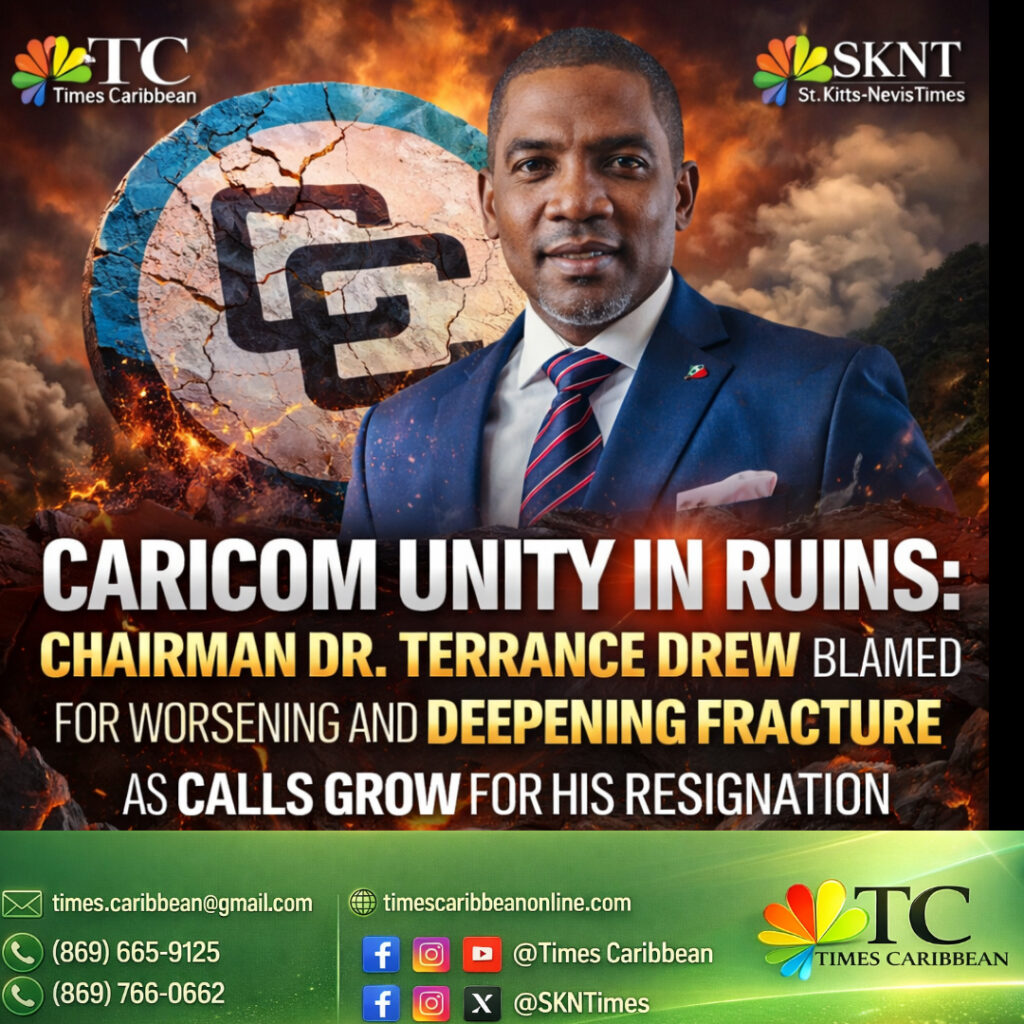
CARICOM UNITY IN RUINS: CHAIRMAN DR. TERRANCE DREW BLAMED FOR WORSENING AND DEEPENING FRACTURE AS CALLS GROW FOR HIS RESIGNATION

LEADERSHIP FAILURE AT THE HELM: CHAIRMAN DR. TERRANCE DREW UNDER FIRE AS CARICOM UNITY COLLAPSES
The deepening crisis within is no longer simply about the controversial reappointment of Secretary-General —it is now a full-blown indictment of leadership at the highest level, with Chairman facing mounting scrutiny over what critics describe as a dangerously passive and ineffective response.
At a moment demanding decisive intervention, diplomacy, and unifying statesmanship, Dr. Drew’s handling of the matter has been widely perceived as hesitant, unclear, and ultimately counterproductive. Rather than diffusing tensions sparked by Trinidad and Tobago’s Prime Minister , the Chairman’s approach has allowed the dispute to escalate into a regional standoff—one now threatening participation at the highest levels of CARICOM governance.
This is not mere political disagreement. It is a breakdown of functional leadership.
Respected Caribbean diplomat has already articulated the principle at stake: when leadership becomes the source of division rather than cohesion, it must step aside. His call for resignation was rooted in preserving the integrity and forward movement of regional integration. Yet that same standard now casts a glaring spotlight on Chairman Drew.
CARICOM’s ultimate mandate is unity—cooperation among sovereign states bound by shared economic, political, and social goals. But under Drew’s chairmanship, that unity appears increasingly fractured. The absence of firm mediation, the lack of a clear pathway to consensus, and the visible deterioration of intergovernmental trust all point to a leadership vacuum at the center of the crisis.
If key leaders are unwilling to attend meetings, if diplomatic relations are strained to the point of paralysis, and if the Chairman cannot command confidence across the bloc, then the implications are severe: CARICOM risks becoming an organization adrift, unable to fulfill its foundational purpose.
The uncomfortable but unavoidable conclusion is this—if Chairman Drew’s leadership is objectively deepening the rift, then by the very principle outlined by Sir Ronald Sanders, he too must consider resignation. Leadership is not merely about holding office; it is about maintaining confidence, fostering unity, and steering through crisis.
At present, those benchmarks appear unmet.
This is a defining moment for CARICOM. It must decide whether it will uphold its commitment to unity or allow internal dysfunction to erode its credibility beyond repair.
















Leave a comment
You must be logged in to post a comment.