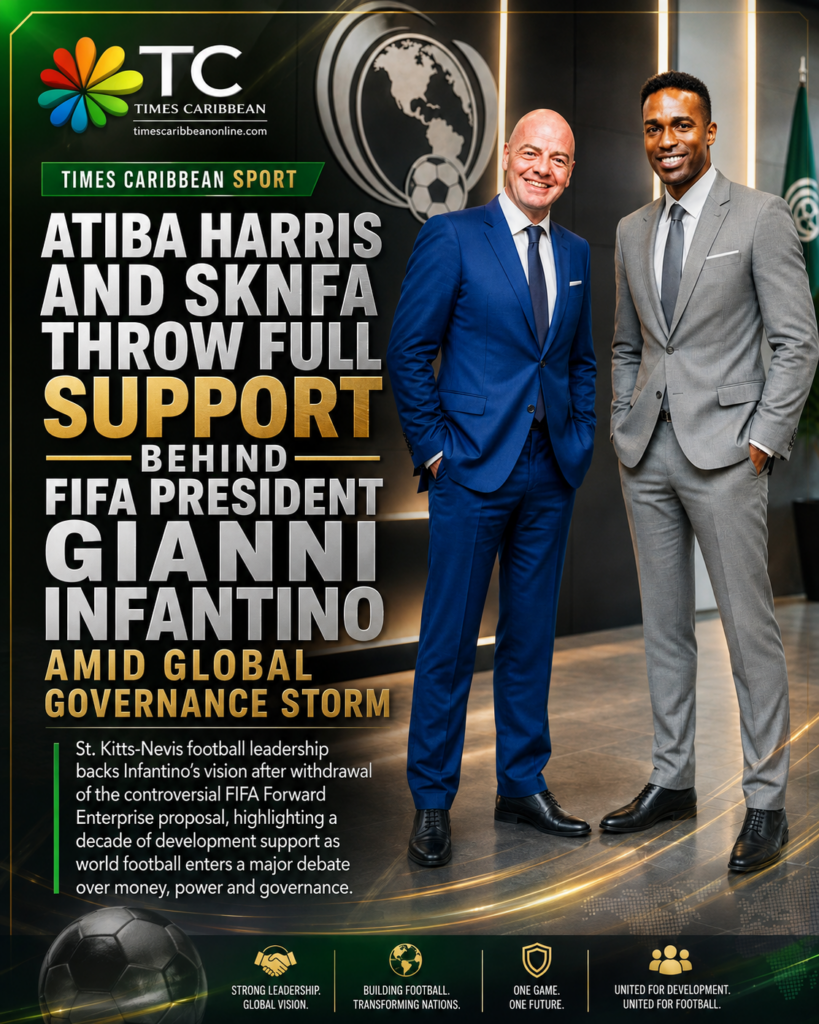
ATIBA HARRIS AND SKNFA THROW FULL SUPPORT BEHIND FIFA PRESIDENT GIANNI INFANTINO AMID GLOBAL GOVERNANCE STORM

St. Kitts-Nevis football leadership backs Infantino’s vision after withdrawal of controversial FIFA Forward Enterprise proposal, highlighting a decade of development support as world football enters a major debate over money, power and governance
TIMES CARIBBEAN SPORTS FEATURE | BASSETERRE, ST. KITTS | August 23, 2026
The St. Kitts-Nevis Football Association, headed by President Atiba Harris, has placed itself firmly behind FIFA President Gianni Infantino at one of the most turbulent moments of his decade-long leadership of world football.
In an unusually strong official declaration, the SKNFA welcomed Infantino’s withdrawal of the controversial FIFA Forward Enterprise proposal but went much further — explicitly reaffirming its confidence in his leadership and vision.
The Association stated that it looks forward to supporting Infantino as he completes his current constitutional mandate and continues pursuing football development across FIFA’s 211 member associations.
That is significant.
This is not simply a routine thank-you note to FIFA. It places the Harris-led SKNFA on the record at a moment when Infantino is confronting serious resistance from some of the most powerful organisations in international football.
And the timing makes the St. Kitts-Nevis position especially noteworthy.
A GLOBAL FOOTBALL DIVIDE
The controversy centres on the proposed FIFA Forward Enterprise — FFE — project, which FIFA said was designed to consolidate commercial and event activities within a FIFA-controlled subsidiary and dramatically expand the resources available for football development.
FIFA initially said the proposed model could help increase global development funding to more than US$10 billion, including substantially larger allocations to its 211 member associations. Under the proposal, member associations could potentially have benefited from an optional US$20 million in special-project funding and sharply increased Forward allocations in future cycles.
Infantino described the concept as a major opportunity to generate more money for football pitches, national teams, young players and the women’s game, while insisting that it would proceed only with majority support from FIFA’s members.
But opposition came fast.
Concacaf said its 41 member associations had expressed deep concerns about the process surrounding the proposal, including the level of consultation, the deadline and whether the relevant FIFA governance structures had been properly engaged. Concacaf consequently rejected the proposal and called for greater transparency and proper governance.
UEFA and the Asian Football Confederation also became major critics.
Reuters reported that the proposal contemplated bringing outside investors into a new commercial structure involving FIFA’s premier competitions. Opposition centred not merely on how much money could be raised, but on whether an asset as important as the commercial future of the World Cup should be opened to private investment under the proposed structure.
By July 31, Infantino announced that the proposal would not proceed, acknowledging that it had created divisions inconsistent with FIFA’s objective of bringing the football community together.
The proposal was dead.
The political fallout was not.
SKNFA CHOOSES INFANTINO
Against that backdrop, the SKNFA’s statement is impossible to view merely as administrative language.
It is a clear declaration of support.
The Association praised Infantino’s commitment to maintaining unity across FIFA’s membership and argued that dialogue, consultation and respect for established institutional processes remain essential to world football.
Then came perhaps the most important part.
The SKNFA directly linked its confidence in the FIFA leadership to what it described as the substantial financial and technical support St. Kitts and Nevis football has received during Infantino’s presidency.
For a small football nation, that argument has substance.
FIFA’s own development data shows millions of dollars in committed football investment connected to St. Kitts and Nevis. Current FIFA records list approximately US$2.36 million in infrastructure funding, about US$2.21 million in national-team support and another US$672,000 in other projects among completed and ongoing FIFA Forward commitments.
These are not insignificant numbers in a country with a comparatively small population, commercial market and domestic football economy.
For football nations like St. Kitts and Nevis, FIFA is not simply a governing body in Zurich.
It is a major development partner.
THE ATIBA HARRIS FACTOR
That relationship also overlaps with one of the most successful periods in the international history of St. Kitts and Nevis football.
Atiba Harris, himself a former St. Kitts and Nevis international and professional footballer, became SKNFA President after winning the Association’s 2021 election by 15 votes to 11. At the beginning of his presidency, Harris promised a football administration based on higher standards, inclusiveness, equality and fairness.
Five years later, FIFA continues to formally list Harris as President of the Association and a member of FIFA’s Laws of the Game Committee.
His administration’s most visible international breakthrough came in 2023.
The Sugar Boyz eliminated Curaçao and French Guiana during the Concacaf Gold Cup preliminaries and qualified for the Gold Cup group stage for the first time in the country’s history.
St. Kitts and Nevis then entered a group featuring Trinidad and Tobago, the United States and Jamaica.
The results at the tournament were difficult, but the qualification itself represented a landmark for one of FIFA’s smaller members. Concacaf later described the campaign as an enormous achievement for a nation whose population was smaller than the crowd attending its final group match against Jamaica.
The SKNFA now specifically points to FIFA’s support as one factor that helped make that international breakthrough possible while also enabling participation in youth and women’s competitions, infrastructure programmes, technical development and assistance to member clubs.
That helps explain why the Harris administration is prepared to publicly defend Infantino.
THIS IS BIGGER THAN ONE PROPOSAL
But the debate surrounding Infantino has moved well beyond whether FFE itself survived.
It has become a struggle over the direction of FIFA.
Reuters reported on August 20 that UEFA, AFC and Concacaf figures were discussing the possibility of an unprecedented confidence challenge against Infantino amid continuing concerns over governance and the abandoned commercial proposal. Infantino nevertheless retains important support elsewhere in the football world.
By August 23, six Nordic football associations had gone even further, saying they had lost confidence in Infantino and calling for governance reforms and an independent examination of the failed proposal.
Yet the FIFA President continues to argue that the core philosophical issue is one of football equality.
During a Caribbean visit this weekend, Infantino stressed that FIFA has an obligation to reduce the financial gulf between major football powers and smaller member associations.
That message resonates powerfully in countries such as St. Kitts and Nevis.
For a wealthy European football association, FIFA development grants may represent only one piece of a massive commercial ecosystem.
For a small Caribbean association, those resources can help determine whether national teams travel, whether youth competitions take place, whether pitches are upgraded and whether technical programmes survive.
Reuters reported Sunday that Infantino has continued making precisely that case, presenting greater redistribution as necessary if all 211 FIFA members are to have meaningful opportunities to develop.
SKNFA’S POSITION IS MORE NUANCED THAN IT FIRST APPEARS
There is another important distinction.
The SKNFA did not issue a statement demanding that the controversial FFE plan be revived.
It welcomed its withdrawal.
That means the Association’s position can reasonably be read as supporting Infantino without necessarily supporting every proposal advanced under his presidency.
That distinction matters.
Concacaf’s July statement said its membership rejected the FFE proposal over governance and procedural concerns.
The SKNFA’s later declaration does not seek to reverse that outcome. Instead, it applauds Infantino for withdrawing the initiative and then separately endorses his wider leadership.
In effect, the message from Basseterre appears to be:
The proposal became too divisive. Withdrawing it was appropriate. But the controversy does not erase what FIFA under Infantino has delivered for smaller football nations.
That is a defensible institutional position, even as others within the football world reach a very different conclusion.
THE REAL ISSUE FOR SMALL CARIBBEAN ASSOCIATIONS
The broader question now confronting Caribbean football is more complicated than choosing between FIFA and Concacaf.
It is about influence.
FIFA operates on a one-association, one-vote system. St. Kitts and Nevis formally possesses the same vote in a FIFA presidential election as Brazil, Germany, Argentina or England.
That structure gives small countries a level of political influence they would rarely possess if world football were governed according to population, commercial revenue or international success.
Infantino’s development-driven political model has historically appealed to many smaller associations precisely because he argues that FIFA’s enormous global revenues should be redistributed throughout its entire membership.
Critics counter that strong development funding and strong governance are not mutually exclusive.
Both arguments deserve examination.
A football association can appreciate millions in development support and still insist on transparency.
It can support a FIFA president while disagreeing with one of his proposals.
And it can remain part of Concacaf while reaching its own conclusions about the leadership of world football.
That is essentially where Atiba Harris and the SKNFA now stand.
A HIGH-STAKES DECLARATION
What cannot be disputed is that the SKNFA has chosen clarity over ambiguity.
At a time when several influential football organisations are openly questioning Infantino’s leadership, the Association governing football in St. Kitts and Nevis has publicly placed its support behind him.
Not quietly.
Not indirectly.
Fully and officially.
The decision also puts increased attention on President Atiba Harris as Caribbean football administrators begin positioning themselves within a potentially defining debate ahead of FIFA’s next presidential election cycle.
The coming months may determine whether the FFE controversy becomes a temporary fracture that Infantino successfully repairs or the beginning of a deeper challenge to his control of world football.
Either way, St. Kitts and Nevis has already declared where it stands.
For Atiba Harris and the SKNFA, the calculation appears clear: Infantino’s presidency should ultimately be judged not only by the controversy surrounding one abandoned proposal, but also by the resources, opportunities, infrastructure and international pathways that FIFA says it has expanded for football’s smaller nations.
And in St. Kitts and Nevis, where the Sugar Boyz have already experienced the biggest tournament breakthrough in their history during Harris’ administration, that development argument carries considerable weight.
The FFE proposal may have been withdrawn. But the global battle over Infantino’s leadership is far from over — and the SKNFA has now planted the St. Kitts and Nevis flag firmly on his side.
















Leave a comment
You must be logged in to post a comment.