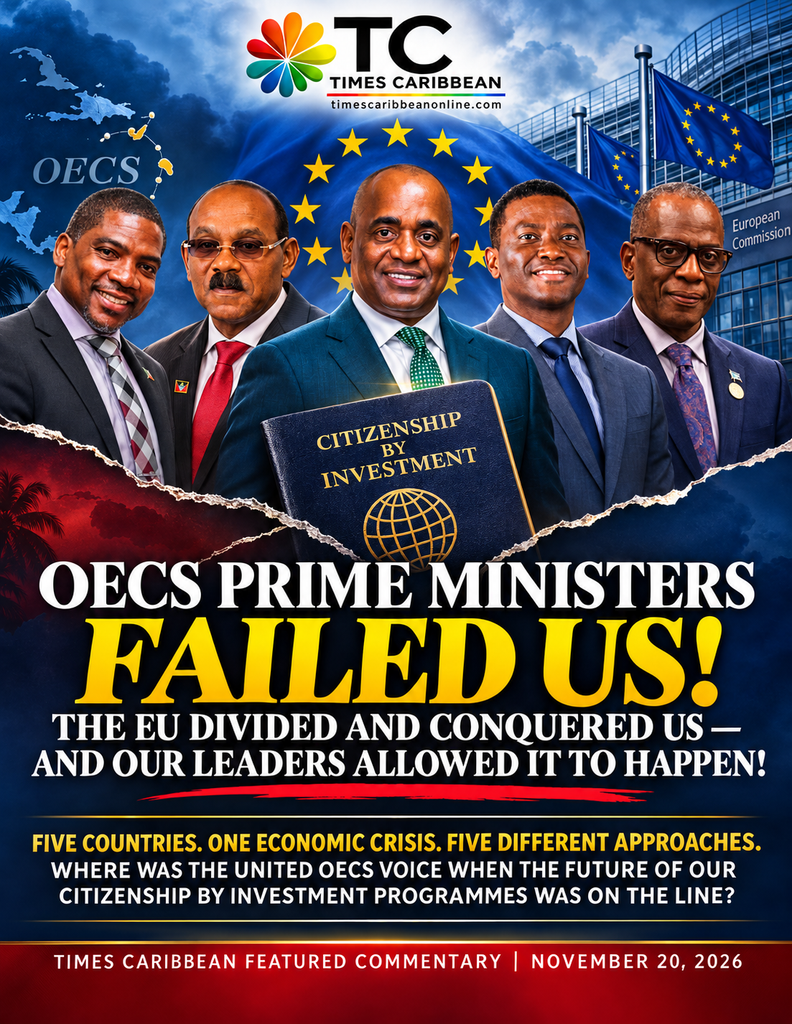
OECS PRIME MINISTERS FAILED US! THE EU DIVIDED AND CONQUERED US — AND OUR LEADERS ALLOWED IT TO HAPPEN!

FIVE COUNTRIES. ONE ECONOMIC CRISIS. FIVE DIFFERENT APPROACHES. WHERE WAS THE UNITED OECS VOICE WHEN THE FUTURE OF OUR CITIZENSHIP BY INVESTMENT PROGRAMMES WAS ON THE LINE?
TIMES CARIBBEAN FEATURED COMMENTARY | NOVEMBER 20, 2026
The European Union approached this issue as one powerful bloc. The five Eastern Caribbean countries most affected have yet to demonstrate that they secured an equally powerful, united negotiating outcome.
And that is where our regional leadership deserves serious scrutiny.
On June 25, 2026, the European Commission sent formal correspondence to Antigua and Barbuda, Dominica, Grenada, St. Kitts and Nevis, and Saint Lucia, pressing for the phasing out of their Citizenship by Investment (CBI) programmes by June 1, 2028, or risking the suspension of visa-free travel to Europe’s Schengen Area.
The countries were subsequently given until November 12 to communicate their positions.
Five small economies. One common challenge. A major source of development financing potentially disappearing.
Where was the united response?
To be fair, the leaders did meet collectively in Dominica on July 10. They issued a joint statement and promised coordinated diplomacy, including a high-level mission to Brussels. Representatives from the region also engaged European officials in New York in September, while technical discussions took place in Brussels.
But meetings are not the same as results.
Where is the publicly presented, jointly endorsed final negotiating framework? Where are the binding financial commitments? Where is the collective agreement protecting the economic interests of all five countries?
That is the missing piece.
ONE EUROPEAN POSITION. DIFFERENT CARIBBEAN RESPONSES.
ANTIGUA AND BARBUDA: NEGOTIATING MORE TIME
On October 30, Prime Minister Gaston Browne wrote to European Commissioner Magnus Brunner, indicating that Antigua and Barbuda was prepared to terminate its programme under negotiated conditions.
But Browne sought a transition until the end of 2030, alongside financial and technical assistance from Europe.
At least Antigua put specific conditions on the table.
The concern is that this was communicated through a national proposal rather than one publicly documented agreement carrying the combined negotiating weight of all five countries.
SAINT LUCIA: A LETTER THE PUBLIC HAS NOT SEEN
Prime Minister Philip J. Pierre confirmed that his government had communicated its position to Brussels.
The contents remain confidential pending an EU response.
Pierre has defended the programme’s importance to national development, pointing to approximately EC$65 million transferred to central government during the last reported financial period.
The question remains: why should the people whose economic future is being discussed not know the principal terms their government is pursuing?
Diplomatic confidentiality has its place. But so does democratic accountability.
GRENADA: KEEP THE PROGRAMME AND THE VISA-FREE ACCESS
Prime Minister Dickon Mitchell publicly expressed his preference for preserving both CBI and Schengen visa-free travel.
An understandable position.
But it differs significantly from Antigua’s conditional commitment to eventual closure.
How does a region negotiate maximum collective advantage when its publicly stated national objectives are moving in different directions?
DOMINICA: DEFENDING A DEVELOPMENT LIFELINE
Prime Minister Roosevelt Skerrit’s administration has consistently emphasized the economic and developmental importance of CBI.
Dominica’s October 28 statement warned that any transition must protect infrastructure investments, employment, disaster resilience and national economic stability.
Yet the public still deserves a clear account of the eventual terms sought, the commitments obtained and the consequences for the country’s finances.
ST. KITTS AND NEVIS: THE WIND-DOWN ANNOUNCED
On November 13, Prime Minister Dr. Terrance Drew announced that St. Kitts and Nevis would gradually wind down its 42-year-old CBI programme, with a closure timeline to be negotiated with European authorities.
He argued that the issue extended beyond Schengen travel to the protection of correspondent banking relationships, international payments, remittances and financial stability.
Those concerns deserve serious consideration.
But so does another question.
What exactly has St. Kitts and Nevis secured in exchange for agreeing to phase out a programme that has generated billions for the Federation?
A commitment to negotiate is not the same as a guaranteed replacement revenue stream.
THE OECS PROMISED A UNITED FRONT. WHERE ARE THE RESULTS?
The July 10 joint declaration was clear. Regional leaders agreed to pursue coordinated engagement with European institutions, present a unified regional position and undertake a high-level mission to Brussels.
That promised mission must now be properly accounted for. The available public reporting establishes regional meetings and technical engagement, but does not clearly document the completion of the full high-level Brussels mission announced in July.
If it took place, publish the outcomes.
If it did not, explain why.
And if the five countries have agreed on a common set of minimum economic protections, publish that framework.
The Caribbean should not be left piecing together its own economic future from individual press conferences, separate letters and occasional announcements.
A united Caribbean cannot exist only in communiqués. It must exist at the negotiating table.
EUROPE’S HISTORY CANNOT BE EXCLUDED FROM THE CONVERSATION
There is also a larger moral and historical question that should not be dismissed.
Europe’s economic development was deeply connected to centuries of colonial expansion, enslavement and the exploitation of African and Caribbean peoples.
Historical research estimates that approximately 12.5 million enslaved Africans were forcibly transported aboard transatlantic slave ships, with about 10.7 million surviving the Atlantic crossing.
The human consequences of colonialism, including the atrocities committed under Belgian colonial rule in the Congo, remain part of the historical record.
These are not minor footnotes.
They are central to the Caribbean’s development story.
The European Union has a legitimate interest in protecting its borders and financial systems. Its revised visa regulations identify investor citizenship schemes as a potential ground for suspending visa-free access, subject to established procedures.
But Caribbean governments also have a legitimate right to demand proportionality, respect and economic fairness.
If Europe wants the dismantling of a revenue mechanism on which small Caribbean economies have depended, then Europe must be prepared to discuss the cost of that transition.
And those discussions should include the wider questions of historical responsibility, reparatory justice and development financing.
ST. KITTS AND NEVIS: THE FINANCIAL WARNING SIGNS ARE ALREADY FLASHING
The International Monetary Fund’s May 2026 assessment paints a troubling picture.
| Economic indicator | IMF 2025 figure |
|---|---|
| Overall fiscal deficit | 11.7% of GDP |
| Public debt | 58.4% of GDP |
| Government deposits | 7.2% of GDP |
| CBI revenue | Approximately 6% of GDP |
Government deposits have declined sharply from earlier years, while the IMF projects continued fiscal pressures.
The Federation’s 2026 budget involves expenditure exceeding EC$1 billion, with estimated revenue and grants of approximately EC$894.8 million.
Claims that eliminating CBI would automatically create a current annual EC$500 million shortfall require careful qualification, particularly because programme receipts have already fallen substantially from their historical peaks.
But the wider financial concern is undeniable.
According to Prime Minister Drew’s November 13 address, CBI generated approximately EC$6.5 billion between 2008 and 2025.
That is an extraordinary sum for a small federation.
Which raises an uncomfortable question.
After decades of CBI income, how resilient is our economy without it?
Where are the financial reserves? Where are the completed transformational investments? How prepared are our schools, healthcare facilities, emergency shelters, agricultural systems and energy infrastructure?
Governments past and present must account for the use of those revenues.
CBI has financed real public expenditure and development. That should be acknowledged. But citizens are entitled to a full, independent accounting of whether those investments delivered lasting value and sufficient economic diversification.
Billions collected should have meant greater economic independence.
Instead, we are confronting the possibility of losing a major source of financing before alternative sources have matured.
Geothermal energy may offer tremendous opportunities. So may agriculture, tourism, technology and renewable energy.
But future possibilities do not automatically pay today’s salaries, fund tomorrow’s healthcare or maintain next month’s public services.
Hope is not an economic strategy.
TEN DEMANDS THE OECS SHOULD HAVE PUT ON ONE NEGOTIATING TABLE
Rather than presenting fragmented national positions, the five countries should have advanced a common package containing:
- A funded seven-year transition to 2033, allowing governments sufficient time to restructure their economies without unnecessary disruption.
- European financing for geothermal and renewable energy, with commercially operational projects established before the loss of major CBI revenue.
- Transitional budget financing based on independently verified revenue losses and essential public-service obligations.
- Comprehensive scholarship and technical training opportunities to prepare Caribbean youth for new industries and international employment.
- A fully financed climate-resilience and emergency-shelter programme, supported by a published assessment of national shelter capacity and school infrastructure needs.
- A formal reparatory justice dialogue, placing historical responsibility, development assistance and the legacy of enslavement within the wider partnership.
- Debt relief, concessional financing and targeted budget support to protect vulnerable economies during the transition.
- A long-term Schengen travel assurance framework, pursuing 15 years of stability through legally permissible commitments and safeguards.
- Upfront investment in agriculture, digital industries, tourism and export development, with measurable projects and implementation dates.
- One common OECS negotiating framework, establishing minimum regional conditions before any final national agreements are concluded.
Would Europe agree to every demand?
Possibly not.
But that is what negotiation is about.
You identify your objectives. You establish your collective leverage. You negotiate what is achievable. And you insist that the costs of transition are properly recognized.
What you do not do is leave five vulnerable economies to navigate the same enormous challenge without a clearly articulated common negotiating floor.
WHY SHOULD SCHENGEN ACCESS OUTWEIGH EVERY OTHER ECONOMIC CONSIDERATION?
Most ordinary St. Kitts and Nevis passport holders already require visas to travel to the United States.
That has not ended travel, business, educational exchanges or family connections.
Losing visa-free access to Europe would certainly create inconvenience and economic consequences. Those consequences must be assessed seriously.
But a Schengen visa requirement is not the same thing as a prohibition on travel.
Should the region automatically accept the closure of programmes supporting public finances simply to avoid the possibility of additional visa procedures?
That question deserves an informed national debate.
Of course, Prime Minister Drew has raised a broader concern about financial relationships, and that cannot be casually dismissed.
But those risks should be independently examined and clearly distinguished from the issue of Schengen travel privileges.
Our people deserve to know the real economic trade-offs.
THE BIGGEST FAILURE MAY BE WHAT HAPPENS AFTER CBI
The debate cannot end with blaming Brussels.
Our own governments have had decades to diversify.
Successive administrations have spoken about renewable energy, food security, tourism expansion, manufacturing, digital transformation and financial resilience.
Yet CBI remained an important source of public financing.
Now the international environment is changing, and the Caribbean is discovering how difficult it can be to replace years of investment-related revenue.
That is a failure of long-term economic planning for which governments across different political administrations must accept their share of responsibility.
The responsibility is not limited to one political party.
Nor is it limited to one prime minister.
PRIME MINISTERS, THE PEOPLE DESERVE ANSWERS — NOT JUST LETTERS
The European Union has exercised the considerable influence that comes with controlling access to a major international travel area.
Our regional governments have the responsibility to protect their citizens, their sovereignty and their countries’ long-term economic stability.
The essential question is not whether every Caribbean leader should adopt an identical domestic policy.
It is whether five countries facing one common external challenge can establish a united negotiating position strong enough to protect their shared interests.
So far, the publicly available record leaves too many unanswered questions about the collective outcome.
That is why our leaders must be held accountable.
Publish the regional negotiating objectives.
Disclose the transition assistance being requested.
Explain the projected revenue losses.
Provide the replacement financing plans.
And tell the Caribbean people precisely what has been secured.
Because the future of our countries cannot be settled through announcements about what we intend to give up without equal clarity about what our people stand to gain.
When one door closes, four others may open.
BUT RESPONSIBLE LEADERSHIP DEMANDS THAT WE SECURE THE KEYS BEFORE WE CLOSE THE FIRST ONE.
The OECS must demonstrate that it can negotiate as a serious economic bloc, not merely gather as a diplomatic association.
FIVE COUNTRIES. ONE ECONOMIC FUTURE. ONE REGIONAL VOICE.
THE CARIBBEAN DESERVES BETTER.
TIMES CARIBBEAN — Featured Political & Economic Commentary
This article presents editorial analysis and opinions based on publicly reported government statements, European Union policy documents and IMF economic assessments. Proposed negotiating demands are recommendations, not confirmed agreements.
















Leave a comment
You must be logged in to post a comment.